WhatsApp ordering for a restaurant in Malaysia works best as a short, structured chat: the AI sends your menu, confirms items and total, offers a pickup time and shares approved payment instructions. Staff verify payment before the kitchen starts. Six eligible service replies may cost RM0 while the monthly free allowance remains; an illustrative RM0.36 applies only after it is used, without other exemptions.
RM0.35 and RM0.06 in this article and its supplied illustrations are planning assumptions, not verified current Meta quotations. Gupshup's October announcement describes 1,000 free service replies per business phone number per month, then eligible service charges from 1 October 2026. Utility templates do not use that allowance. Inbound messages and qualifying 72-hour free entry point messages remain exempt. Confirm the recipient market, applicable rate card, free allowance and provider fees before budgeting. Figures below exclude tax and any unlisted costs.
Examples show a proposed workflow, not a guarantee that every account or plan supports it. Ask our team to confirm the channel, integration, permissions and delivery method for your setup. Staff-group notifications and group assistants require separate eligibility and integration checks; a standard one-to-one WhatsApp API account should not be assumed to access every existing staff group. Use approved individual notifications or a staff dashboard if group delivery is unavailable. Test the workflow and human handover before use.
- Keep WhatsApp orders structured: menu, items, total, pick-up time, name and payment, in that order.
- Let the AI offer pick-up times from the rules you set, such as "ready in 20 minutes", and update them during rush hour.
- Payment is verified by staff in your bank account, never from a screenshot alone.
- Train the AI to state your halal status exactly as it is. Never claim a certification your business does not hold.
- Allergy and ingredient questions should go to a person, not be guessed by the AI.
- From 1 October 2026, Meta charges eligible outbound service replies above the monthly 1,000-message allowance per phone number inside the customer-service window, at an assumed RM0.06 each in Malaysia.
Why take restaurant orders on WhatsApp in Malaysia?
Your regulars already have your number. WhatsApp ordering turns that into a proper ordering channel.
Delivery platforms are useful for reaching new customers, but orders placed directly with you have their own advantages:
- A direct relationship. The customer's chat is with your restaurant, so you can answer questions and remember preferences.
- No platform commission on pick-up orders. You still pay Meta's per-message fees, which are small per order.
- Flexible orders. Office lunch for 12, a birthday tray or "less spicy, no peanuts" is easier to handle in a chat than in a fixed app menu.
- Your own customer list. With consent, you can tell regulars about a new menu item or a holiday closure.
The challenge is volume. At 12:15pm on a weekday, nobody at the counter has time to type out totals and pick-up times for ten chats at once. That is the part an AI assistant can take over.
How does WhatsApp ordering work for a restaurant in Malaysia?
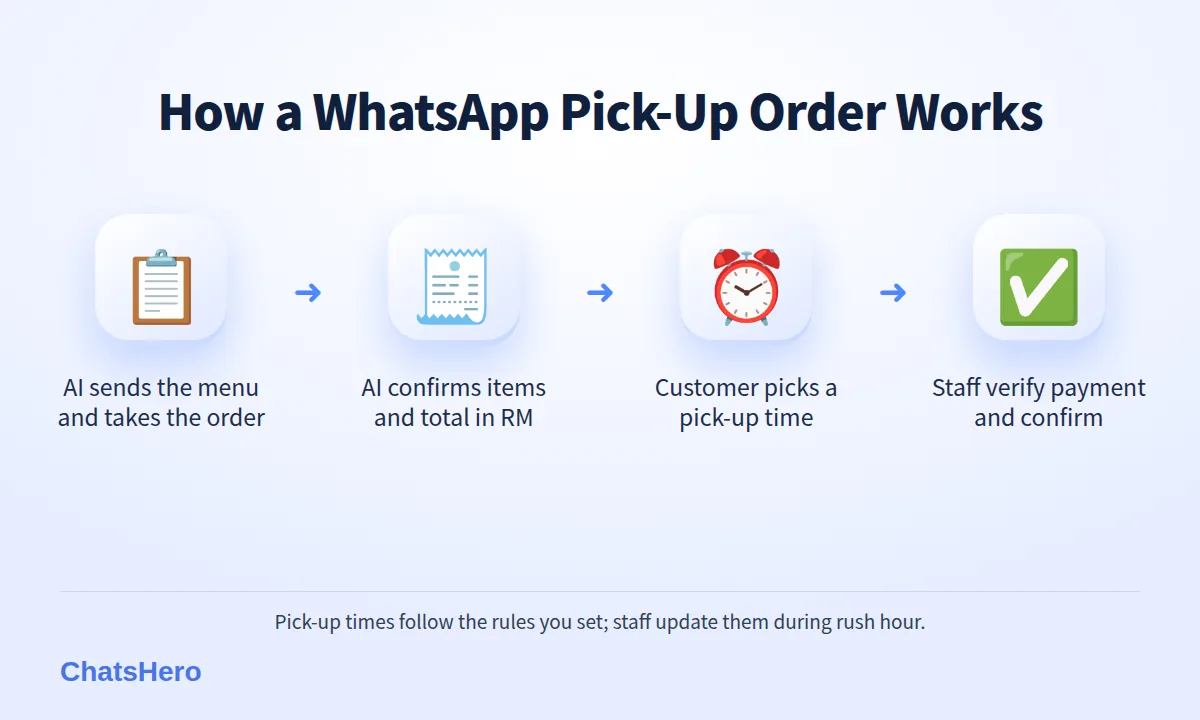
With ChatsHero on the official WhatsApp Business API, a typical pick-up order runs like this:
- The customer says hi or sends an order. The AI replies instantly with the menu as an image or PDF, or takes the order straight away if the customer already knows what they want.
- The AI confirms the order. It lists each item, add-ons such as extra egg or less sugar, and the total, from the menu and prices you trained it on.
- The customer picks a pick-up time. The AI offers times based on your rules, for example "ready in 20 minutes" or "slots every 15 minutes from 11:30am".
- The customer pays. The AI sends your DuitNow QR or bank details, and the customer sends the payment receipt.
- Staff verify and confirm. A staff member checks that the money has arrived and confirms the order in the chat. The order is recorded in Google Sheets for the kitchen and counter.
For dine-in regulars who pay at the counter, you can skip the payment step and mark the order "pay on pick-up". Decide which customers qualify, and tell the AI.
What should your WhatsApp menu and order confirmation include?
A good WhatsApp menu is short enough to read on a phone. Send a clear image or PDF of your pick-up menu with prices, and train the AI on the same list so its totals always match.
Every order confirmation should include:
- Items and add-ons"2 × Nasi Lemak Ayam (1 less spicy), 2 × Iced Kopi (less sugar)"
- Total in RMIncluding any packaging charge, stated up front.
- Pick-up detailsTime, customer name for the counter, and a Google Maps pin.
Keep the confirmation factual. If you want to suggest a dessert or promote a new drink, do it in the conversation, not in a separate template message: Meta decides a template's category from its content, and promotional content is charged as marketing.
How should the AI answer halal and allergy questions?
These are the questions where a wrong answer does real damage, so set strict rules.
Halal questions
Train the assistant to state your halal status exactly as it is, in one sentence you have written:
- If your premises hold a valid halal certificate from JAKIM or your state Islamic religious authority, say so, and keep the certificate details up to date. Customers can check a premise's status on the official Halal Malaysia portal.
- If you are not certified, say that plainly, for example: "Our kitchen is pork-free and we do not serve alcohol, but we are not halal-certified." Never let the AI say "halal", "Muslim-friendly" or anything that suggests certification you do not hold.
- Pass detailed questions about suppliers or ingredients to a staff member.
Misleading halal claims are an offence under Malaysia's Trade Descriptions Act 2011 and its halal orders, enforced by KPDN. Getting this sentence right protects your customers and your business.
Allergy questions
The AI should never promise that a dish is free of an allergen. When a customer mentions an allergy, it hands the chat to a person with a "Human Agent Needed" alert, and your staff answer based on what the kitchen actually uses that day.
What does a WhatsApp food order look like from start to finish?
Here is an illustrative lunch order at a fictional café in Johor Bahru that is pork-free but not halal-certified, showing the halal answer and the payment check.
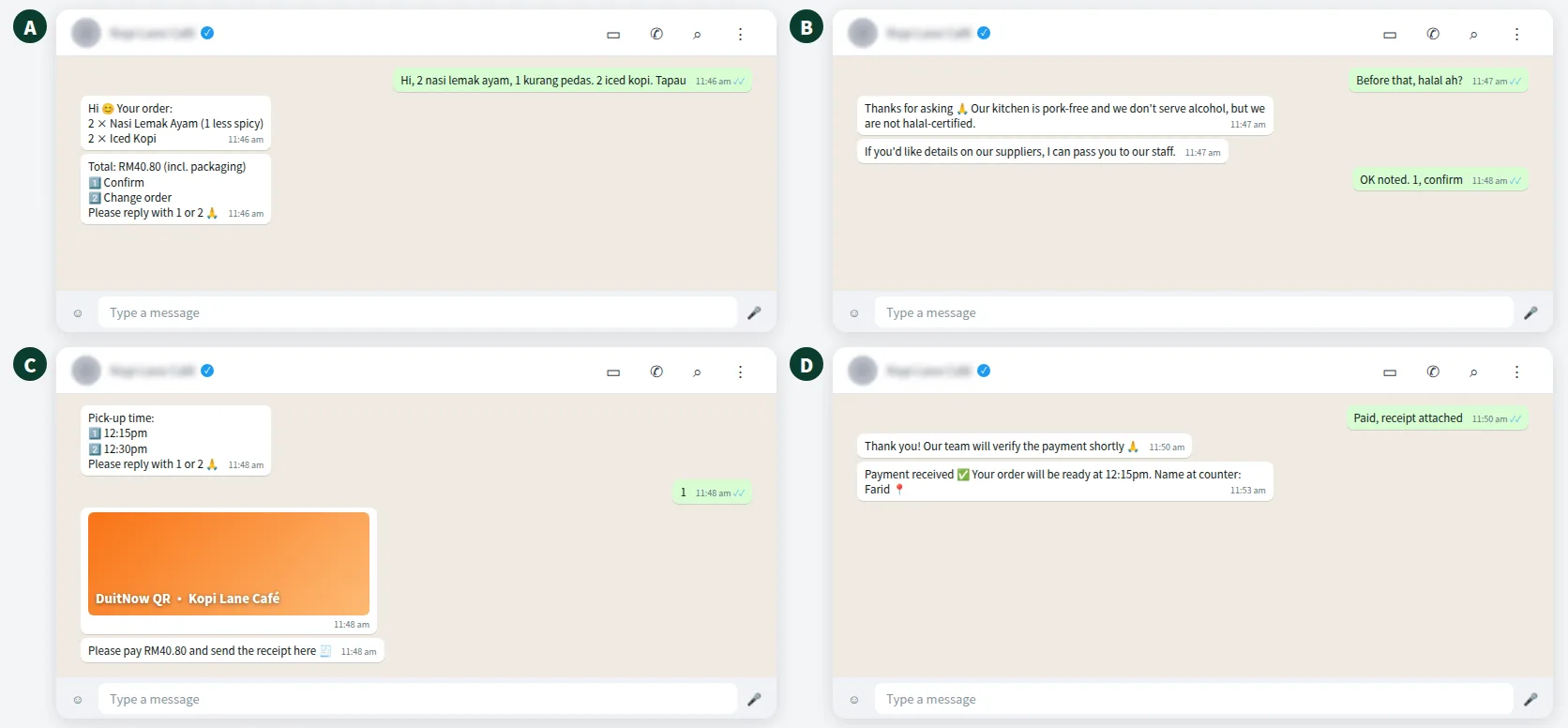
A real order is less likely to read "I would like to order two portions of…" and more likely "2 nasi lemak ayam, 1 kurang pedas, tapau". The assistant understands mixed English, Malay and Chinese orders, as we explain in our guide on how AI chatbots understand Bahasa Rojak.
Want to see how this looks with your own business? WhatsApp us and chat with the ChatsHero AI.
How do you handle payment for WhatsApp orders?
There are three common ways to take payment for WhatsApp orders:
- DuitNow QR or bank transfer before preparing. The AI sends your DuitNow QR, the customer pays and sends the receipt, and a staff member checks the money has arrived before the kitchen starts.
- Pay on pick-up. Simple and friendly for regulars, with some risk that an order is never collected.
- A mix. Prepay for new customers and large orders, pay on pick-up for regulars you know.
Check the account, not the screenshot. ChatsHero does not detect payments. A staff member verifies each payment in your bank or payment app and confirms the order in the chat.
For large orders such as an office lunch for 20, ask for payment or a deposit before you buy ingredients, and state your refund rule for cancellations before the customer pays.
WhatsApp ordering vs phone calls vs delivery apps: which is better?
You don't have to pick just one channel. Here is how they compare for pick-up and direct orders:
| Phone calls | WhatsApp, answered by staff | WhatsApp with AI | Delivery apps | |
|---|---|---|---|---|
| Order accuracy | Depends on who answers | Written, but typed in a rush | Written, itemised, with total | Structured app menu |
| Rush-hour load on staff | High | High | Low: staff verify payment and prepare | Low |
| Custom requests | Easy | Easy | Easy, with handover when needed | Limited |
| Customer relationship | Yours | Yours | Yours, recorded in Google Sheets | Mostly the platform's |
| Main cost | Staff time | Staff time | Plan + Meta per-message fees | Commission per order (check your contract) |
One sensible approach is to keep delivery apps for new customers and delivery, and move regulars and pick-up orders to WhatsApp. Compare ChatsHero plans on our pricing page.
How do WhatsApp orders reach the kitchen and counter?
Each order the AI confirms is recorded in Google Sheets: time, customer, items, total, pick-up time, payment status and order status. Your counter staff update the status as they go, from "Awaiting payment" to "Paid", "Preparing" and "Collected". A daily summary goes to your team's WhatsApp group.
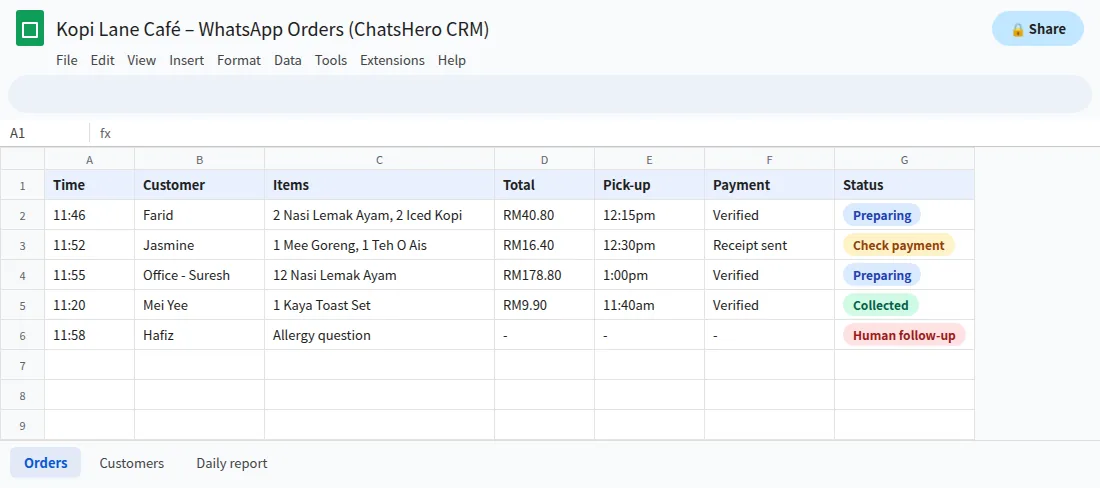
The sheet also gives you useful numbers over time: your busiest pick-up times, your most-ordered items, and which customers order every week. That helps with prep, staffing and deciding which items to keep on the pick-up menu.
How much does WhatsApp ordering cost for a restaurant in Malaysia?
There are two separate costs. Your ChatsHero plan covers the AI assistant and platform. Meta's per-message fees are billed to your own WhatsApp account. From 1 October 2026, Meta charges eligible outbound service replies above the monthly 1,000-message allowance per phone number inside the customer-service window using RM0.06 only as an illustrative budgeting assumption in Malaysia (see Meta's pricing page and this summary of the change).
Example (illustrative, using RM0.06 per reply):
- One order with 6 business replies: 6 × RM0.06 = RM0.36
- 300 orders a month: 300 × RM0.36 = RM108
- A weekly specials message to 500 opted-in customers is marketing: 500 × RM0.35 = RM175 per send
If a customer starts the chat from a Click-to-WhatsApp ad or your Facebook Page button and you reply within 24 hours, a 72-hour free window applies to message delivery. Keep order chats short, and send promotions only to customers who agreed to receive them, in line with Malaysia's Personal Data Protection Act. The official API lowers the risk to your number compared with unofficial blasting tools, but customers who block or report you still lower your quality rating. Learn more about ChatsHero.
Frequently Asked Questions
How does WhatsApp ordering work for a restaurant in Malaysia?
The customer messages your number, an AI assistant sends the menu, confirms the items and total, offers a pick-up time and shares your DuitNow QR. Staff verify the payment and confirm, and the order is recorded in Google Sheets.
Can the chatbot detect when a customer has paid?
No. The customer sends a receipt, and a staff member checks your bank or payment app before confirming the order. Never start preparing based on a screenshot alone.
What should the AI say when customers ask if the food is halal?
Exactly your real status, in a sentence you write. If you hold a valid halal certificate from JAKIM or a state authority, say so. If not, say you are not halal-certified. Never suggest a certification you do not have.
Can customers order in Malay or Chinese?
Yes. ChatsHero understands orders in English, Bahasa Melayu and Chinese, including mixed messages such as "2 nasi lemak, 1 kurang pedas, tapau".
How much does each WhatsApp order cost in Meta fees?
From 1 October 2026, eligible outbound service replies above the monthly 1,000-message allowance per phone number inside the customer-service window are illustrated here at RM0.06 each in Malaysia, so an order chat with six replies is an assumed RM0.36. Fees are billed to your own WhatsApp account, are set by Meta and may change.
Can I send weekly specials to customers on WhatsApp?
Yes, to customers who agreed to receive them. These are marketing messages, illustratively RM0.35 each in Malaysia, so keep the list to customers likely to order.
Does WhatsApp ordering replace delivery apps?
Not necessarily. A sensible set-up is to keep delivery apps for new customers and delivery orders, and use WhatsApp for regulars, pick-up and large orders.