Good WhatsApp lead follow up is short, useful and well-timed: reply to the first enquiry within minutes, follow up two or three times over about a week, and give every message a reason — an answer, a photo or a free slot. Stop when the customer says no. After 24 hours of silence, a nudge is usually a marketing template costing an assumed RM0.35 in Malaysia.
RM0.35 and RM0.06 in this article and its supplied illustrations are planning assumptions, not verified current Meta quotations. Gupshup's October announcement describes 1,000 free service replies per business phone number per month, then eligible service charges from 1 October 2026. Utility templates do not use that allowance. Inbound messages and qualifying 72-hour free entry point messages remain exempt. Confirm the recipient market, applicable rate card, free allowance and provider fees before budgeting. Figures below exclude tax and any unlisted costs.
Examples show a proposed workflow, not a guarantee that every account or plan supports it. Ask our team to confirm the channel, integration, permissions and delivery method for your setup. Staff-group notifications and group assistants require separate eligibility and integration checks; a standard one-to-one WhatsApp API account should not be assumed to access every existing staff group. Use approved individual notifications or a staff dashboard if group delivery is unavailable. Test the workflow and human handover before use.
- A lead that goes quiet has not said “no” — a polite follow-up is a service, not a nuisance.
- Reply to new enquiries within minutes; the first reply matters more than any follow-up.
- Use a simple cadence as a starting point: Day 0, Day 1, Day 3 and Day 7, then stop unless the customer opted in to updates.
- Every message needs a reason: a missing answer, a photo, a quote, a slot or a deadline.
- Record each lead’s status in one sheet so nobody is chased twice or forgotten.
- Only message people who contacted you or opted in, honour opt-outs, and watch your WhatsApp quality rating.
Why does WhatsApp lead follow up matter so much for Malaysian SMEs?
A quiet lead is not a lost lead — until you go silent too.
A customer asks for a quotation, you reply, and then nothing. The customer gets busy, compares two other shops, and may buy from whoever stays in touch. In Malaysia that conversation often happens on WhatsApp: DataReportal data published via Statista ranked WhatsApp as the most used social platform in Malaysia in Q3 2025 among internet users aged 16–64.
Speed also matters. In a well-known Harvard Business Review study of 2,241 US companies (2011), firms that contacted a web lead within an hour were nearly seven times as likely to qualify it as firms that waited even one hour longer — yet 23% of companies never responded at all. Those were US web-form leads, not WhatsApp chats, but the lesson carries over: interest fades fast, and the business that follows up politely stays in the race.
Follow-up is part of good service. Customers who asked you a question usually want the answer, the photo or the slot you promised. The annoying part is not the follow-up itself — it is how it is done.
What makes a WhatsApp follow up message annoying?
The problem is seldom that a business followed up; it is how. The same message can feel helpful or pushy depending on timing, content and tone.
| Annoying follow-up | Helpful follow-up |
|---|---|
| “Hi, any update?” with nothing new | “Here are the 3 photos you asked for 📷” |
| Messages every day for two weeks | 2–3 messages over about a week, then stop |
| Voice calls straight after a WhatsApp enquiry | Ask first: “Can I call you for 2 minutes?” |
| Long paragraphs of product details | One idea per message, easy to reply |
| Sent at 11pm from a staff member’s personal phone | Sent during reasonable hours from the business number |
| Ignores “not now” and keeps pushing | Respects “no” and offers to check back later |
Notice the pattern. Good follow-ups give the customer something — information, a choice or a deadline — and make replying easy. Bad ones only ask for the customer’s attention.
How often should you follow up leads on WhatsApp?
There is no official rule, but this cadence is a sensible starting point for follow up leads Malaysia businesses receive from ads, walk-ins and referrals. Adjust it to how long your customers usually take to decide: a nasi lemak catering order moves in a day, a kitchen renovation can take weeks.
- Day 0 – reply within minutes. Answer the question, confirm the details, and agree the next step (“I’ll send photos tomorrow”).
- Day 1 – deliver what you promised. Photos, quotation, a price list or a video. This is the most welcome follow-up of all.
- Day 3 – offer a clear next step. A free site visit, a sample, a trial class or two time slots to choose from.
- Day 7 – a polite final check. “Should I keep your quotation open, or close it for now?” It is easy to answer, which makes a reply more likely.
- After that – stop. Only send occasional updates if the customer agreed to receive them.
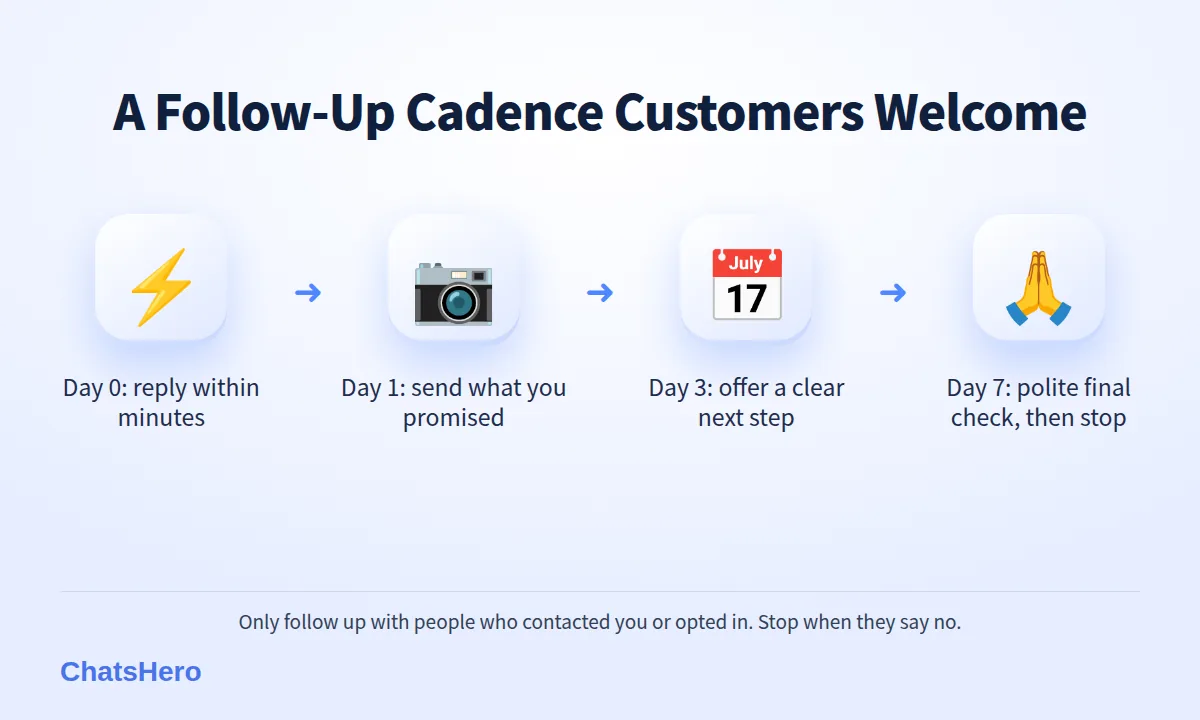
The last step is what keeps you from being annoying. A lead who never replies after four thoughtful messages is telling you something; respect it and keep your number’s reputation healthy.
What should a sales follow up template on WhatsApp say?
Keep each message short, personal and about the customer’s need. Here are four templates you can adapt, using a fictional kitchen cabinet business in Johor Bahru:
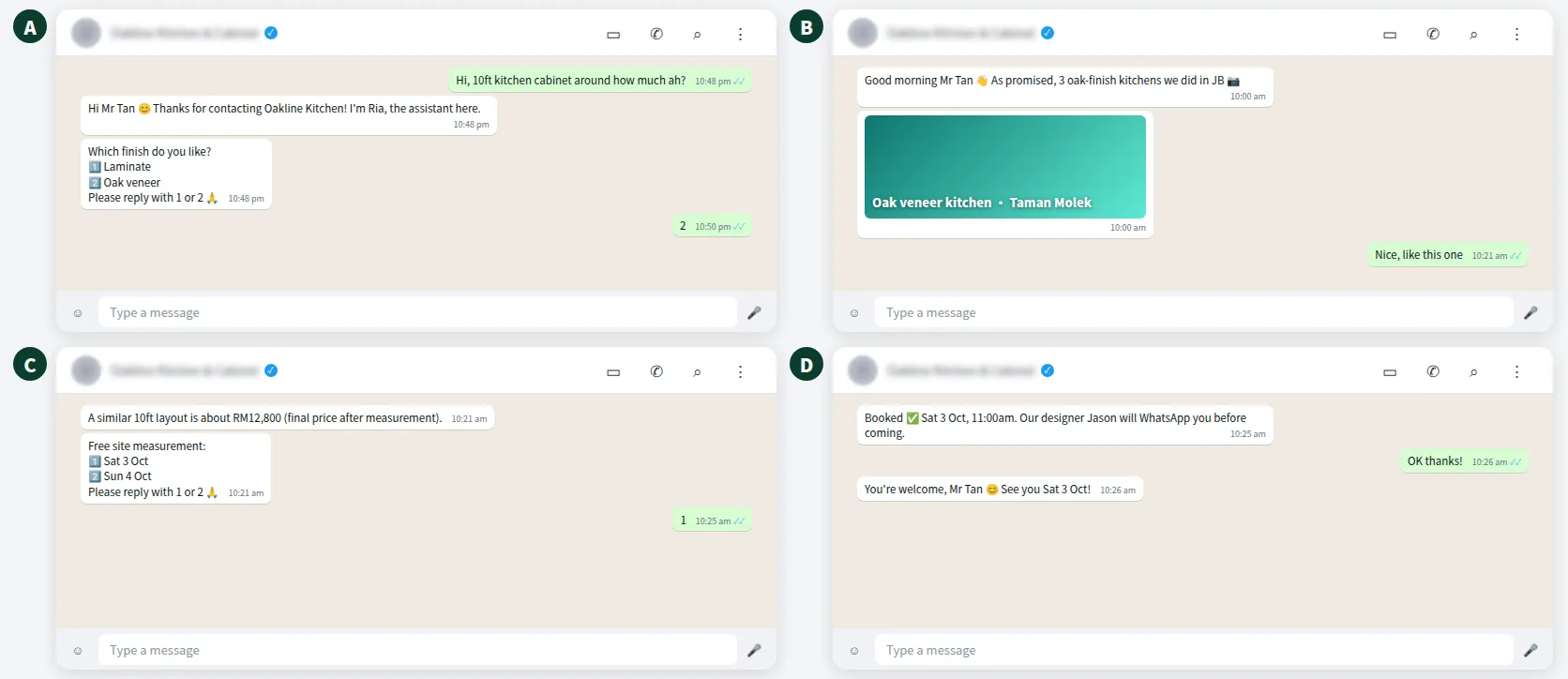
- Day 1 (deliver): “Hi Mr Tan 👋 As promised, here are 3 oak-finish kitchens we did in JB 📷 Which style is closest to what you want?”
- Day 3 (next step): “Our designer can measure your kitchen for free. Please reply 1 for Sat 3 Oct or 2 for Sun 4 Oct 🙏”
- Day 7 (final check): “Just checking — should I keep your quotation open, or close it for now? Either is fine 😊”
- After “not now”: “No problem at all! Would you like me to check back in a month? Reply 1 for yes or 2 for no.”
Every template ends with an easy action — a number to reply, a short question or a choice. Numbered replies work well on WhatsApp because customers can answer with one tap on the keyboard.
What the full conversation looks like
Here is an example of the same routine inside WhatsApp, from the first enquiry to a booked site measurement. Numbers such as prices are illustrative.
How do you follow up leads in English, Malay and Chinese?
Reply in the language the customer used. If a customer writes “Boleh buat kabinet 10 kaki? Harga berapa?”, a follow-up in formal English feels cold. If they switch to Mandarin halfway through, switch with them.
This is hard for a small team: the one staff member who reads Chinese is on leave, or the night enquiry in Bahasa Melayu waits until morning. ChatsHero’s AI replies 24/7 in English, Bahasa Melayu and Chinese, and customers can mix languages in one message. Read how the AI handles mixed-language messages in our guide to chatbots and Bahasa Rojak.
Want to see how this looks with your own business? WhatsApp us and chat with the ChatsHero AI.
How do you track every lead so none are forgotten?
When leads sit in three staff phones, nobody knows who replied to whom, and the same customer gets chased twice while another is never contacted again.
With ChatsHero, each lead is recorded in Google Sheets: name, WhatsApp number, what they asked about and the quotation, and your team keeps the stage and next follow-up date up to date. The AI’s Remind feature sends the follow-up on schedule, and your team sees the same list the AI is working from.
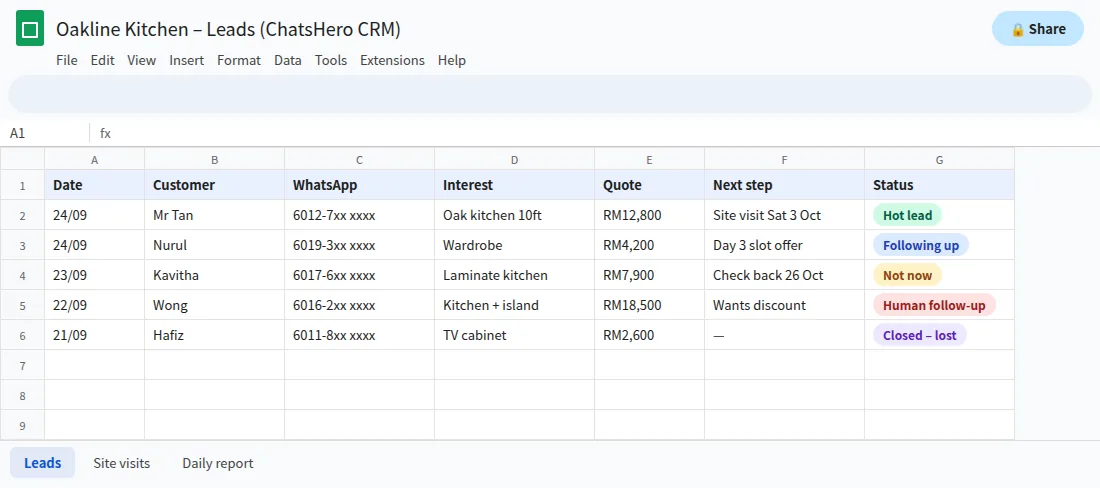
- One lead listEvery enquiry lands in the same sheet, so nobody is chased twice.
- Cadence on autopilotDay 1, 3 and 7 follow-ups go out as you planned them.
- Morning summaryNew, hot and lost leads reported to your team’s WhatsApp group each day.
When a lead is ready to buy, asks for a discount or has a complaint, ChatsHero sends a “Human Agent Needed” alert to your team’s WhatsApp group so a salesperson takes over. See what each plan includes on our pricing page.
What are WhatsApp’s rules for lead nurturing messages?
Lead nurturing WhatsApp messages sent through the official WhatsApp Business API follow Meta’s rules. Knowing them keeps your number’s risk low and your costs predictable.
- Opt-in. Meta’s opt-in guidelines say businesses must get permission, state their business name, and honour opt-out requests. A customer who messaged you about a quotation has started a conversation; a random number from a list has not.
- The 24-hour window. For 24 hours after a customer’s last message, you can reply freely. After that, you can only start a conversation with a pre-approved template message.
- Costs. A sales nudge is usually a marketing template, illustratively RM0.35 per message in Malaysia; utility messages such as an appointment confirmation are an assumed RM0.06. From 1 October 2026, Meta also charges per message for eligible service replies above the monthly 1,000-message allowance per phone number inside the customer-service window, which used to be free (see Meta’s pricing page and this summary of the change). These fees are billed to your own WhatsApp account, separately from your ChatsHero plan.
- Quality rating. If many people block or report your number, its quality rating drops, templates can be paused and your messaging limit stops growing. Fewer, better follow-ups protect your number.
- PDPA. Malaysia’s Personal Data Protection Act applies to the names and numbers you collect: use them for the purpose the customer expects, keep them secure, and stop marketing when asked.
No tool can promise a number will never be restricted, but staying on the official API and following these rules keeps the risk low.
When should you stop following up a lead?
Stop immediately when the customer says no, asks you to stop, or blocks you. Stop after your final check if there has been no reply at all. And pause if the customer says “not now” — then only check back if they agreed to it.
| Customer signal | What to do |
|---|---|
| “Not interested” / “Stop” | Thank them, mark as lost, no more messages |
| “Maybe next month” | Ask if you may check back; set a date only if they agree |
| Read but no reply after Day 7 | Close the lead; no further nudges |
| Asks a new question | Reply quickly — the lead is warm again |
A clean “close” message can prompt a reply, and even when it does not, it leaves a good impression. The customer who was not ready this month may come back next year — if you did not annoy them. Learn more about ChatsHero, an Malaysian company.
Can an AI chatbot follow up leads without sounding like a robot?
Yes, if it is trained on your business and your tone. ChatsHero is trained the way you would brief a new staff member: paste your price list, send a screenshot of a good past conversation, or record a voice note explaining how you handle quotations. In Plan and Build modes, the AI builds the bot for you — no prompt writing.
The AI handles the repetitive part of WhatsApp lead follow up — first replies at midnight, the Day 1 photos, the Day 3 slot offer, recording everything in the sheet. Your salespeople handle the part that needs a human: negotiating, visiting the site, and closing. Start with one product line, read the AI’s follow-ups for a week, then widen it. More WhatsApp sales guides are on our blog.
Frequently Asked Questions
How often should I do WhatsApp lead follow up?
A sensible starting point is Day 0 (reply within minutes), Day 1 (send what you promised), Day 3 (offer a next step) and Day 7 (a polite final check). After that, stop unless the customer agreed to receive updates.
Is it rude to follow up a customer on WhatsApp?
Not if the customer contacted you first and each message is useful. It becomes annoying when messages have nothing new, arrive too often or ignore a clear “no”.
What time is best to send a WhatsApp follow up message?
Send follow-ups during reasonable hours, such as mid-morning or early evening, and avoid late nights. Replies to a customer’s own late-night enquiry are fine — they asked.
How much does a WhatsApp follow-up message cost in Malaysia?
On the official API, a sales nudge sent after the 24-hour window is usually a marketing template, illustratively RM0.35 each. From 1 October 2026, Meta also charges eligible service replies above the monthly 1,000-message allowance per phone number inside the customer-service window. These fees are billed by Meta to your own WhatsApp account and can change.
Can I follow up leads from a list I bought?
No. Meta requires opt-in, and Malaysia’s PDPA governs how personal data is collected and used. Messaging people who never contacted you raises your block and report rate and can get your number restricted.
Can a chatbot do sales follow-up automatically?
Yes. ChatsHero records each lead in Google Sheets, sends follow-ups on the schedule you set in English, Bahasa Melayu or Chinese, and alerts your team in a WhatsApp group when a human should take over.