A WhatsApp chatbot is worth it for a small business when the value of time saved plus the gross profit from extra sales is higher than the full monthly cost: the plan fee (from RM350) plus Meta's per-message fees of an assumed RM0.06 per reply. In our examples, busy service businesses break even; very low-volume shops often do not.
RM0.35 and RM0.06 in this article and its supplied illustrations are planning assumptions, not verified current Meta quotations. Gupshup's October announcement describes 1,000 free service replies per business phone number per month, then eligible service charges from 1 October 2026. Utility templates do not use that allowance. Inbound messages and qualifying 72-hour free entry point messages remain exempt. Confirm the recipient market, applicable rate card, free allowance and provider fees before budgeting. Figures below exclude tax and any unlisted costs.
Examples show a proposed workflow, not a guarantee that every account or plan supports it. Ask our team to confirm the channel, integration, permissions and delivery method for your setup. Staff-group notifications and group assistants require separate eligibility and integration checks; a standard one-to-one WhatsApp API account should not be assumed to access every existing staff group. Use approved individual notifications or a staff dashboard if group delivery is unavailable. Test the workflow and human handover before use.
- Worth it = (hours saved × your hourly value) + (extra sales × gross profit) − (plan fee + Meta fees).
- From 1 Oct 2026 Meta charges for eligible service replies above the monthly 1,000-message allowance per phone number inside the customer-service window too, so count message volume honestly.
- Use gross profit, not revenue, when you value extra sales — most online calculators skip this.
- In the worked examples, a 40-enquiry-a-day service business and a high-ticket business come out ahead; a 10-enquiry home business does not on staff-cost maths alone.
- The owner's own time often decides it: if your evenings are worth RM30 an hour, the answer changes.
- It is not worth it if enquiries are few, fully custom, or nobody will keep the bot's answers up to date.
How do you work out if a WhatsApp chatbot is worth it for a small business?
Worth it = time saved + extra gross profit − full monthly cost
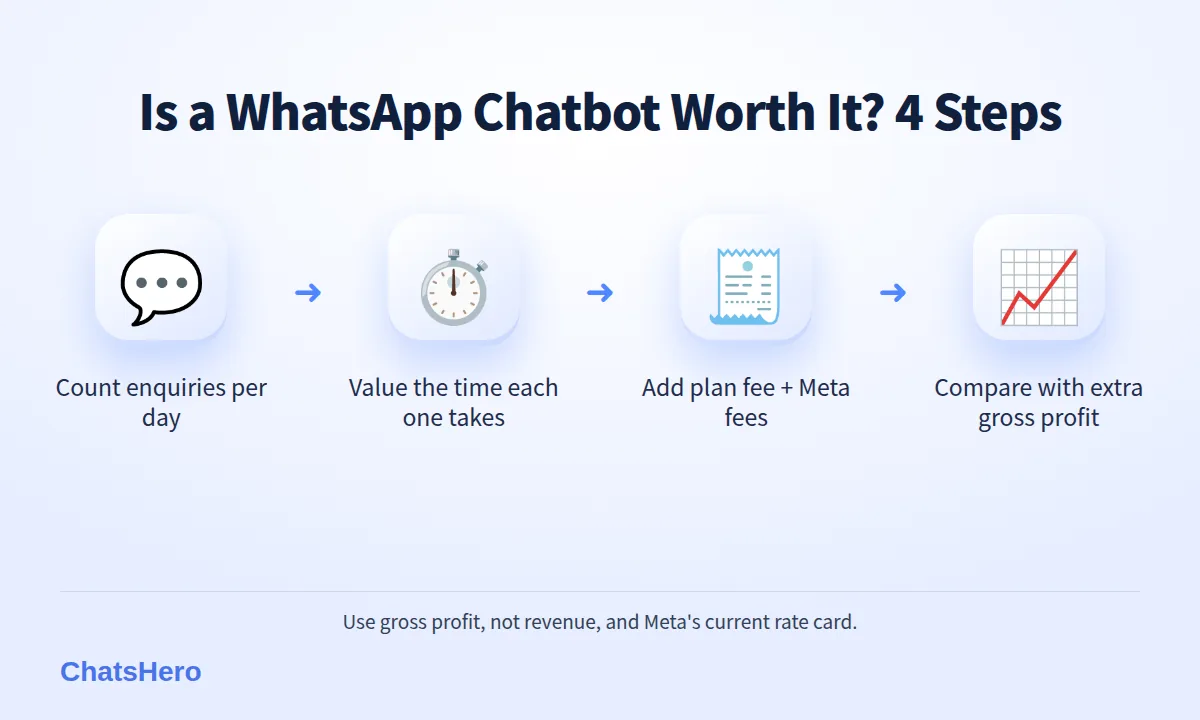
Deciding whether a WhatsApp chatbot is worth it for a small business comes down to four numbers you can estimate in 15 minutes:
- CostPlan fee + Meta's per-message fees + your setup and maintenance time.
- Time savedMinutes per enquiry × enquiries per month × what an hour of that time is worth.
- Extra salesOrders you win because replies are instant and 24/7 — valued at gross profit, not price.
If time saved plus extra gross profit is bigger than the cost, it pays. If it is close, the softer benefits (no missed chats, records in Google Sheets, fewer late-night replies) may tip it. If it is far below, wait.
What does a WhatsApp chatbot really cost a Malaysian small business?
There are two bills, and many ROI calculators show only the first.
1. The platform plan
Using ChatsHero as the example (other vendors price differently): Starter is RM350 a month billed annually or RM420 billed quarterly, Growth is RM650 or RM780, and the done-for-you WE-DO plan is RM950 or RM1,140. See the pricing page for what each includes.
2. Meta's per-message fees
On the official WhatsApp Business API, Meta charges per message, billed to your own WhatsApp account and separate from any vendor plan. In Malaysia, a marketing message is an assumed RM0.35 and a utility or authentication message an assumed RM0.06 (Meta pricing). From 1 October 2026, free-form eligible service replies above the monthly 1,000-message allowance per phone number inside the customer-service window are also charged per message, using an illustrative utility-rate assumption (summary of the change). Inbound messages from customers stay free, and the 72-hour free window after a Click-to-WhatsApp ad or Facebook Page CTA still applies when you reply within 24 hours.
So count your volume. If each enquiry needs about five replies from the bot:
| Enquiries a day | Bot replies a month (×5 ×30) | Illustrative service fees after 1,000 free/number/month |
|---|---|---|
| 10 | 1,500 | RM30 |
| 15 | 2,250 | RM75 |
| 40 | 6,000 | RM300 |
Rates are set by Meta and can change; check the current rate card before you decide. Replies inside a free ad entry-point window cost less.
How much is the time saved really worth?
Be conservative. Only count time that is truly freed up — a staff member who still has to sit at the counter all day is not saving you wages just because the bot answers chats.
Two useful benchmarks:
- The national minimum wage is RM1,700 a month (since 1 February 2025, and 1 August 2025 for employers with fewer than five staff). Over 26 eight-hour days that is about RM8 an hour, before EPF, SOCSO and EIS.
- The median monthly salary for Malaysian citizens was RM2,793 in 2024 (DOSM Salaries & Wages Survey 2024) — roughly RM13 an hour on the same basis.
In the examples below we use RM10 an hour for staff time and 4 minutes per enquiry handled by the bot instead of a person. Your own numbers may be higher or lower — a quotation that needs photos and back-and-forth can take 15 minutes.
For many micro-businesses, the time saved is the owner's. Replying at 11pm does not appear on a payslip, but it has a cost. Put your own hourly value on it — even RM30 an hour changes the result.
How much extra sales can faster replies bring?
This is the number to be most careful with, because it is easy to inflate. What the research does say is that speed matters. In a US study of 2,241 companies published in Harvard Business Review (2011), firms that tried to contact a web lead within an hour were nearly seven times as likely to qualify it as those that waited longer; the average response time was 42 hours.
That is not a promise of seven times the sales for a Malaysian shop. It is a reason to count the enquiries you currently answer late — after closing time, during lunch rush, on public holidays — and estimate how many of those you lose.
Then value each extra sale at gross profit: price minus materials, delivery and direct labour. An RM80 aircond service may leave RM40–RM60 after the technician's time and parts. Using the full RM80 would overstate the return.
Is a WhatsApp chatbot worth it for a small business? Three worked examples
All three businesses are fictional and every figure is an example to show the method, not a result any business has achieved.
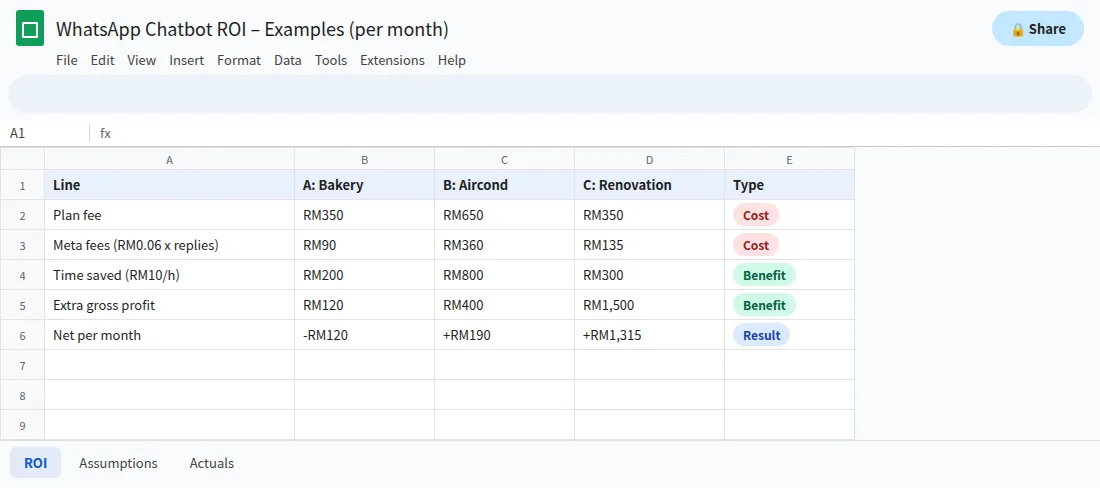
| Per month (example) | A: Home bakery, 10 enquiries/day | B: Aircond service, 40/day | C: Renovation contractor, 15/day |
|---|---|---|---|
| Plan fee | RM350 (Starter) | RM650 (Growth) | RM350 (Starter) |
| Illustrative service fees after 1,000 free replies | RM30 | RM300 | RM75 |
| Total cost | RM380 | RM950 | RM425 |
| Time saved (4 min each, RM10/h) | 20h = RM200 | 80h = RM800 | 30h = RM300 |
| Extra sales × gross profit | 3 × RM40 = RM120 | 8 × RM50 = RM400 | 1 × RM1,500 = RM1,500 |
| Net result | −RM60 | +RM250 | +RM1,375 |
What the examples show
- A, the home bakery, loses RM120 a month on staff-cost maths. But if the owner values her evenings at RM30 an hour, the 20 hours become RM600 and the result turns positive. The honest answer: it depends on how much you value your own time.
- B, the aircond service, comes out only slightly ahead on paper. The bigger win may be not hiring an extra person just to answer chats — a full-time hire at minimum wage costs at least RM1,700 a month before EPF and SOCSO.
- C, the renovation contractor, needs just one extra project every three months to cover the cost, because each job carries a high gross profit.
What does the chatbot actually do to earn its keep?
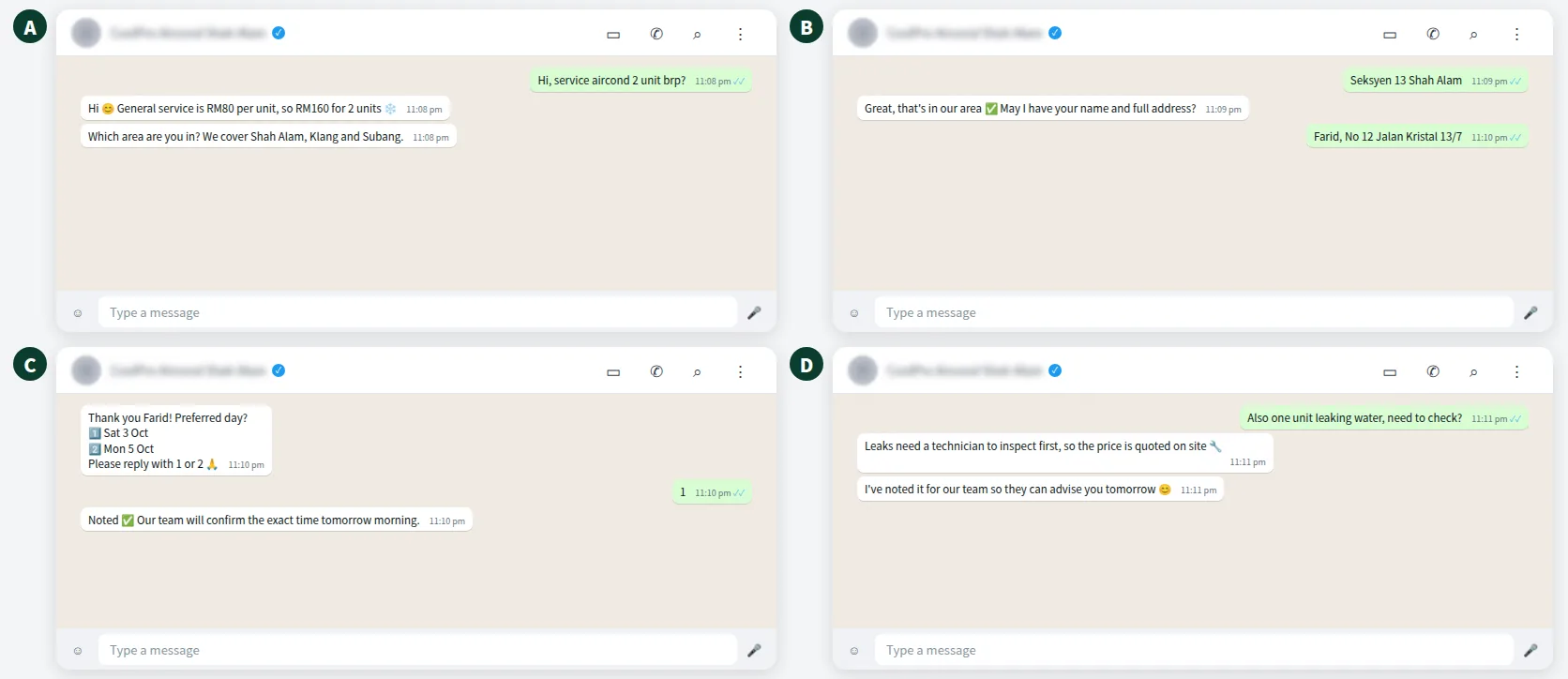
The return comes from a few repeatable jobs. Here is example B at 11pm on a Friday: the bot answers the price, collects the details, records the lead and passes anything unusual to the team.
With ChatsHero, those jobs follow the 5R routine:
- Reply instantly, 24/7, in English, Bahasa Melayu and Chinese.
- Resolve common questions — prices, areas covered, opening hours.
- Remind customers with automatic follow-ups.
- Record every lead and its status in Google Sheets.
- Report a daily or weekly summary to your team's WhatsApp group.
Setup time is part of the cost, so keep it small: training works in Plan and Build modes by pasting text, uploading a screenshot or sending a voice note — no prompt writing.
When is a WhatsApp chatbot not worth it?
Sometimes the honest answer is no — or not yet. A chatbot is probably not worth it when:
- You get only a handful of enquiries a day and you already reply within minutes. There is little time to save and few lost sales to win back.
- Every enquiry is fully custom. If each reply needs a site visit, measurements or a detailed quote, a bot can collect details but cannot close the sale.
- You have no fixed prices or FAQs. A bot needs something clear to answer from. Write your price list first.
- Nobody will maintain it. Wrong prices after a change cost more than slow replies.
- Your customers mostly walk in or call. Automating WhatsApp will not help if that is not where they are.
- Margins are thin and message volume is high. With Meta charging per reply from 1 October 2026, a long chat for a small sale can cost more than it earns.
- You would be using it to blast people who never opted in. That raises the risk of blocks and reports, and is not a use case worth paying for.
If you are close to the line, the free WhatsApp Business App with quick replies and a clear price list may be enough for now.
How do you test the ROI before committing?
Do not rely on anyone's calculator — including this one. Measure your own numbers:
- For one week, count enquiries per day and note how many arrive after hours.
- Time how long a typical enquiry takes to answer.
- Write down your gross profit per typical sale.
- Plug the numbers into the formula with your plan price and Meta fees at your expected volume.
- After the first month, compare leads recorded in Google Sheets against the same week before the bot.
If you want a second opinion on your numbers, send them to our team on WhatsApp — or read more about who we are and browse other guides on the ChatsHero blog.
Want to see how this looks with your own business? WhatsApp us and chat with the ChatsHero AI.
Frequently Asked Questions
Is a WhatsApp chatbot worth it for a small business in Malaysia?
It is worth it when the value of time saved plus the gross profit from extra sales exceeds the plan fee and Meta's per-message fees. In our examples, busy service businesses and high-ticket businesses come out ahead, while a very low-volume home business may not unless the owner values their own time highly.
How much does a WhatsApp chatbot cost per month?
Two parts: the vendor plan (ChatsHero starts at RM350 a month billed annually) and Meta's per-message fees, billed to your own WhatsApp account — an assumed RM0.06 per utility message or reply and RM0.35 per marketing message in Malaysia. Rates are set by Meta and can change.
Do replies to customers cost money on WhatsApp?
On the official WhatsApp Business API, from 1 October 2026 Meta charges per message for eligible service replies above the monthly 1,000-message allowance per phone number inside the customer-service window as well. Inbound messages stay free, and the 72-hour window after a Click-to-WhatsApp ad remains free when you reply within 24 hours.
How many extra sales do I need to break even?
Divide the part of your monthly cost not covered by time saved by your gross profit per sale. For example, if RM300 of cost remains and each sale earns RM50 gross profit, you need six extra sales a month.
When is a WhatsApp chatbot not worth it?
When you get only a few enquiries a day and already reply fast, when every enquiry is fully custom, when you have no clear prices or FAQs, when nobody will keep the bot updated, or when most customers walk in or call.
Can I start small and upgrade later?
Yes. Start with one number and your most common questions, measure enquiries and leads for a month, then decide whether to add more bots or channels.