In the WhatsApp catalogue vs website debate, the short answer is: use a WhatsApp catalogue when you sell a small range (as a rough rule of thumb, under about 50 items), customers ask questions before buying, and orders are placed by chat. Use a website when you have many products, want self-checkout and Google traffic. For many growing SMEs the answer is both — website to be found, WhatsApp to close.
RM0.35 and RM0.06 in this article and its supplied illustrations are planning assumptions, not verified current Meta quotations. Gupshup's October announcement describes 1,000 free service replies per business phone number per month, then eligible service charges from 1 October 2026. Utility templates do not use that allowance. Inbound messages and qualifying 72-hour free entry point messages remain exempt. Confirm the recipient market, applicable rate card, free allowance and provider fees before budgeting. Figures below exclude tax and any unlisted costs.
Examples show a proposed workflow, not a guarantee that every account or plan supports it. Ask our team to confirm the channel, integration, permissions and delivery method for your setup. Staff-group notifications and group assistants require separate eligibility and integration checks; a standard one-to-one WhatsApp API account should not be assumed to access every existing staff group. Use approved individual notifications or a staff dashboard if group delivery is unavailable. Test the workflow and human handover before use.
- A WhatsApp Business catalogue holds up to 500 items, each with a title, price, description, link and product code.
- A catalogue is quick and free to set up, but it does not bring you Google search traffic.
- A website supports self-checkout and SEO, but costs more to build and maintain.
- Products that need advice, customisation or delivery-zone checks often close faster in chat.
- Online sellers must show full price, delivery time and terms, whichever channel they use.
- An AI chatbot can answer product questions 24/7 and record every WhatsApp order in Google Sheets.
What is the difference between a WhatsApp catalogue and a website?
A catalogue is a shop window inside the chat. A website is a shop with its own front door.
A WhatsApp Business catalogue lets you list products or services on your business profile. According to the WhatsApp Help Center, a catalogue can hold up to 500 items, each with a title and optional price, description, website link and product code. Customers browse it without leaving WhatsApp, then message you to order.
A website (or online store) lives on the open web. Customers can find it on Google, browse at their own pace, add items to a cart and pay through a payment gateway, without talking to anyone.
So the real WhatsApp catalogue vs website question is not “which is better?” It is: does my customer want to talk before buying, or buy without talking?
WhatsApp catalogue vs website: how do they compare side by side?
| Factor | WhatsApp catalogue | Website / online store |
|---|---|---|
| Setup cost | Free inside WhatsApp Business | Domain, hosting or platform fee, design time |
| Setup time | An afternoon | Days to weeks |
| Product limit | Up to 500 items | Practically unlimited |
| Found on Google | No | Yes, with good SEO |
| Checkout | Order by chat; you confirm and collect payment | Cart and payment gateway, self-service |
| Asking questions | Natural — it is already a chat | Needs a chat button or contact form |
| Staff effort per order | Higher, unless replies are automated | Lower for simple orders |
| Follow-up | Easy in the same chat | Mostly by email |
The table shows the trade-off clearly. A catalogue wins on speed, cost and conversation. A website wins on discovery, scale and self-service checkout.
Channel follows buying behaviour. If most of your customers ask at least one question before paying, the order will end up on WhatsApp anyway.
When is a WhatsApp catalogue enough for ordering?
A catalogue plus WhatsApp ordering is usually enough when most of these are true:
- You sell a small range. As a rough rule of thumb, under about 50 regular items — frozen food, cakes, kuih, plants, printing, home-based fashion.
- Orders need checking. Delivery zone, slot, flavour, size or custom text have to be confirmed.
- Customers are local and repeat. Regulars in your town who reorder every week or month.
- Payment is simple. Bank transfer or DuitNow QR, with your team verifying the payment.
The weakness is time. When 40 people ask “still got stock?” in one evening, a person answering by hand becomes the bottleneck. That is where an AI auto-reply helps: it answers product, price and delivery questions from your own information, 24/7, and hands tricky chats to staff.
When do you really need a website or online store?
A website becomes worth the cost when:
- You have many products or variants. Hundreds of SKUs with sizes and colours are easier to browse with filters and search.
- You want Google traffic. People searching “buy frozen dumplings Penang” will not find your WhatsApp catalogue.
- Customers prefer self-checkout. Low-price, no-question items like refills or accessories suit a cart.
- You sell nationwide or across borders. A website builds trust with buyers who have never met you.
Malaysian businesses earned RM937.5 billion in e-commerce income in 9M2025 (DOSM, reported by The Star) — most of it business-to-business, but a sign of how normal selling online has become. Even so, a website shopper may still tap the WhatsApp link before paying, to ask about delivery or stock.
Whichever channel you choose, the Consumer Protection (Electronic Trade Transactions) Regulations 2012 expect online sellers to show their business name and registration number, contact details, the full price including delivery, payment method, terms and estimated delivery time. Put these in your catalogue descriptions or auto-replies too.
How do Malaysian SMEs combine a website with WhatsApp ordering?
For many growing shops, the best answer to WhatsApp catalogue vs website is “both, with clear jobs”. The website brings people in; WhatsApp answers doubts and closes the order.
- Keep one product list. Maintain prices and stock in one place (for example, a Google Sheet) and update the website, catalogue and AI answers from it.
- Add a WhatsApp button to every product page. Pre-fill the message, e.g. “Hi, I’m asking about Pork & Chive Dumplings (30 pcs)”.
- Train the AI on your catalogue. Paste the product list, delivery zones and FAQ so it can answer instantly in English, Bahasa Melayu or Chinese.
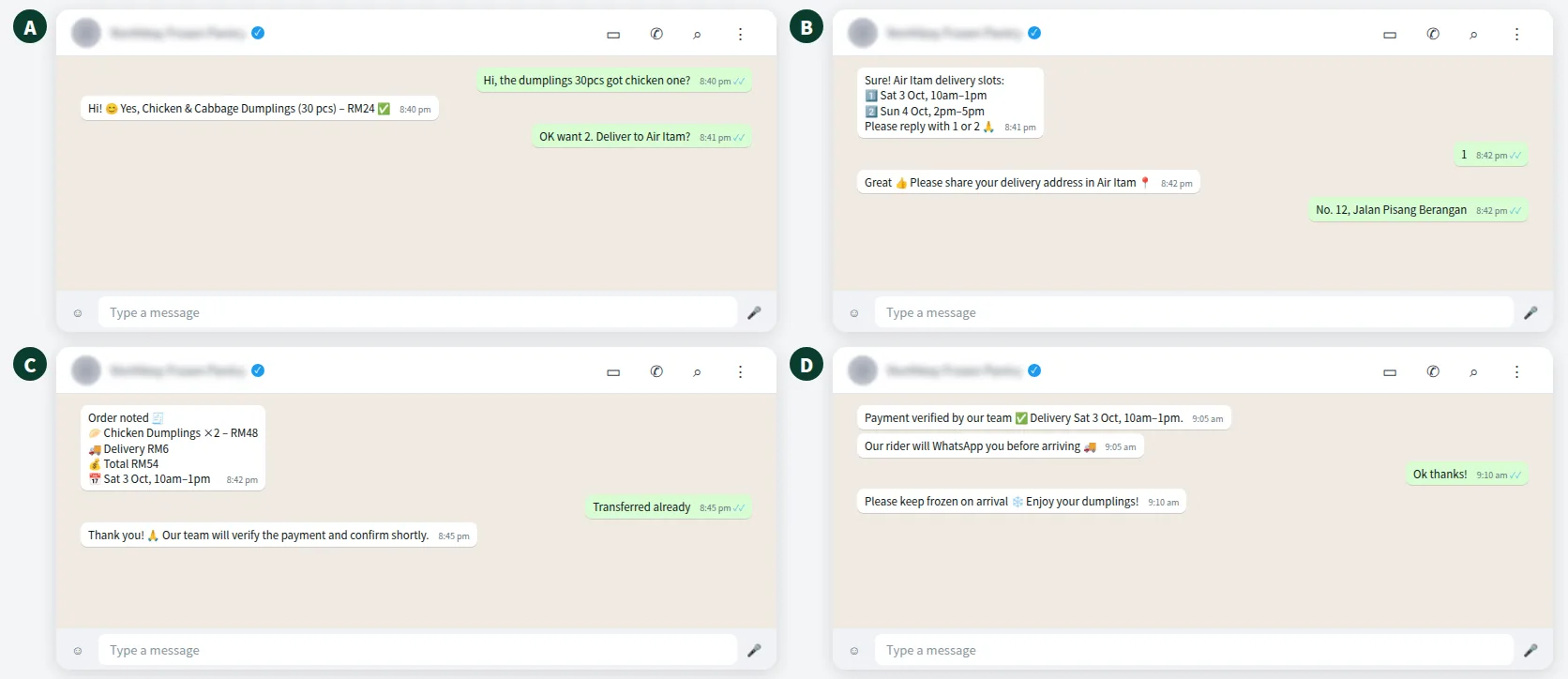
- Take orders in chat with numbered replies. “1️⃣ Delivery 2️⃣ Self-pickup — please reply with 1 or 2 🙏”.
- Record every order automatically. Each confirmed order goes into Google Sheets with items, amount, slot and status.
- Hand over the exceptions. Complaints, bulk or custom orders trigger a “Human Agent Needed” alert in your team’s WhatsApp group.
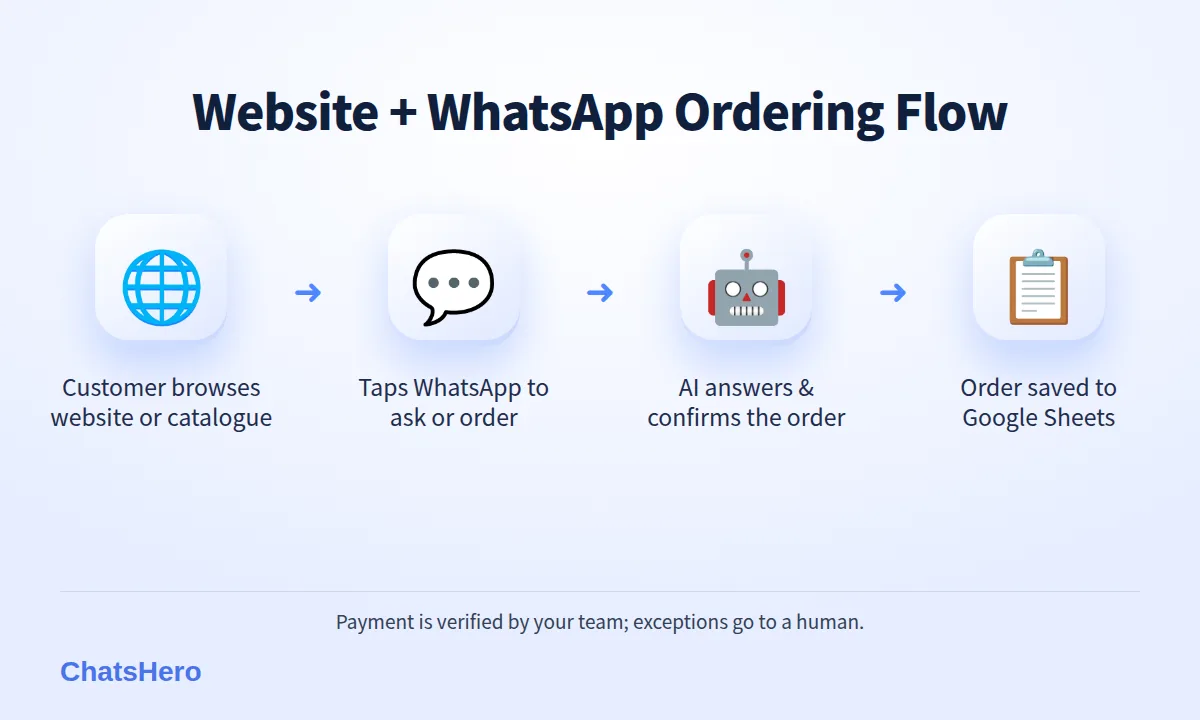
This is where ChatsHero fits: it works on the official WhatsApp Business API alongside your website, Facebook and Instagram. See the plans.
How do you keep track of orders that come in through WhatsApp?
The biggest risk of chat-based ordering is orders buried in chats. A customer says “I’ll transfer tonight”, the chat scrolls away, and nobody follows up. ChatsHero records each order and enquiry into a Google Sheet as it happens, so the team works from one list.
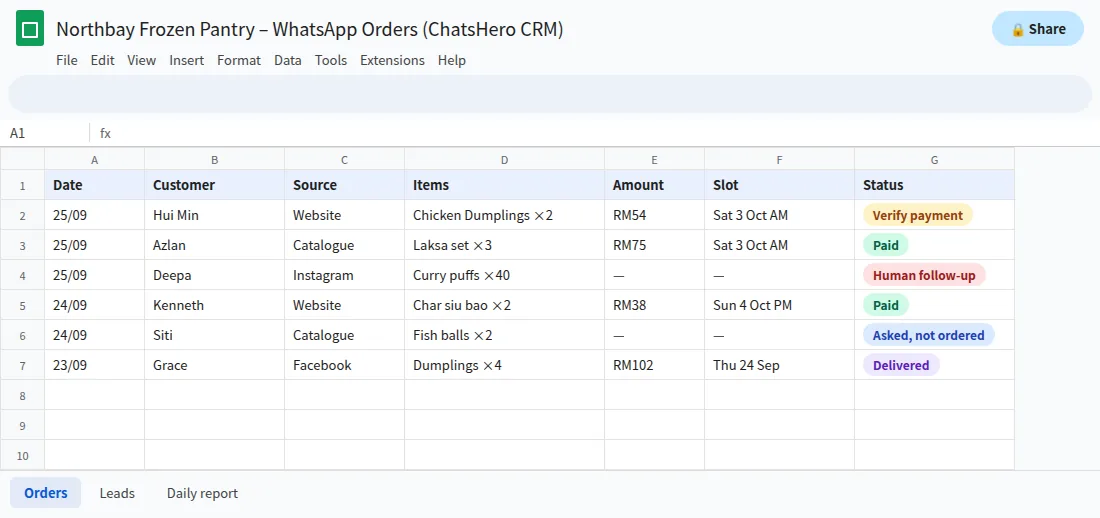
- Source columnWebsite, catalogue or Instagram — asked in chat or filled by your team — shows which channel starts orders.
- Slot columnSort by delivery slot to plan the rider’s route.
- Status columnYour team moves orders from “Awaiting payment” to “Verified”.
With the sheet in place, you can also see which products people ask about on WhatsApp but never buy — a sign the price, photo or description needs work on both the catalogue and the website.
What does WhatsApp ordering cost compared with a website?
A catalogue on the WhatsApp Business app is free. If you move to the official WhatsApp Business API for automation and multiple staff, Meta charges per message, billed to your own WhatsApp account. In Malaysia a utility message such as an order confirmation is illustratively RM0.06, and a marketing message illustratively RM0.35 (see Meta’s pricing page). From 1 October 2026, eligible service replies above the monthly 1,000-message allowance per phone number inside the customer-service window are also charged, using an illustrative utility-rate assumption.
| Example month | Chat-first shop | Website-first shop |
|---|---|---|
| Orders | 400 via WhatsApp | 400 via cart, 150 with WhatsApp questions |
| Order confirmations (≈RM0.06) | 400 × RM0.06 ≈ RM24 | 150 × RM0.06 ≈ RM9 (WhatsApp only) |
| Other costs | Automation plan | Platform, hosting, payment gateway fees |
The figures above are examples only; Meta’s rates can change. A ChatsHero plan starts from RM350 a month (annual Starter) with unlimited messages and blasting inside the platform, separate from Meta’s fees.
Want to see how this looks with your own business? WhatsApp us and chat with the ChatsHero AI.
Which option should you choose for your shop?
Use this quick rule of thumb:
- Starting out, local, under about 50 items (a rough guide): WhatsApp catalogue + AI replies. Add a simple website later.
- Growing, 50–300 items, mix of new and repeat buyers: website for discovery, WhatsApp for questions and ordering.
- Large range, mostly self-serve buyers: website with checkout, and WhatsApp for pre-sale questions, order updates and after-sales.
Whatever you choose, answer fast: a shopper comparing three sellers at 11pm may well buy from the first one that replies clearly. A good next step is to count last month’s orders by channel — the numbers usually make the choice for you. If WhatsApp wins, ChatsHero can take over the replies.
Frequently Asked Questions
WhatsApp catalogue vs website: which is better for a small business?
For a small, local range where customers ask questions before buying, a WhatsApp catalogue with fast replies is usually enough. Once you need Google traffic, many products or self-checkout, add a website and keep WhatsApp for questions and closing orders.
How many products can a WhatsApp Business catalogue hold?
The WhatsApp Help Center states a catalogue can contain up to 500 items. Each item has a title and optional price, description, website link and product code.
Can customers pay inside a WhatsApp catalogue in Malaysia?
A common approach is to take the order in chat and share a bank transfer or DuitNow QR. Your team then verifies the payment before confirming the order.
Does a WhatsApp catalogue help my Google ranking?
No. A catalogue lives inside WhatsApp and is not indexed like a website. If you want to be found through Google search, you need a website with useful product pages.
Can an AI chatbot take orders from my WhatsApp catalogue?
An AI chatbot such as ChatsHero can answer questions about your products, prices and delivery using the information you train it on, collect order details and record them in Google Sheets. Unusual orders are handed to your staff.
Do I still need to show prices and delivery terms if I sell only on WhatsApp?
Yes, it is good practice and in line with the Consumer Protection (Electronic Trade Transactions) Regulations 2012 for online sellers: show the full price including delivery, payment method, terms and estimated delivery time.