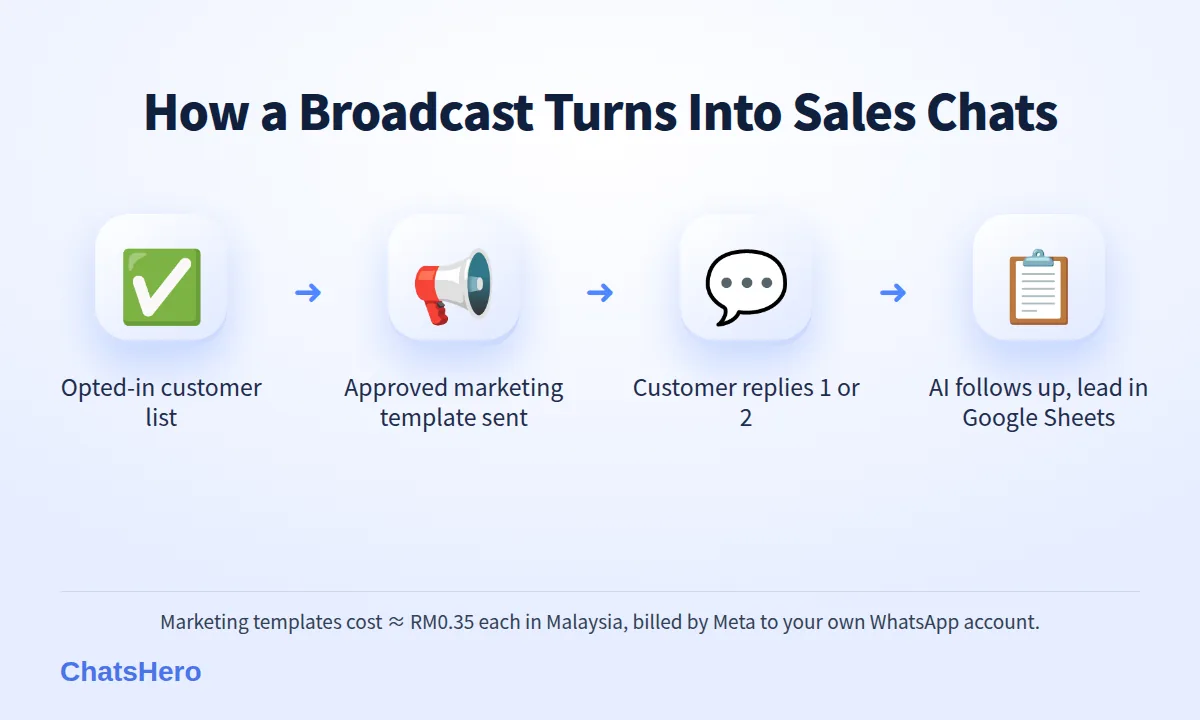
The WhatsApp broadcast message examples that get replies share one pattern: a personal greeting, one clear offer with a deadline, and a question customers can answer with a single number. Send them only to customers who opted in. On the official API each one is a Meta marketing template, an assumed RM0.35 per message in Malaysia, so 1,000 recipients are illustrated here at RM350.
RM0.35 and RM0.06 in this article and its supplied illustrations are planning assumptions, not verified current Meta quotations. Gupshup's October announcement describes 1,000 free service replies per business phone number per month, then eligible service charges from 1 October 2026. Utility templates do not use that allowance. Inbound messages and qualifying 72-hour free entry point messages remain exempt. Confirm the recipient market, applicable rate card, free allowance and provider fees before budgeting. Figures below exclude tax and any unlisted costs.
- Ask one question the customer can answer with a number ("Please reply with 1 or 2 🙏"). Replies turn a broadcast into a sales conversation.
- Keep it short: greeting, one offer, one deadline, one question, one opt-out line.
- Only send to customers who agreed to receive promotions, and remove anyone who asks to stop.
- Promotional broadcasts are Meta marketing templates: an assumed RM0.35 each in Malaysia, billed to your own WhatsApp account.
- Write natively in English, BM or Chinese for each customer group instead of translating word for word.
- Plan for the replies: an AI assistant can answer them 24/7 and record interested customers in Google Sheets.
What makes a WhatsApp broadcast message get replies?
A broadcast that only announces gets read. A broadcast that asks gets answered.
Most promotional broadcasts are written like posters: a long list of products, prices and a phone number. Customers read them, maybe, and move on. A broadcast that gets replies is written like the start of a conversation. It sounds as if it came from a person, makes one offer, and ends with a question so easy to answer that replying takes two seconds.
Five elements appear in almost every good example below:
- A personal greeting with the customer's name and your business name.
- One offer, not five. The more choices you list, the fewer people choose.
- A real deadline or limited quantity, stated honestly.
- A numbered question: "1️⃣ Yes, reserve 2️⃣ Not now. Please reply with 1 or 2 🙏"
- An opt-out line such as "Reply STOP if you prefer not to receive promos."
That last line is not just good manners. Customers who can say "stop" easily are less likely to block or report you, which protects your number's quality rating.
Who can you send WhatsApp broadcast messages to in Malaysia?
Only people who agreed to hear from you. Meta's opt-in requirements say businesses must clearly state that a person is opting in to receive messages and name the business they are opting in to, and must comply with applicable law. Meta also recommends clear instructions for opting out of specific kinds of messages, and honouring those requests.
In Malaysia, the Personal Data Protection Act 2010 applies too: collect contact details for a stated purpose, keep them secure, and stop direct marketing when a customer asks you to.
Ask at a natural moment. After a purchase or booking: "Would you like to receive our promotions on WhatsApp? 1️⃣ Yes 2️⃣ No. Please reply with 1 or 2 🙏" Record the answer in Google Sheets, and have your team keep the broadcast list up to date, including removing anyone who later replies STOP.
A customer who asked you a question once has not agreed to a monthly promotion. When in doubt, ask first.
How much does a WhatsApp broadcast cost in Malaysia?
On the official WhatsApp Business API, a promotional broadcast is sent as a marketing template. Meta decides a template's category from its content, so any message with an offer, discount or product push is marketing, even if you intended it as an update.
| Message type | Example | Approx. Meta rate (Malaysia) |
|---|---|---|
| Marketing template | Promotion, new arrival, event invite, win-back offer | ≈ RM0.35 (≈ RM0.3467) |
| Utility template | Order update, booking reminder with no offer | ≈ RM0.06 (≈ RM0.0564) |
| Replies inside the 24-hour window | Answering customers who reply to your broadcast | Charged from 1 Oct 2026, using an illustrative utility-rate assumption |
An illustrative calculation: a broadcast to 1,000 opted-in customers costs 1,000 × RM0.35 = RM350. If 120 of them reply and you exchange about 4 messages each, that is 480 replies × RM0.06 ≈ RM29 more. Rates are set by Meta and can change; see Meta's pricing documentation and this summary of the 1 October 2026 change. These fees are billed to your own WhatsApp account. Your ChatsHero plan is separate and includes unlimited blasting within the platform; compare plans on the pricing page.
Because every message costs money, a smaller, well-chosen list usually beats blasting everyone.
How do you write a broadcast message step by step?
- Pick one goal. Sell one product, fill one set of slots or invite to one event.
- Choose the segment. Past buyers of running shoes, not everyone who ever messaged you.
- Write the hook in the first line. The notification preview shows only the start of the message.
- Add the offer and the deadline. "20% off, this Sat and Sun only."
- End with a numbered question and "Please reply with 1 or 2 🙏".
- Add the opt-out line and submit the template for Meta's approval.
- Prepare for replies before you press send (see below).
Templates use variables for personal details, so "Hi [Name]" becomes "Hi Kumar" for each customer. Keep variables to what you actually have in your list.
WhatsApp broadcast message examples for shops and F&B
These WhatsApp broadcast message examples use fictional businesses. Replace the details with your own and keep the structure. Each is written natively in its language, not translated.
1. Weekend sale (English, retail)
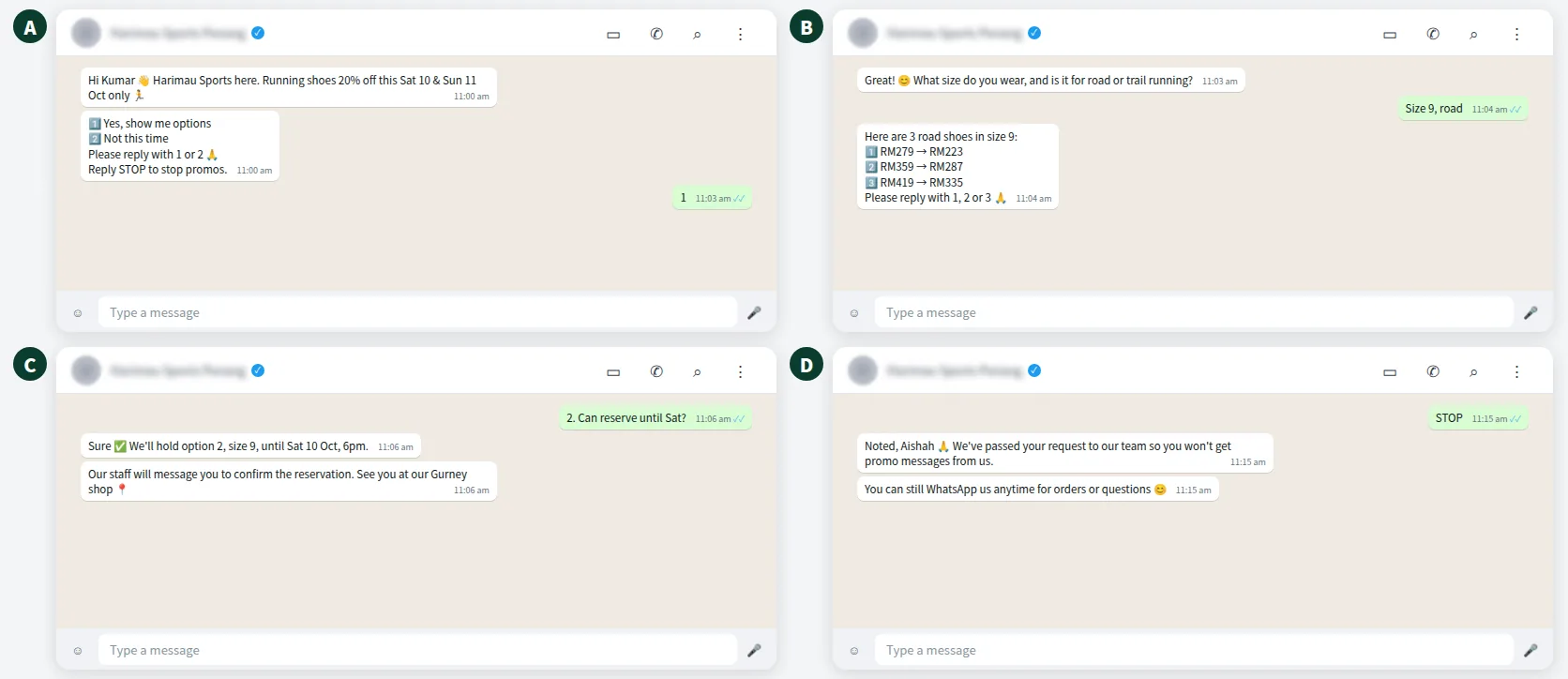
"Hi [Name] 👋 Harimau Sports here. Running shoes are 20% off this Sat 10 & Sun 11 Oct only 🏃 Want us to check your size?
1️⃣ Yes, show me options
2️⃣ Not this time
Please reply with 1 or 2 🙏
Reply STOP to stop promos."
2. Back in stock (English, retail)
"Hi [Name], good news! The black trail shoes you asked about are back in stock, only 8 pairs in size 8–10 👟 Should we hold a pair for you until Wed 7 Oct?
1️⃣ Yes, hold one
2️⃣ No, thanks
Please reply with 1 or 2 🙏"
3. New menu item (Bahasa Melayu, F&B)
"Salam [Nama] 😊 Kedai Makan Selera Pantai ada menu baharu minggu ni: Nasi Kerabu Set RM12.90 🍛 Nak kami simpan satu untuk makan tengah hari Jumaat 9 Okt?
1️⃣ Ya, simpan satu
2️⃣ Lain kali
Sila balas 1 atau 2 🙏
Balas STOP jika tak mahu terima promosi."
4. New flavour launch (Chinese, bakery)
"[名字] 你好 😊 甜心饼家新口味「猫山王榴莲千层」本周六 10/10 开卖,每天只做 30 盒 🍰 要帮你先留一盒吗?
1️⃣ 要,帮我留
2️⃣ 下次再说
请回复 1 或 2 🙏
不想收到优惠讯息,请回复 STOP。"
5. Slow-day offer (English, café)
"Hi [Name] ☕ Rainy Mondays at Kopi Senja are quiet, so here's a treat: any 2 drinks for RM15 this Mon 5 Oct, 2pm–5pm. Coming by?
1️⃣ Yes, see you
2️⃣ Maybe next time
Please reply with 1 or 2 🙏"
6. Pre-order reminder (Bahasa Melayu, retail)
"Hi [Nama] 👋 Pre-order tudung koleksi baharu Butik Seri Ayu tutup Ahad 11 Okt. Stok warna dusty pink tinggal sikit je 🌸 Nak tengok gambar penuh?
1️⃣ Ya, hantar gambar
2️⃣ Tak apa
Sila balas 1 atau 2 🙏"
Broadcast message examples for service businesses
7. Slots opening (English, salon)
"Hi [Name] 💇 Lily Hair Studio just opened extra slots for Thu 8 and Fri 9 Oct. Hair colour is RM20 off for these two days. Want one?
1️⃣ Thu 8 Oct
2️⃣ Fri 9 Oct
3️⃣ Not now
Please reply with 1, 2 or 3 🙏"
8. New intake (Bahasa Melayu, tuition)
"Salam [Nama] 😊 Pusat Tuisyen Bestari buka pendaftaran kelas 2027. Daftar sebelum 31 Okt untuk yuran pendaftaran percuma 📚 Anak tahun berapa?
1️⃣ Tahun 4–6
2️⃣ Tingkatan 1–3
Sila balas 1 atau 2 🙏"
9. Free trial class (Chinese, fitness)
"[名字] 你好 💪 活力健身本月推出新课程「晨间拉伸」,10 月每个星期六早上 8 点,第一次体验免费!要帮你预留位子吗?
1️⃣ 好,帮我预留
2️⃣ 下次再说
请回复 1 或 2 🙏"
10. Year-end service promo (English, car workshop)
"Hi [Name] 🚗 Before the year-end balik kampung trips, Jaya Auto Care has a full inspection + oil change package at RM149 until Sat 31 Oct. Book a slot?
1️⃣ Yes, book
2️⃣ Not now
Please reply with 1 or 2 🙏"
11. Win-back message (English, any business)
"Hi [Name], it's been a while since your last visit to Lily Hair Studio 😊 Here's RM15 off your next appointment, valid until Sat 31 Oct. Shall we find you a slot?
1️⃣ Yes please
2️⃣ Maybe later
Please reply with 1 or 2 🙏"
12. Event invite (Bahasa Melayu, retail)
"Salam [Nama] 🎉 Harimau Sports Penang anjurkan larian santai 5km percuma pada Ahad 18 Okt, 7 pagi di Padang Kota. Nak kami daftarkan nama anda?
1️⃣ Ya, daftar
2️⃣ Tak dapat hadir
Sila balas 1 atau 2 🙏"
Notice what these examples avoid: long product lists, ALL CAPS, vague "limited time" claims and links as the only call to action. A reply is worth more than a click, because it starts a conversation you can continue.
What happens after customers reply to your broadcast?
A good broadcast creates a wave of replies within an hour or two, often more than a small team can answer quickly. If the replies wait, the interest fades. This is where an AI assistant pays off: ChatsHero answers each reply 24/7 in English, Bahasa Melayu or Chinese, continues with the next question, and hands customers to your team with a "Human Agent Needed" alert when they want something special.
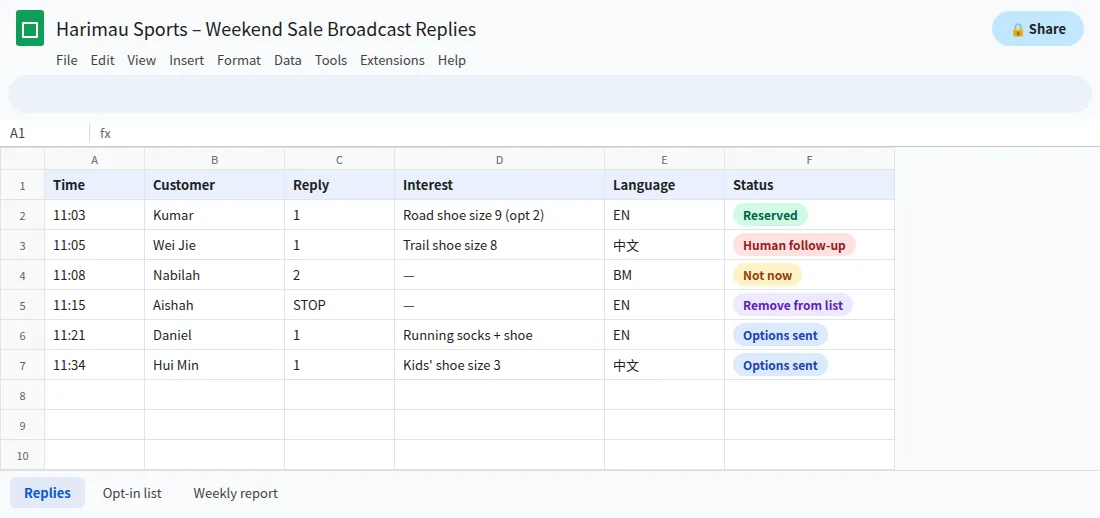
Every interested customer is recorded in Google Sheets, including those who replied STOP, so your team can see who wants what and update the broadcast list. The AI does not check payments; your team verifies them.
Want to see how this looks with your own business? WhatsApp us and chat with the ChatsHero AI.
Which broadcast mistakes hurt your WhatsApp number?
| Weak broadcast | Why it fails | Stronger version |
|---|---|---|
| "MEGA SALE!!! 50 items on offer, click link" | Feels like spam; no reason to reply | One product, one offer, one numbered question |
| Sent to every number you have | More blocks and reports, higher cost | Only opted-in customers, segmented by interest |
| No way to opt out | Customers block instead of saying stop | "Reply STOP to stop promos" and honour it |
| Promo hidden in a "reminder" | Meta categorises it as marketing anyway | Keep reminders and promotions separate |
| Nobody answers the replies | You pay for interest you never convert | AI replies instantly, staff take over hot leads |
- Quality ratingLow quality can pause your templates and stop limit increases.
- Messaging limitsSet per business portfolio; check the current tier in WhatsApp Manager.
- Official APILower risk than unofficial blasting tools, but not a licence to spam.
How often should you send WhatsApp broadcast messages?
There is no official number, so let your customers tell you. Track three things per broadcast in your sheet: replies, STOP requests and sales. If replies fall and STOP requests rise, you are sending too often or to the wrong segment. A reasonable starting point for many small businesses is a few well-targeted broadcasts a month rather than daily blasts, then adjust based on those numbers.
Timing matters too. Send when your team, or your AI assistant, is ready to answer, and avoid late-night sends for anything other than urgent updates. Write each language version natively; customers notice stiff translations, and mixed-language replies are normal in Malaysia (our article on Bahasa Rojak explains why that is not a problem for the AI). To learn how we work with Malaysian SMEs, read about ChatsHero.
Frequently Asked Questions
What are good WhatsApp broadcast message examples for small businesses?
Good examples are short and personal: a greeting with the customer's name, one offer with a real deadline, and a numbered question such as 1 for yes and 2 for not now. Weekend sales, back-in-stock alerts, new slots and win-back offers all work well in this format.
Do I need permission to send WhatsApp broadcasts in Malaysia?
Yes. Meta requires customers to opt in to messages from your business, and Malaysia's Personal Data Protection Act 2010 means you should stop direct marketing when a customer asks. Ask for opt-in at a natural moment, such as after a purchase.
How much does a WhatsApp broadcast message cost in Malaysia?
A promotional broadcast on the official API is a marketing template, an assumed RM0.35 per message in Malaysia (≈ RM0.3467). Sending to 1,000 opted-in customers is illustrated here at RM350. The fee is billed by Meta to your own WhatsApp account.
Can I use buttons in my WhatsApp broadcast?
ChatsHero uses numbered replies instead, for example 1 for yes and 2 for not now, followed by Please reply with 1 or 2. Customers answer by typing a single number.
What should I do when a customer replies STOP?
Honour it. Reply politely to confirm, and have your team remove the customer from your broadcast list. ChatsHero records the reply in Google Sheets so it is easy to spot and update.
Should I write broadcasts in English, BM or Chinese?
Write in the language each customer group uses, and write each version natively rather than translating word for word. ChatsHero can then handle replies in English, Bahasa Melayu and Chinese, including mixed-language messages.