WhatsApp API pricing in Malaysia depends on category, recipient market and the applicable rate card. From 1 October 2026, the announced service model includes 1,000 free replies per business phone number each month; eligible additional replies become chargeable. This guide uses RM0.35 for marketing and RM0.06 for chargeable utility, authentication or service messages only as planning assumptions. Inbound customer messages and qualifying free entry point messages remain free.
The 1 October change is upcoming. Announcements from Gupshup and respond.io specify 1,000 free service messages per business phone number per month before service charges apply. Qualifying 72-hour free entry point messages remain exempt. RM0.35 and RM0.06 here are illustrative budgeting assumptions, not a verified October rate-card quotation. Confirm your market, currency and account charges before committing spend.
- Meta charges per delivered message; the rate depends on the message category and the customer’s country code (+60 for Malaysia).
- For worked examples only, assume RM0.35 marketing and RM0.06 chargeable utility, authentication or service messages. Confirm actual rates before spending.
- From 1 October, service replies above the monthly 1,000-message allowance become chargeable; in-window utility templates also become chargeable, subject to free entry point exemptions.
- Messages customers send you are still free, and the 72-hour window after a Click-to-WhatsApp ad stays free.
- Fewer, clearer replies and cleaner broadcast lists are the easiest ways to keep your Meta bill down.
- Meta fees are separate from your chatbot or software subscription, so budget for both.
What changes in WhatsApp API pricing on 1 October 2026?
The short version: some previously free messages become chargeable, but free allowances still apply.
Since 1 July 2025, Meta has billed eligible template messages per delivered message instead of per 24-hour conversation. Until 30 September 2026, one big exception made life easy for Malaysian SMEs: once a customer messaged you, your free-form replies inside the 24-hour customer service window cost nothing, and utility templates in that window were free too.
From 1 October 2026, provider announcements describe per-message service billing above a free monthly allowance. Each business phone number receives 1,000 free service messages monthly, with charges from the 1,001st. Utility templates inside an open customer service window also become chargeable. Check Meta pricing and your provider notice for rates and account-specific billing arrangements.
What did not change:
- Messages customers send to you are still free.
- The 72-hour free entry point window after a Click-to-WhatsApp ad or a Facebook Page call-to-action button remains free for message delivery.
- Marketing templates remain chargeable outside qualifying free entry points.
- Volume discounts still apply to utility and authentication templates, but Meta says service messages have no volume tiers.
How much does each WhatsApp message cost in Malaysia (in RM)?
Meta publishes market- and currency-specific rate cards. The figures below are illustrative RM budgeting assumptions, not verified October 2026 list prices. Your invoice depends on recipient market, category, billing currency and any provider fees.
| Message category | Typical use | Illustrative cost per chargeable message | Charged inside the 24-hour window? |
|---|---|---|---|
| Marketing | Promotions, new menu, festive offers, “we miss you” messages | ≈ RM0.35 | Normally charged; qualifying free entry points are exempt |
| Utility | Booking confirmations, order updates, payment reminders | ≈ RM0.06 | Yes, from 1 Oct 2026 |
| Authentication | One-time passwords (OTP) | ≈ RM0.06 | Already chargeable; free entry point exemptions may apply |
| Service (free-form reply) | Answering a customer’s question in a chat they started | ≈ RM0.06 | Above 1,000 free service messages/month/phone number; free entry points remain exempt |
| Customer’s message to you | Any inbound message | RM0 | Free |
Two details catch people out. First, Meta decides the category from the content, so a “reminder” that also pushes a discount is a marketing message at about RM0.35. Second, the rate follows the customer’s phone number, not yours. A +65 Singapore customer is charged at Singapore rates even if your business is in Johor Bahru.
Always confirm on Meta’s official page. The WhatsApp Business Platform pricing page links to the current rate cards and explains each category.
How does Meta decide when a WhatsApp message is charged?
A customer message opens or resets the 24-hour customer service window. From 1 October, check any qualifying 72-hour free entry point and the service allowance before applying the category and rate to chargeable delivered messages. Billing arrangements can differ by provider.
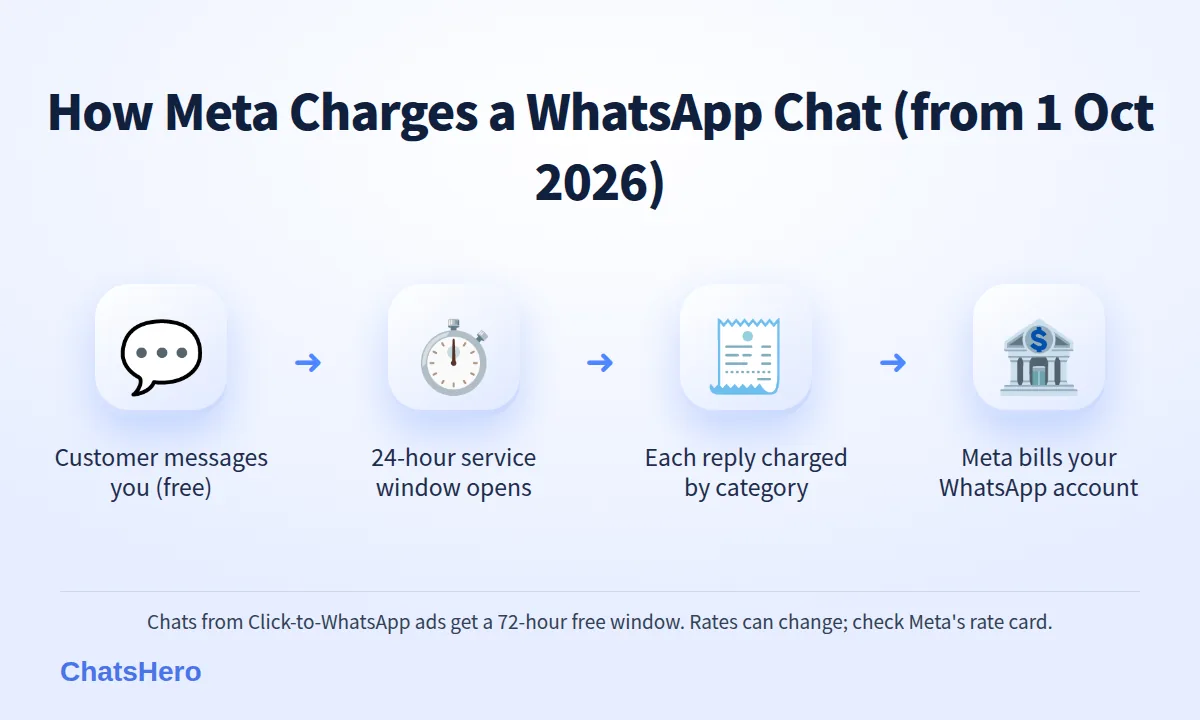
A few rules explain almost every bill:
- Count chargeable delivered messages. Short separate replies consume the allowance faster and can increase costs after it is exhausted.
- Outside the 24-hour window you must use a template. Templates are pre-approved by Meta and fall into marketing, utility or authentication.
- Click-to-WhatsApp ads give you 72 free hours. If the chat started from an ad and you reply in time, messages in that window are free for delivery.
- Volume tiers only help at scale. Discounts on utility and authentication only kick in at high monthly volumes, so a small business should not count on them.
What will WhatsApp API pricing in Malaysia cost my SME per month?
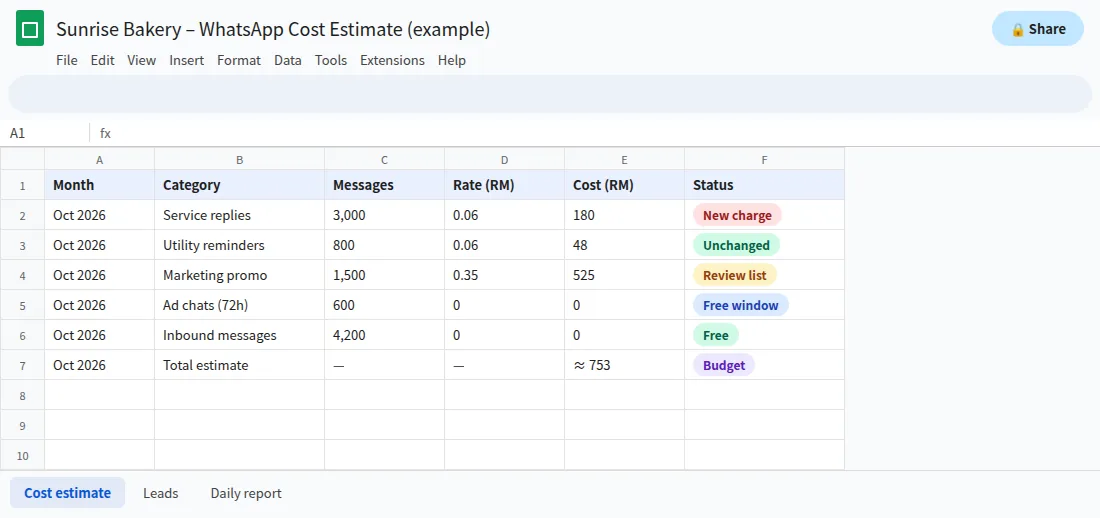
Example only: Sunrise Bakery is a fictional cake shop in Ipoh. Assume one phone number, 3,000 service messages, no qualifying free entry point messages, and planning rates of RM0.06 chargeable utility/service and RM0.35 marketing. These are assumed rates and volumes, not a client result or a verified quotation.
| Monthly activity (example) | Messages | Before 1 Oct 2026 | From 1 Oct 2026 |
|---|---|---|---|
| Replies to customer enquiries (service) | 3,000 | RM0 | (3,000 − 1,000 free) × RM0.06 = RM120 |
| Order and pickup reminders (utility, outside window) | 800 | 800 × RM0.06 = RM48 | RM48 |
| Festive promo broadcast (marketing) | 1,500 | 1,500 × RM0.35 = RM525 | RM525 |
| Estimated Meta fees | 5,300 | ≈ RM573 | ≈ RM693 |
Deducting the 1,000 free service messages leaves 2,000 chargeable replies in this example. Service costs add RM120, making total estimated Meta fees RM693, rather than RM753. Marketing remains the largest part of this illustrative bill.
For each phone number, estimate chargeable service volume as max(0, eligible monthly service messages minus 1,000). Exclude qualifying free entry point messages, calculate chargeable templates by category and market, then add platform/provider fees.
How can I reduce my WhatsApp Business API cost after the change?
You cannot switch the fees off, but you can stop wasting them. These steps apply to almost any business on the API:
- Answer in one clear message. Combine the greeting, answer and next step into one reply instead of three or four bubbles.
- Give numbered options. “Reply 1 for price list, 2 for booking” gets the customer to the answer in fewer back-and-forth messages.
- Keep reminders purely informational. A pickup reminder is utility (≈ RM0.06); add a promo and it becomes marketing (≈ RM0.35).
- Clean your broadcast list. Only send promotions to customers who opted in and still buy from you. Fewer blocks also protect your quality rating.
- Use Click-to-WhatsApp ads wisely. Chats started from those ads get a 72-hour free window, so reply fast and finish the sale inside it.
- Review costs monthly. Check Meta’s billing in WhatsApp Manager and compare it with your sales from WhatsApp.
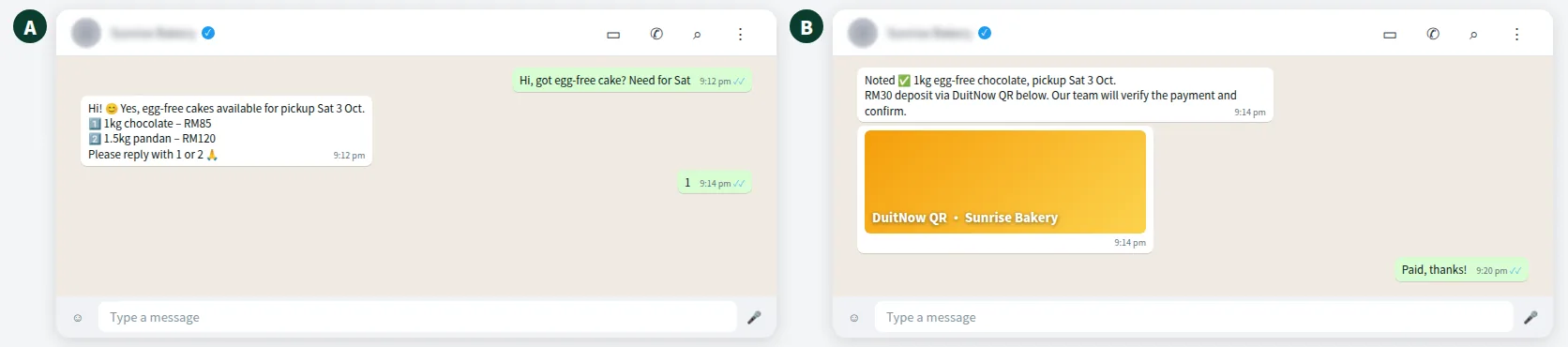
What does a cost-efficient reply look like?
Below is an example of the same enquiry handled with one complete answer and a numbered choice, instead of a long string of short messages.
Is the WhatsApp Business API still worth it for SMEs in Malaysia?
The API can be worthwhile when a managed inbox, automation and integrations save enough staff time or generate enough additional profit to cover total costs. At the assumed RM0.06 rate, 1,000 chargeable replies cost RM60, but an RM60 order is revenue, not necessarily profit. Assess your own margins and platform costs.
Small shops with few daily chats may still prefer the Business app. For others, compare useful replies, faster follow-up and team workflows against total costs rather than assuming the API automatically pays for itself.
- One message, not fiveComplete useful replies consume fewer messages and can reduce charges after free allowances.
- Utility stays utilityKeep reminders free of promos so they stay at ≈ RM0.06, not ≈ RM0.35.
- Know your mixA monthly sheet of messages by category shows where the money goes.
How are Meta fees billed with a platform like ChatsHero?
There are two separate costs, and it pays to keep them apart in your budget:
- Meta’s per-message fees, billed by Meta directly to your own WhatsApp Business account. These are the rates in this guide.
- Your platform subscription, which covers the AI chatbot, inbox, automation and reports. ChatsHero plans start at RM350 a month (Starter, annual billing) and include unlimited messages and blasting within the platform. See the full breakdown on our pricing page.
Because the Meta fees sit on your own account, you always see exactly what Meta charges. ChatsHero runs on the official WhatsApp Business API and replies 24/7 in English, Bahasa Melayu and Chinese, including mixed-language chats (read how AI chatbots understand Bahasa Rojak). Want to know more about who we are? Visit our about page.
Want to see how this looks with your own business? WhatsApp us and chat with the ChatsHero AI.
Will WhatsApp API prices in Malaysia change again?
Pricing may change again. Meta introduced per-message template billing in July 2025, and providers have announced a service change scheduled for October 2026. Check future effective dates and current rate cards before changing your budget.
Practical habits that protect you:
- Check Meta’s pricing page every quarter and whenever your provider sends a notice.
- Keep a simple cost sheet of monthly messages by category so you notice changes early.
- Build your WhatsApp flows around useful, short messages. Those stay cost-effective whatever the rate.
If a rate change lands, your cost sheet makes the impact obvious within a week, and you can adjust your broadcast plan before the next invoice. Past pricing updates are also summarised on the ChatsHero blog.
Frequently Asked Questions
What is the WhatsApp API pricing in Malaysia from October 2026?
The announced October change provides 1,000 free service messages per phone number monthly, then service charges. In-window utility templates also become chargeable, with free entry point exemptions. RM0.35 and RM0.06 here are planning assumptions; verify your market and currency rates.
Are customer messages to my business charged?
No. Inbound customer messages are free. Only eligible business-sent messages are charged; service allowances and qualifying free entry point exemptions remain available.
Is the 24-hour customer service window still free?
Until 30 September, ordinary service replies within the customer service window remain free. From 1 October, the announced model provides 1,000 free service messages per phone number monthly, then charges additional service replies. The 24-hour rule for free-form replies remains.
Are chats from Click-to-WhatsApp ads still free?
Yes. Meta says messages sent in the 72-hour free entry point window, opened by Click-to-WhatsApp ads or Facebook Page call-to-action buttons, remain free for message delivery.
Can I pay Meta in ringgit?
Check available billing currencies and the current rate card for your WhatsApp Business Account. The RM examples do not guarantee MYR billing or a particular exchange rate.
Is the Meta fee included in the ChatsHero plan?
No. Meta’s per-message fees are billed by Meta directly to your own WhatsApp Business account. Your ChatsHero plan covers the AI chatbot, automation and platform, with unlimited messages and blasting within the platform.
Does the free WhatsApp Business app have the same charges?
No. The standard WhatsApp Business app on your phone is free to use. The per-message charges apply to the WhatsApp Business Platform (API).