WhatsApp ads ROI tracking works best with three habits: give every Facebook, Instagram and TikTok ad its own pre-filled first message, record every lead and sale from WhatsApp in one Google Sheet, and divide revenue by ad spend each week. For example, RM1,500 of spend that brings RM9,000 in WhatsApp sales is a ROAS of 6.
RM0.35 and RM0.06 in this article and its supplied illustrations are planning assumptions, not verified current Meta quotations. Gupshup's October announcement describes 1,000 free service replies per business phone number per month, then eligible service charges from 1 October 2026. Utility templates do not use that allowance. Inbound messages and qualifying 72-hour free entry point messages remain exempt. Confirm the recipient market, applicable rate card, free allowance and provider fees before budgeting. Figures below exclude tax and any unlisted costs.
Examples show a proposed workflow, not a guarantee that every account or plan supports it. Ask our team to confirm the channel, integration, permissions and delivery method for your setup. Staff-group notifications and group assistants require separate eligibility and integration checks; a standard one-to-one WhatsApp API account should not be assumed to access every existing staff group. Use approved individual notifications or a staff dashboard if group delivery is unavailable. Test the workflow and human handover before use.
- Ads Manager counts chats started, not sales. The sale happens inside WhatsApp, so that is where you must record it.
- Give each ad a unique pre-filled first message (for example "Hi, I saw the curtain promo on TikTok") so the lead source is visible in the chat.
- Record every lead in Google Sheets with source, status and sale value; your team marks paid orders.
- Copy ad spend from Meta Ads Manager and TikTok Ads Manager into the same sheet once a week.
- Track cost per lead, conversion rate, ROAS and ROI per ad, not just per platform.
- Leads from Facebook and Instagram Click-to-WhatsApp ads get Meta's 72-hour free messaging window; TikTok leads do not.
Why is WhatsApp ads ROI tracking so hard for Malaysian SMEs?
Your ad platform sees the click. Only your WhatsApp sees the sale.
Most Malaysian SMEs that run Click-to-WhatsApp ads know their ad spend to the sen. Ask what those ads earned last month, though, and the answer is often a guess. The reason is structural: the customer clicks an ad on Facebook, Instagram or TikTok, then continues the conversation in WhatsApp. The price discussion, the quotation, the deposit and the final payment all happen in the chat, outside the ad platform.
So Meta Ads Manager reports messaging conversations started and cost per conversation, and TikTok Ads Manager reports clicks or conversations. Useful, but neither tells you which of those chats became paying customers. Without that last step, WhatsApp ads ROI tracking stops at "we got 200 chats" and never reaches "this ad made RM6,000".
The audience is too big to ignore. DataReportal's Digital 2026 Malaysia report puts Facebook's ad reach at 23.0 million people and TikTok's ad reach at 30.7 million adults (18+) in late 2025, based on each platform's own advertising tools. With that much spend flowing into these platforms, a simple tracking habit pays for itself quickly.
Which numbers should you track for Click-to-WhatsApp ads ROI?
You only need a handful of numbers. Some come from the ad platform; the rest come from your WhatsApp conversations.
| Metric | How to calculate | Where the data comes from |
|---|---|---|
| Ad spend | Total spent per ad or campaign | Meta Ads Manager / TikTok Ads Manager |
| Chats started | Number of new WhatsApp conversations | Ads Manager, cross-checked with your sheet |
| Cost per lead (CPL) | Ad spend ÷ leads | Google Sheets |
| Conversion rate | Sales ÷ leads × 100% | Google Sheets |
| ROAS | Revenue ÷ ad spend | Google Sheets |
| ROI | (Gross profit − ad spend) ÷ ad spend × 100% | Google Sheets |
ROAS (return on ad spend) is the quick health check. ROI is the honest one, because it uses gross profit rather than revenue. A curtain shop with a 40% margin needs a ROAS above 2.5 just to break even on the ad; a service business with higher margins can survive on less.
Measure per ad, not just per platform. "TikTok works" is less useful than "the 15-second before-and-after video works and the photo carousel does not".
How do you tag each Facebook or TikTok ad so the lead source is visible?
The simplest tag is the customer's first message. Both Meta and TikTok let you set the text a customer sees ready to send when they tap your ad. Meta calls this a pre-filled message for ads that click to WhatsApp; TikTok's instant messaging ads also open WhatsApp with a starter message. Make that message different for every ad.
- List your live ads and give each a short, human name: "TikTok blackout video", "FB living room carousel", "IG Raya promo".
- Write a unique pre-filled message per ad that still sounds natural, for example "Hi, I saw the blackout curtain video on TikTok" or "Hi, I want the Raya curtain promo from Instagram".
- Train the chatbot to note the source: when a first message matches one of your ad phrases, the AI writes that ad name into the "Source" column in Google Sheets along with the lead.
- Ask when it is unclear. If a customer deletes the text or messages you directly, the AI asks one polite question: "Where did you find us? 1️⃣ Facebook/Instagram 2️⃣ TikTok 3️⃣ Friend or Google. Please reply with 1, 2 or 3 🙏"
- Let your team correct tags. Anything still marked "Unknown" gets checked and updated by a staff member during the weekly review.
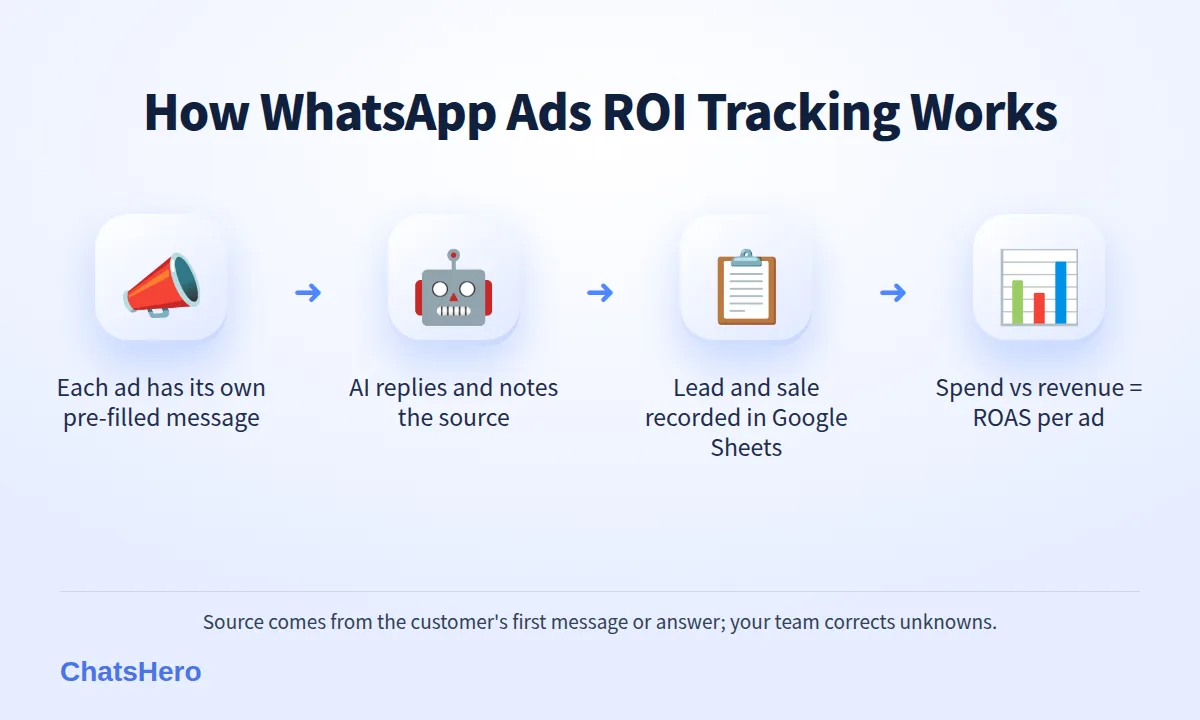
This is tagging, not automatic attribution. The source comes from what the customer sends or answers, and customers can edit a pre-filled message. Expect a small share of "Unknown" leads and let your team tidy them up.
How does the chatbot record WhatsApp leads and sales in Google Sheets?
Once the source is known, the rest is ordinary lead handling, done consistently. With ChatsHero, the AI replies to the enquiry 24/7 in English, Bahasa Melayu or Chinese, asks the qualifying questions you set, and records the details in Google Sheets: date, name, WhatsApp number, source, what they asked for and the lead status.
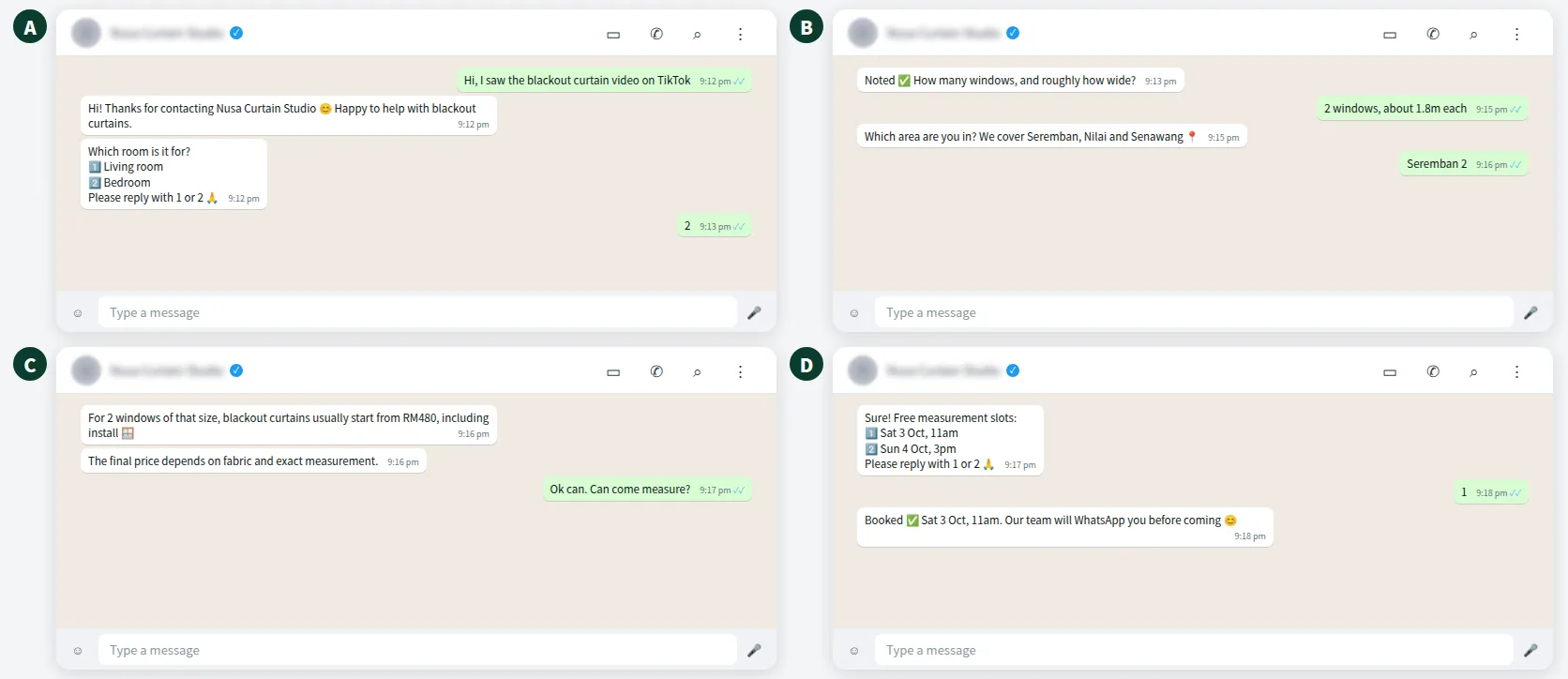
Here is an illustrative chat for a fictional Seremban curtain shop, Nusa Curtain Studio, from a TikTok ad click to a booked measurement visit.
When the customer pays, your team updates the row: status to "Paid" and the sale value in RM. ChatsHero does not detect payments by itself, so this step stays with a person, which is also the right place for a final check. The AI can remind customers who went quiet, and when someone needs a human, it hands the chat to your team with a "Human Agent Needed" alert in your WhatsApp group.
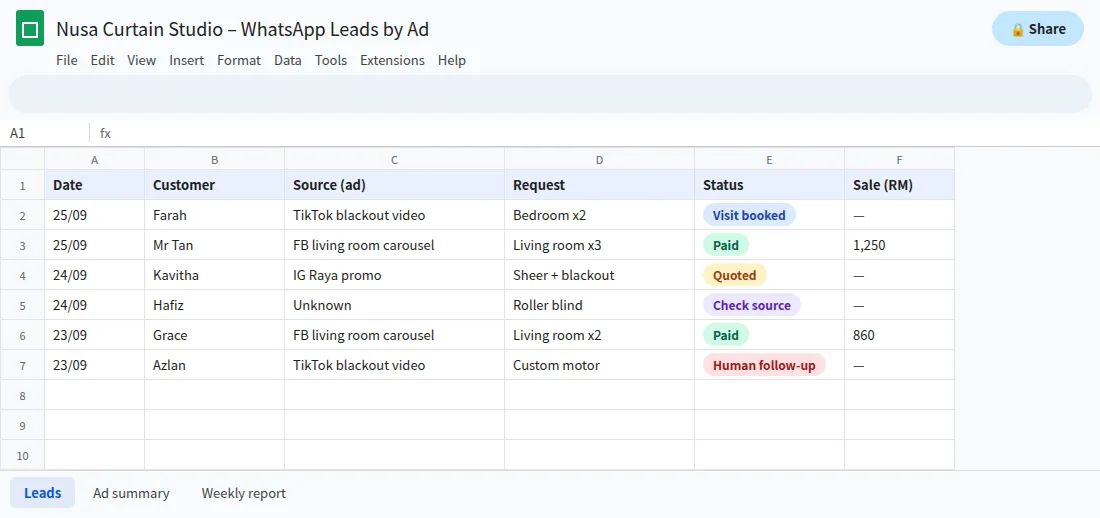
Because every lead lands in the same sheet, you can filter by source and see exactly which ad produced which customers. That is the core of WhatsApp ads ROI tracking: one row per lead, one column for the source, one column for the money.
How do you calculate WhatsApp ads ROI in Google Sheets?
Add a second tab called "Ad summary" with one row per ad. Copy the spend from each ads manager once a week, then let formulas do the rest. With leads in a tab called "Leads" (source in column E, status in column G, sale value in column H), the formulas look like this:
- Leads:
=COUNTIF(Leads!E:E, A2) - Sales:
=COUNTIFS(Leads!E:E, A2, Leads!G:G, "Paid") - Revenue:
=SUMIFS(Leads!H:H, Leads!E:E, A2, Leads!G:G, "Paid") - ROAS: revenue ÷ spend
A worked example (illustrative numbers)
| Ad | Spend | Leads | Sales | Revenue | CPL | ROAS |
|---|---|---|---|---|---|---|
| FB living room carousel | RM1,500 | 120 | 18 | RM9,000 | RM12.50 | 6.0 |
| TikTok blackout video | RM1,000 | 150 | 9 | RM4,500 | RM6.67 | 4.5 |
| IG Raya promo | RM800 | 40 | 3 | RM1,200 | RM20.00 | 1.5 |
In this example, TikTok brings the cheapest leads, but Facebook turns more of them into sales and wins on ROAS. The Instagram promo loses money at a 40% margin: RM1,200 revenue gives RM480 gross profit against RM800 of spend, an ROI of −40%. Without WhatsApp sales data, you would probably have scaled the ad with the cheapest leads.
Include WhatsApp message fees in the cost
Meta charges per message on the official WhatsApp Business API, billed to your own WhatsApp account and separate from your ChatsHero plan. From 1 October 2026, free-form eligible service replies above the monthly 1,000-message allowance per phone number inside the customer-service window are charged using an illustrative utility-rate assumption (≈ RM0.06 in Malaysia), as this summary of Meta's change explains. The exception matters for ads: when a customer arrives through a Click-to-WhatsApp ad on Facebook or Instagram and you reply within 24 hours, a 72-hour free window opens. Meta does not list TikTok ads as a free entry point, so budget for those replies: 150 TikTok leads × 10 replies × RM0.06 = RM90 in the example above. Small, but worth a column.
Want to see how this looks with your own business? WhatsApp us and chat with the ChatsHero AI.
Facebook vs TikTok ads to WhatsApp: which gives better ROI?
There is no universal winner, which is exactly why you track. What differs is how each platform sends people to WhatsApp and what that costs you afterwards.
| Facebook & Instagram (Meta) | TikTok | |
|---|---|---|
| Ad type | Ads that click to WhatsApp | Instant messaging ads (Lead Generation objective) |
| Starter message | Custom pre-filled message per ad | Starter message opens in WhatsApp |
| Ad platform metric | Messaging conversations started, cost per conversation | Clicks or conversations |
| Meta messaging fees | 72-hour free window if you reply within 24h | Standard per-message charges |
TikTok's own messaging ads guide describes two formats: direct messaging ads that keep people inside TikTok, and instant messaging ads that send them to apps such as WhatsApp. For WhatsApp ads ROI tracking, the instant messaging format keeps everything in one inbox and one sheet.
- Cheap leads ≠ good leadsCompare cost per sale, not only cost per chat.
- Same offer, fair testRun the same promo on both platforms before judging either.
- Allow for the sales cycleA renovation lead may pay weeks later; review 30 days back.
How often should you review WhatsApp ad results?
Weekly is the right rhythm for most SMEs: frequent enough to stop a losing ad early, slow enough for leads to turn into sales. A 20-minute routine:
- Copy last week's spend per ad from Meta Ads Manager and TikTok Ads Manager into the "Ad summary" tab.
- Check the "Unknown" source rows and correct any your team can identify.
- Make sure every paid order is marked "Paid" with the right amount.
- Look at ROAS per ad and pause anything clearly below break-even after a fair test.
- Move that budget to the ad with the best cost per sale.
ChatsHero can also send a daily or weekly report to your team's WhatsApp group, so owners see activity without opening the sheet. The ROI decision itself is yours; the sheet just makes it an easy one.
What mistakes ruin WhatsApp ads ROI tracking?
- Using one pre-filled message for every ad. Then every lead looks the same and you can only compare platforms, not creatives.
- Leaving sales outside the sheet. If staff close deals in their personal WhatsApp or over the phone and never update the row, your ROAS will look worse than reality.
- Judging too early. A few days and a few hundred ringgit is rarely enough data; Meta itself suggests running an ad for at least seven days (see its guide to ads that click to WhatsApp).
- Counting revenue as profit. Use gross profit for ROI, or a high-revenue, low-margin ad will look better than it is.
- Slow replies. A lead that waits until morning may have messaged three competitors. Tracking only helps if the chats are answered.
If you are still choosing a plan, the ChatsHero pricing page compares Starter, Growth and the done-for-you WE-DO plan. You can also read who we are and how we work with Malaysian SMEs.
What should you do with your ROI numbers next?
Treat the sheet as a budget tool. Scale the ads with the lowest cost per sale, rewrite or pause the ones below break-even, and test one new creative at a time with its own pre-filled message. After a month or two you will know which offers, formats and platforms bring paying customers, not just chats.
Customers often reply in a mix of English, Malay and Chinese, and a first message like "boleh pasang this week ah?" still needs to be understood before it can be tagged. Our article on how AI chatbots understand Bahasa Rojak explains how that works. More marketing guides are on the ChatsHero blog.
Frequently Asked Questions
What is WhatsApp ads ROI tracking?
It is linking the money you spend on Facebook, Instagram or TikTok ads that open WhatsApp to the sales that close in those WhatsApp chats. You record each lead's source and sale value, then compare revenue or profit with ad spend.
Does Meta Ads Manager show sales from Click-to-WhatsApp ads?
Ads Manager shows messaging conversations started and cost per conversation. Sales usually close inside the chat, so you need your own record, such as a Google Sheet, to see which conversations turned into paying customers.
Can ChatsHero automatically detect which ad a customer came from?
We don't claim automatic ad attribution. The practical method is a unique pre-filled first message per ad; the AI can be trained to note that source in Google Sheets or ask the customer where they found you, and your team corrects any unknowns.
What is a good ROAS for WhatsApp ads in Malaysia?
It depends on your margin. Break-even ROAS is 1 divided by your gross margin: with a 40% margin you need a ROAS of 2.5 to break even on ad spend. Anything above that is profit before other costs.
Are replies to TikTok ad leads on WhatsApp free?
Meta's 72-hour free window applies to Click-to-WhatsApp ads on Facebook and Instagram and the Facebook Page call-to-action button, when you reply within 24 hours. Meta does not list TikTok ads as a free entry point, so from 1 October 2026 those replies are charged using an illustrative utility-rate assumption, illustratively RM0.06 each in Malaysia.
How often should I update ad spend in the sheet?
Once a week is enough for most SMEs. Copy spend per ad from Meta Ads Manager and TikTok Ads Manager, check unknown sources and paid orders, then review ROAS per ad.