A good trial class follow up on WhatsApp has three parts: confirm and remind before the trial, send the teacher's honest feedback on the same day, and follow up once or twice within a week with the timetable and fees. For a tuition centre charging, say, RM180 a month per subject, each trial that becomes an enrolment is recurring income worth protecting.
RM0.35 and RM0.06 in this article and its supplied illustrations are planning assumptions, not verified current Meta quotations. Gupshup's October announcement describes 1,000 free service replies per business phone number per month, then eligible service charges from 1 October 2026. Utility templates do not use that allowance. Inbound messages and qualifying 72-hour free entry point messages remain exempt. Confirm the recipient market, applicable rate card, free allowance and provider fees before budgeting. Figures below exclude tax and any unlisted costs.
Examples show a proposed workflow, not a guarantee that every account or plan supports it. Ask our team to confirm the channel, integration, permissions and delivery method for your setup. Staff-group notifications and group assistants require separate eligibility and integration checks; a standard one-to-one WhatsApp API account should not be assumed to access every existing staff group. Use approved individual notifications or a staff dashboard if group delivery is unavailable. Test the workflow and human handover before use.
- Treat the trial as the start of a conversation, not a one-off lesson: confirm it, remind the parent and follow up afterwards.
- Send the teacher's feedback on the same day, while the parent still remembers the lesson.
- Two or three follow-ups over seven days are enough. Stop as soon as the parent says no.
- Keep the feedback message free of promotions: Meta decides a template's category from its content, and an offer makes it a marketing message.
- Record every trial in Google Sheets so the centre manager can see who is waiting for a reply.
- Hand the chat to a person when a parent asks about a child's specific learning needs.
Why do tuition trial classes not turn into enrolments?
The lesson is rarely the problem. The silence after it usually is.
A trial class is the moment a parent sees your teaching up close. Yet after the lesson, it is easy to simply wait for the parent to come back with a decision. There are several points where a trial can quietly go cold:
- Before the trial: the booking was made on a Tuesday night, and by Saturday the parent has forgotten the time or the address.
- Right after the trial: the child says "OK lah" in the car, and the parent has nothing more concrete to go on.
- The next few days: the parent has a question about the schedule, transport or fees, but it feels like a hassle to ask.
- The decision: the parent is comparing two or three centres, and the one that answers clearly and quickly is easier to choose.
Every one of these gaps is a communication gap. Parents in Malaysia already talk to you on WhatsApp, so that is where the fix belongs.
What should you send before the trial class?
Enrolment starts before the child walks in. Three short messages set the right tone:
- Instant confirmation. Date, time, subject, level, address and a Google Maps pin. If the enquiry came in at 10pm, an AI auto-reply can confirm it within a minute instead of the next morning.
- A few questions about the child. School year, school, recent results and the topics they find hard. This helps the teacher prepare and makes the feedback more useful.
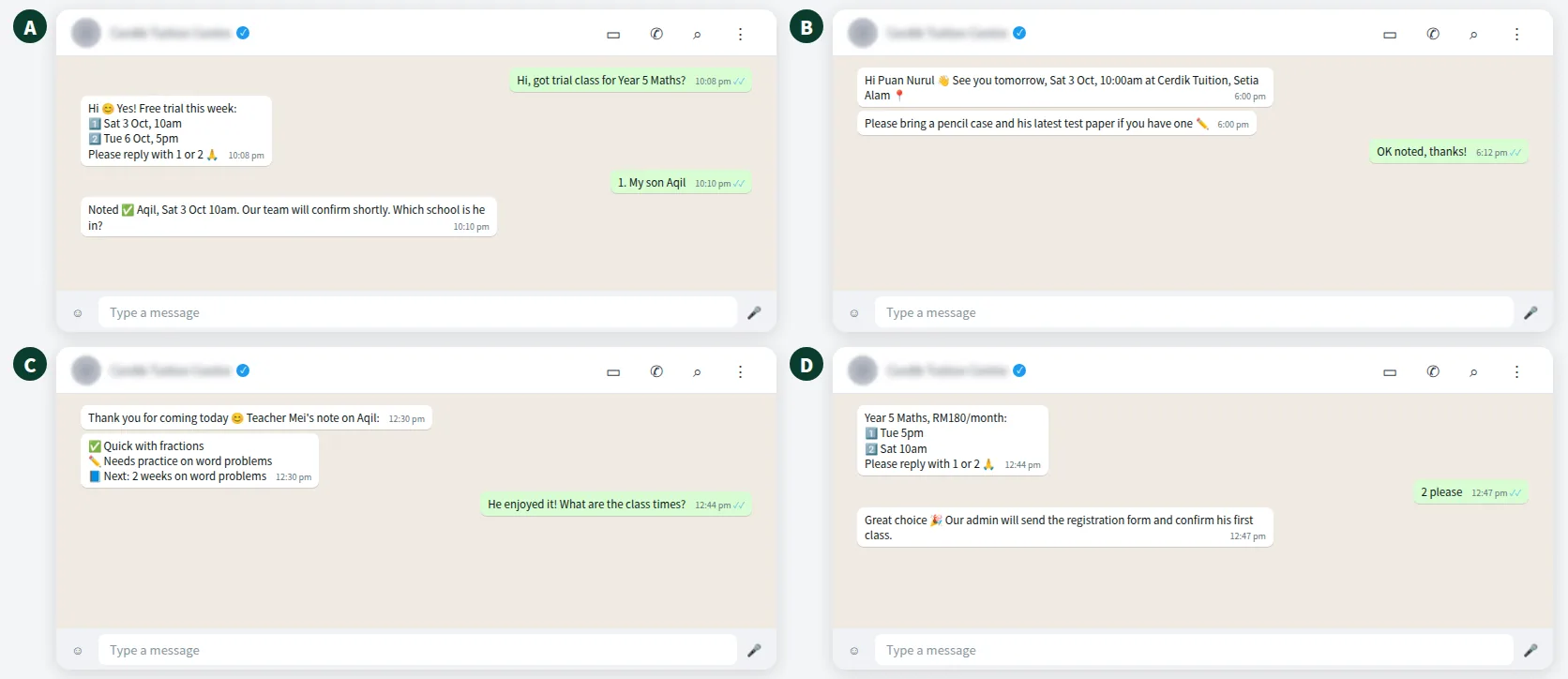
- A reminder the day before. "See you tomorrow, Sat 3 Oct, 10:00am. Please bring a pencil case and the latest school test paper if you have one."
Keep these messages practical. A reminder tied to a booking the parent made is the kind of message Meta usually treats as utility, but Meta decides the category from the content, so keep promotions out of it (see Meta's template guidelines).
What is a good trial class follow up on WhatsApp after the lesson?
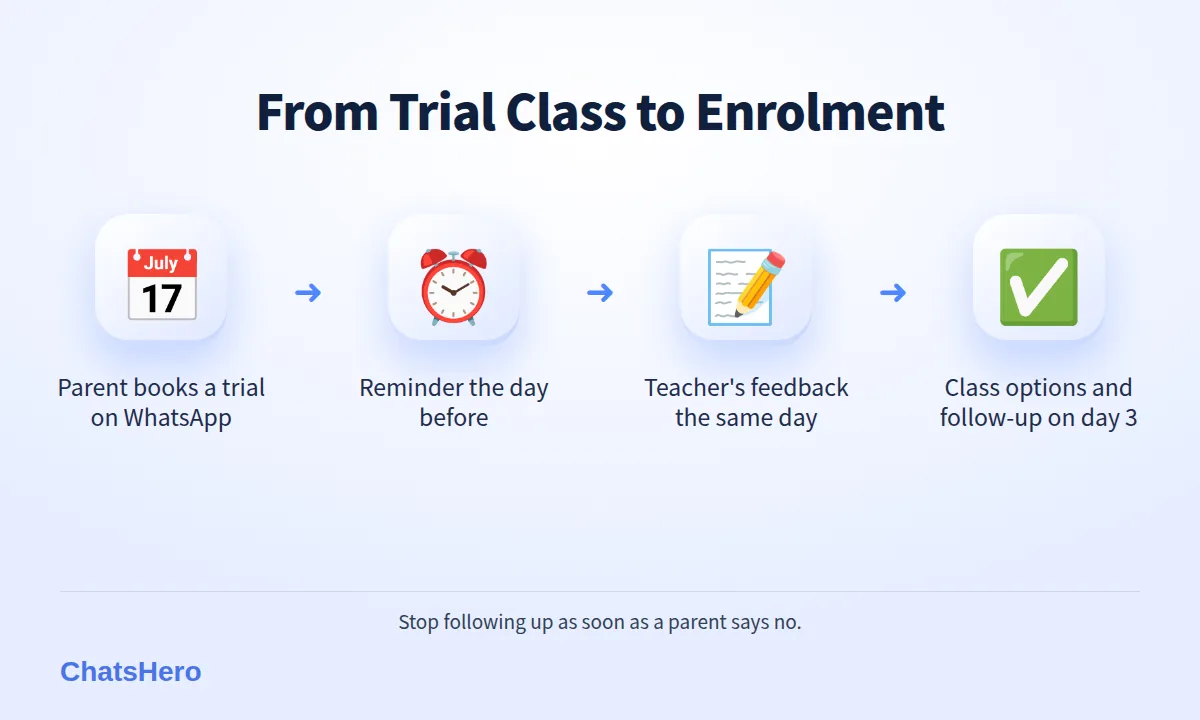
Here is a simple seven-day trial class follow up on WhatsApp that respects the parent's time. Adjust the days to your own centre.
- Same day, within a few hours: thank the parent and share the teacher's feedback — one strength, one area to work on and one suggested next step.
- Same message or right after: share the class options for that level, with day, time and monthly fee, as numbered replies.
- Day 2 or 3: a short check-in: "Any questions about the schedule or fees? Happy to help."
- Day 7: a final, friendly message that closes the loop: "We'll keep Aqil's feedback on file. If you'd like to join later, just reply here."
- Stop. If the parent says no, or asks you to stop, thank them and do not send more.
The AI assistant handles the conversation in between: it answers questions about timetables, fees, holidays and location at any hour, in English, Bahasa Melayu or Chinese, so the parent is never left waiting over a weekend.
What should the teacher's feedback message say?
The feedback message does more to convert a trial than any discount. It shows the parent that the teacher paid attention to their child. Ask teachers to send three lines to the centre after each trial, and the admin or AI turns them into the message.
Example (Year 5 Maths): "Hi Puan Nurul 😊 Thank you for bringing Aqil to today's trial. Teacher Mei's note: Aqil is quick with fractions and very willing to try. He needs more practice turning word problems into sums. In our Year 5 class, we'd start with two weeks on word problems. Any questions, just reply here."
Feedback is not a sales pitch. Avoid promising grades or results. A specific, kind and realistic note builds more trust than "Your child will get an A".
For parents who prefer Bahasa Melayu or Chinese, send the note in their language. Malaysian parents often mix languages in one message, and the AI can follow that, as we explain in our guide on how AI chatbots understand Bahasa Rojak.
What the whole conversation looks like
An illustrative example, from the first enquiry to the parent choosing a class:
How should you answer parents' common questions after a trial?
Most follow-up conversations come down to a handful of questions. Train the AI with your real answers, and decide in advance which ones a person should handle.
| Parent asks | Good reply | Who handles it |
|---|---|---|
| "What are the class times?" | List the slots for that level as numbered options | AI |
| "How much per month?" | Monthly fee, registration fee and materials, clearly separated | AI |
| "The Tuesday class clashes with his swimming" | Offer the other slot, or take note for a waitlist | AI, then staff if no slot fits |
| "Can he join mid-month?" | Your pro-rating rule, stated plainly | AI |
| "She has dyslexia, can your teacher support her?" | Thank the parent and pass to the centre manager | Human |
| "Can you give a discount?" | Your standard sibling or early-payment policy only | AI, then manager |
When a question needs a person, ChatsHero sends a "Human Agent Needed" alert to your team's WhatsApp group, and the centre manager picks up the chat with the full history in front of them.
Want to see how this looks with your own business? WhatsApp us and chat with the ChatsHero AI.
How much does trial class follow-up on WhatsApp cost?
On the official WhatsApp Business API, Meta charges per message, billed to your own WhatsApp account and separate from your ChatsHero plan. In Malaysia, a utility message is illustrated here at RM0.06 and a marketing message illustratively RM0.35. From 1 October 2026, eligible service replies above the monthly 1,000-message allowance per phone number inside the customer-service window are also charged per message, using an illustrative utility-rate assumption (see Meta's pricing page and this summary of the change).
Example for one month (illustrative numbers, using the rates above):
- 40 trial families, about 8 replies each inside the service window: 320 × RM0.06 = RM19.20
- 40 day-before reminders as utility templates: 40 × RM0.06 = RM2.40
- 40 day-3 check-ins that Meta categorises as marketing: 40 × RM0.35 = RM14.00
- Total: about RM35.60 in Meta fees for the month
If the parent first messaged you from a Click-to-WhatsApp ad or your Facebook Page button and you replied within 24 hours, a 72-hour free window applies to message delivery, so early replies to ad leads cost less. Compare that with a single enrolment worth a monthly fee, and the maths is usually easy. Plan fees are on our pricing page.
How do you track every tuition centre trial class in Google Sheets?
A follow-up routine only works if nobody slips through. ChatsHero records each tuition centre trial class in Google Sheets: parent, child's level, subject, trial date, the last follow-up and the outcome. Your admin updates the status when a family enrols, and a daily report goes to your team's WhatsApp group.
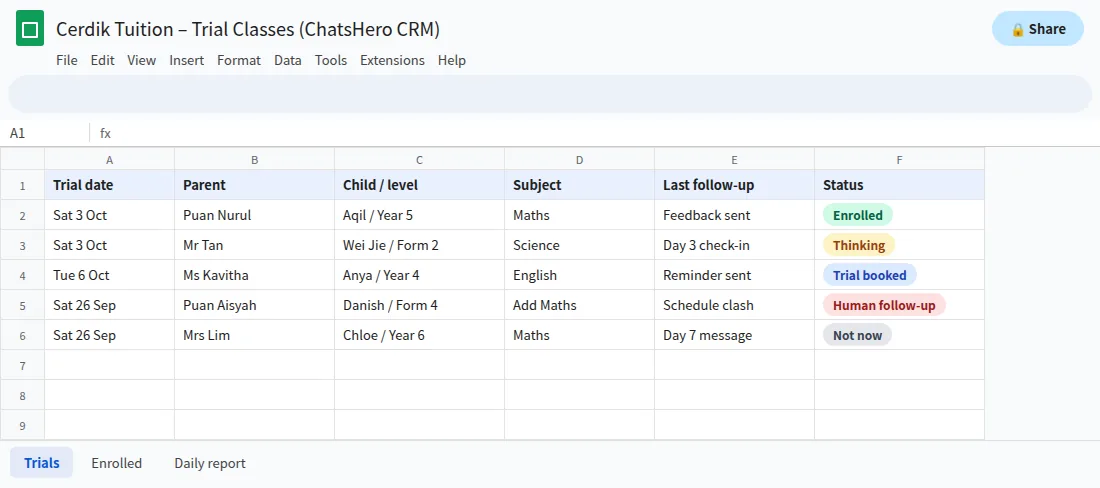
- See who is waitingFilter for trials with no reply after day 3 and decide who calls.
- Compare subjectsYour own sheet shows which subjects and teachers convert trials best.
- Plan classesTrack demand for new slots before opening another class.
After a term, your own data answers useful questions: how quickly the enrolled families were followed up, which slots parents ask for most, and where trials go cold.
How do you keep parent follow-up messages respectful and PDPA-safe?
You are handling parents' phone numbers and information about children, so treat it carefully. Malaysia's Personal Data Protection Act 2010 applies to this data.
- Ask only for what the teacher needs: school year, subjects and recent results. Do not ask for IC numbers in a trial booking.
- Tell parents at booking that you will send the trial reminder and feedback on WhatsApp.
- Keep follow-ups to two or three. When a parent says "no thanks" or asks you to stop, your team marks the contact in the sheet and leaves them out of future messages.
- Only add a family to promotional broadcasts if they agreed to receive them.
- Limit access to the Google Sheet to staff who need it.
ChatsHero runs on the official WhatsApp Business API. That lowers the risk to your number compared with unofficial blasting tools, but no tool can promise a number will never be restricted. Parents who block or report you lower your quality rating, which is one more reason to keep follow-ups short and relevant.
How quickly can a tuition centre set this up?
Set-up is a conversation, not a coding project. In ChatsHero's Plan and Build modes, you paste or voice-note your timetable, fees, trial rules and holiday dates, and the AI builds the assistant. You then write the feedback and day-3 templates in your centre's voice and submit them for Meta's approval.
A sensible first week: train the FAQ on day 1, test with your own staff on day 2, and switch on trial bookings for new enquiries after that. Keep the first version simple, and add more once you see how parents respond. You can read more about ChatsHero and the team behind it.
Frequently Asked Questions
What is a good trial class follow up on WhatsApp?
Confirm the trial and remind the parent the day before, send the teacher's feedback on the same day with the class options, check in once around day 3, and close the loop by day 7. Stop as soon as the parent says no.
How soon after a trial class should I follow up?
On the same day, ideally within a few hours, while the parent and child still remember the lesson. Lead with the teacher's feedback, not the fees.
How many follow-up messages are too many?
For most centres, two or three messages after the trial is enough. More than that can feel like pressure, and parents who block or report your number lower its quality rating.
Should I offer a discount to convert trial students?
Only if it is your standard policy, such as a sibling discount. Honest feedback and clear timetables usually matter more. Note that a message containing an offer is categorised by Meta as marketing, which costs more than a utility message.
Can the AI answer parents in Bahasa Melayu and Chinese?
Yes. ChatsHero replies 24/7 in English, Bahasa Melayu and Chinese, and parents can mix languages in the same chat. Questions about a child's specific learning needs can be handed to a person.
How much does WhatsApp follow-up cost for a tuition centre?
Meta charges per message on the official API: illustratively RM0.06 for utility messages and RM0.35 for marketing messages in Malaysia, billed to your own WhatsApp account. From 1 October 2026, eligible service replies above the monthly 1,000-message allowance per phone number inside the customer-service window are also charged. Your ChatsHero plan is separate.