Physio and TCM booking on WhatsApp works best when the next session is requested before the patient leaves the chat, confirmed by your front desk, and reminded the day before. Let an AI assistant take requests 24/7, record package balances in Google Sheets for your team, and pass every clinical question to the practitioner. A reminder for a booked session is illustrated here at RM0.06 on the official API.
RM0.35 and RM0.06 in this article and its supplied illustrations are planning assumptions, not verified current Meta quotations. Gupshup's October announcement describes 1,000 free service replies per business phone number per month, then eligible service charges from 1 October 2026. Utility templates do not use that allowance. Inbound messages and qualifying 72-hour free entry point messages remain exempt. Confirm the recipient market, applicable rate card, free allowance and provider fees before budgeting. Figures below exclude tax and any unlisted costs.
Examples show a proposed workflow, not a guarantee that every account or plan supports it. Ask our team to confirm the channel, integration, permissions and delivery method for your setup. Staff-group notifications and group assistants require separate eligibility and integration checks; a standard one-to-one WhatsApp API account should not be assumed to access every existing staff group. Use approved individual notifications or a staff dashboard if group delivery is unavailable. Test the workflow and human handover before use.
WhatsApp's Business Messaging Policy says not to share or request full personal ID numbers, financial account numbers or other sensitive identifiers. Use WhatsApp for a checklist and appointment, not for full MyKad, bank-statement or payslip uploads. Collect required documents through your authorised secure portal or in person, with a privacy notice, limited access and a documented retention period. Healthcare chats should remain administrative; do not request clinical records or diagnose through the bot.
- The practitioner decides how many sessions a patient needs; the WhatsApp system only books and reminds.
- Ask for the next session in the same chat, straight after the current one, while the plan is fresh.
- Record package balances in Google Sheets; your team updates them after each visit.
- Keep reminders minimal: name, centre, date and time. No conditions or treatment details on a lock screen.
- No testimonials, 'cure' claims or promised results in WhatsApp messages or broadcasts.
- Pain, injury or 'should I continue?' questions go to a practitioner, never to the bot.
Why do physio and TCM patients drop off between sessions?
Most drop-offs are not decisions. They are follow-ups nobody booked.
A physiotherapy plan or a course of TCM treatment usually runs over several visits. The practitioner explains the plan, the patient says "ok, I'll WhatsApp to book", and then work, school runs and weekends get in the way.
From what centre owners describe to us (an observation, not a survey), the gaps usually come from a few practical things:
- The next session was never booked at the counter. The patient left in a hurry, planning to message later.
- Messages arrive after hours. Patients often think about booking in the evening, when the front desk has gone home.
- The patient wants a specific practitioner and does not know when that person is free, so they wait.
- Nobody knows how many sessions are left in a prepaid package, so neither side follows up.
A physio tcm booking whatsapp routine does not change the treatment plan. It simply makes the next step easy to take, at the time the patient is ready to take it.
How does physio and TCM booking on WhatsApp work for follow-up sessions?
Here is a routine a centre can run with ChatsHero on the official WhatsApp Business API:
- End each session with a next step. The practitioner advises when the patient should come back. The front desk notes it in Google Sheets.
- Patient requests the next session on WhatsApp. Any time, day or night, the AI assistant asks for the preferred day, session and practitioner, and records the request.
- Front desk confirms the slot. Your team checks the practitioner's schedule and confirms. The booking is added to Google Calendar, and your team keeps the calendar up to date.
- Reminder the day before. A short message with the date, time and branch, and an easy way to change it.
- Gentle nudge if a follow-up is missing. If the sheet shows no next booking within the time the practitioner advised, your team sends one friendly message, and then leaves it with the patient.
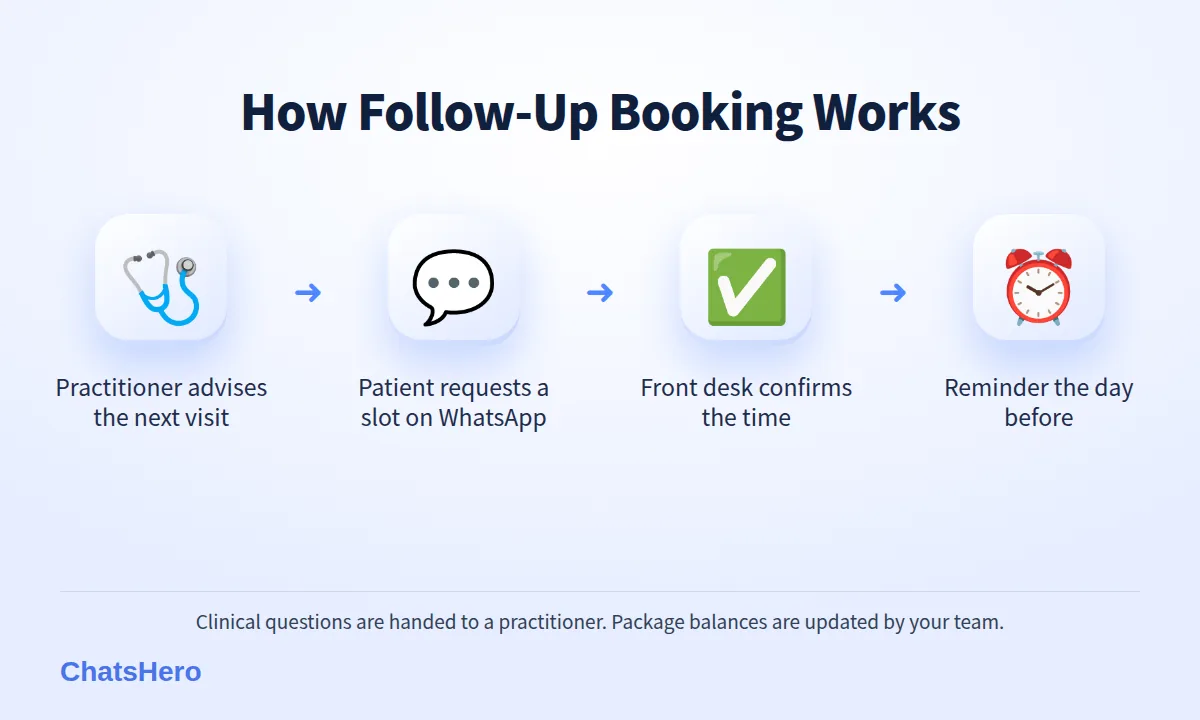
Notice what the AI does not do: it does not promise a slot it cannot see, and it does not decide whether the patient needs more sessions. It gathers the request so your front desk can confirm it in one step instead of five messages.
An example conversation
This illustrative chat shows a follow-up request, a practitioner preference, a clinical question handed to staff and a day-before reminder.
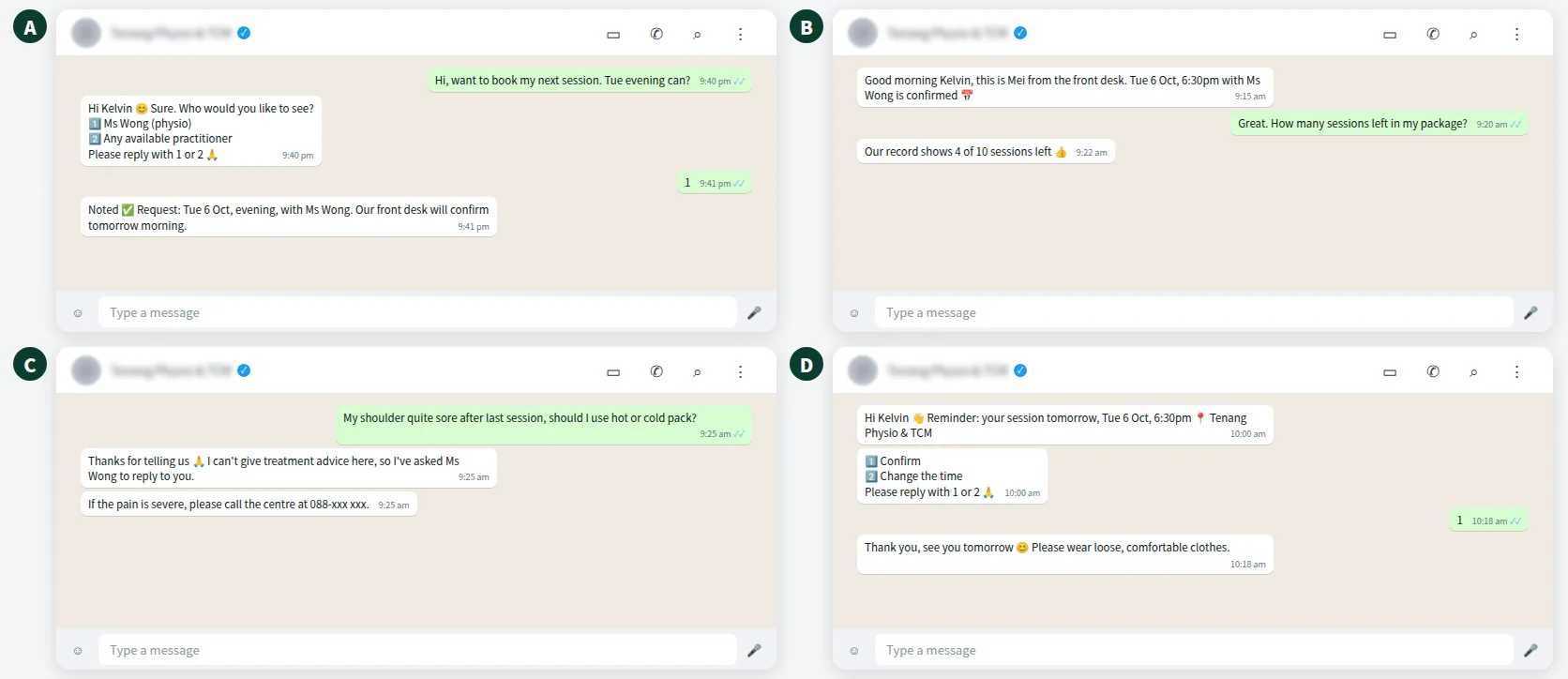
What can the booking bot answer, and what must a practitioner handle?
Train the assistant for admin work only. ChatsHero learns from what you give it in Plan and Build modes (your hours, branches, practitioners' working days, parking notes, what to wear, and your published price list) by text, screenshot or voice note, with no prompt writing.
- Booking deskRequests for a day, session and practitioner, recorded for the front desk to confirm.
- Visit logisticsHours, parking, what to wear for a session, how long a visit takes.
- Straight to a personPain after a session, new injuries, herbs and medicines, 'how many sessions do I need?'
For the third group, the bot should say it cannot give advice and that a team member will reply. ChatsHero sends a "Human Agent Needed" alert to your team's WhatsApp group so the practitioner or front desk can take over the chat. For anything urgent, the bot shares the centre's phone number and the guidance your practitioners wrote.
If your patients prefer Chinese, Bahasa Melayu or English, the assistant replies in all three and follows the patient's choice, even when they mix languages in one message.
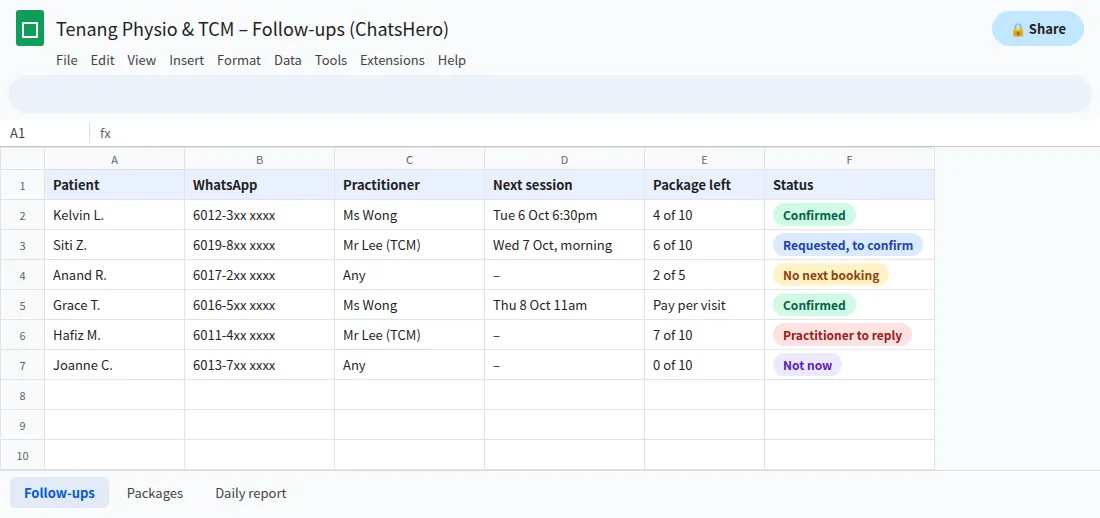
How do you track session packages and follow-ups in Google Sheets?
Prepaid packages (for example, 10 physiotherapy sessions or a course of acupuncture visits) are easy to lose track of when the balance lives on a paper card. Keep it in one place.
ChatsHero records booking requests and replies in Google Sheets. The package balance is recorded in the same sheet and updated by your team after each visit, or from the bot's record of each confirmed booking that your team checks. When a patient asks "how many sessions left?", the front desk answers from the sheet.
| Task | Paper card and personal phone | WhatsApp assistant + Google Sheets |
|---|---|---|
| Night-time booking request | Seen next morning, if not buried | Recorded at once, confirmed by the desk next morning |
| Practitioner preference | Remembered by one staff member | A column in the sheet everyone can see |
| Package balance | On a card the patient may lose | In the sheet, updated by your team |
| Missing follow-up | Noticed weeks later | Filter "no next booking" and message once |
| Daily overview | Flip through the diary | Daily report to the team's WhatsApp group |
What should a follow-up session reminder say?
Keep it to what the patient needs to turn up: name, centre, date, time and branch. Lock-screen previews are visible to anyone nearby, so leave out the condition, the body part being treated and the type of therapy.
Day-before reminder (example): "Hi Kelvin 👋 A reminder of your session tomorrow, Tue 6 Oct, 6:30pm at Tenang Physio & TCM. Reply 1 to confirm or 2 to change the time."
Missing follow-up nudge (example): "Hi Kelvin, this is Tenang Physio & TCM. Your practitioner suggested a follow-up visit around this week. Would you like us to arrange one? Reply 1 for yes or 2 for not now."
One nudge, then respect the answer. A patient who replies "not now" is marked in the sheet by your team and not chased again for that course.
What advertising rules apply to physio and TCM messages in Malaysia?
A booking reminder is not an advertisement, but broadcasts and auto-replies can drift into one. Health services advertising is regulated in Malaysia. The Medicines (Advertisement and Sale) Act 1956 covers advertisements for skills or services relating to the treatment of ailments and conditions, and practitioners fall under their own laws: TCM practitioners under the Traditional and Complementary Medicine Act 2016 (see the Ministry of Health's T&CM Division portal), and physiotherapists under the Allied Health Professions Act 2016.
For WhatsApp, that translates into a few simple house rules:
- No patient testimonials, reviews or "success stories" in broadcasts or bot replies.
- No outcome claims such as "cure back pain in 3 sessions" or "guaranteed pain-free".
- No pressure tactics on treatment: the practitioner advises, the patient decides.
- Stick to facts: services offered, hours, location, practitioners' working days and published prices.
Check your own council's and the Ministry of Health's current guidance before sending any promotional message. This article is general information, not legal advice.
Is patient data safe in a physio TCM booking WhatsApp setup?
It can be, with a few habits. Information about a person's physical or mental health is sensitive personal data under Malaysia's Personal Data Protection Act 2010, and processing it generally needs the patient's explicit consent.
- Ask at registration whether the patient agrees to booking messages and reminders on WhatsApp, and record the answer.
- Keep the sheet minimal: name, WhatsApp number, practitioner, package balance and booking status. Assessment notes stay in your clinical records.
- Limit sheet access to the staff who handle bookings.
- Stop when asked: your team marks the patient in the sheet and leaves them out of reminders and broadcasts.
If a patient sends a photo of a scan or a report in the chat, the bot should not comment on it; it hands the chat to a practitioner.
What does physio and TCM booking on WhatsApp cost?
Your ChatsHero plan covers the AI assistant, broadcasts and Google Sheets records; compare options on our pricing page. Meta's per-message fees are separate and billed to your centre's own WhatsApp account.
A reminder for a session the patient already booked is typically a utility template, an assumed RM0.06 in Malaysia. For example, 600 session reminders in a month × RM0.06 = RM36. A message promoting a new package is marketing, an assumed RM0.35 each, because Meta decides the category from the content. From 1 October 2026, eligible service replies above the monthly 1,000-message allowance per phone number inside the customer-service window are also charged per message using an illustrative utility-rate assumption (Meta pricing). Rates may change.
To start, pick one practitioner's patients for two weeks, run the routine above and review the sheet together. Read more about who we are or browse clinic guides on the ChatsHero blog.
Want to see how this looks with your own business? WhatsApp us and chat with the ChatsHero AI.
Frequently Asked Questions
How does physio and TCM booking on WhatsApp work?
Patients message your centre's WhatsApp number to request a session. An AI assistant asks for the preferred day, session and practitioner and records the request; your front desk confirms the time, and a reminder goes out the day before.
Can the WhatsApp bot tell a patient how many sessions they need?
No. The number of sessions is a clinical decision for the practitioner. The bot should hand that question, and any question about pain, injuries or herbs, to a staff member.
How do we track prepaid session packages?
Record each patient's package balance in Google Sheets. Your team updates it after each visit, or from the bot's record of confirmed bookings that your team checks.
What should a physio or TCM appointment reminder include?
Only the patient's name, your centre's name, the date, time and branch, and a simple way to confirm or change. Leave out the condition and type of treatment.
Can we share patient reviews in WhatsApp broadcasts?
Avoid it. Health services advertising is regulated in Malaysia, and testimonials or outcome claims are the kind of content to keep out. Check your council's and the Ministry of Health's current guidance.
How much do WhatsApp session reminders cost?
A reminder for a booked session is typically a utility message at an assumed RM0.06 in Malaysia, billed by Meta to your own WhatsApp account. Promotional messages are marketing, at an assumed RM0.35. Your ChatsHero plan is separate.