The phone instalment shop law 2026 picture in Malaysia has two parts. The Consumer Credit Act 2025 (in force 1 March 2026) requires credit providers such as BNPL and leasing companies to be licensed, with licensing from 1 June 2026 and a transition period. The Hire-Purchase (Amendment) Act 2026 (from 1 June 2026, provider grace period to 31 March 2027) replaces flat rates with the effective interest rate (EIR). Which rule hits your shop depends on how your plan is structured.
Examples show a proposed workflow, not a guarantee that every account or plan supports it. Ask our team to confirm the channel, integration, permissions and delivery method for your setup. Staff-group notifications and group assistants require separate eligibility and integration checks; a standard one-to-one WhatsApp API account should not be assumed to access every existing staff group. Use approved individual notifications or a staff dashboard if group delivery is unavailable. Test the workflow and human handover before use.
WhatsApp's Business Messaging Policy says not to share or request full personal ID numbers, financial account numbers or other sensitive identifiers. Use WhatsApp for a checklist and appointment, not for full MyKad, bank-statement or payslip uploads. Collect required documents through your authorised secure portal or in person, with a privacy notice, limited access and a documented retention period. Healthcare chats should remain administrative; do not request clinical records or diagnose through the bot.
- This is a general guide, not legal advice. Confirm your own scheme with a lawyer or the regulator.
- Consumer Credit Act 2025: in force 1 March 2026; BNPL, leasing and other non-bank credit providers need a licence from the Consumer Credit Commission (SKP), with licensing under Part V from 1 June 2026 and a transition period – confirm the end date with SKP.
- Hire-Purchase (Amendment) Act 2026: in force 1 June 2026, moving hire-purchase interest to the effective interest rate (EIR) and reducing balance method; BNM gives providers a grace period until 31 March 2027.
- The Hire-Purchase Act may apply to consumer goods such as phones sold on hire purchase – confirm with KPDN or your lawyer.
- Drop approval guarantees, “no payslip needed” promises and interest-free claims; say “subject to approval” and disclose the full cost.
- WhatsApp's Business Policy prohibits debt collection messaging – never automate arrears chasing on WhatsApp.
What changed in the phone instalment shop law in 2026?
We are not lawyers. This article summarises public information from regulators and news sources as of September 2026. It is not legal advice. Before changing your instalment scheme, speak to a lawyer or contact the regulator directly.
Monthly payment plans for phones come in many shapes. Two laws reshaped the rules around them in 2026:
| Date | What happened | Source |
|---|---|---|
| 31 Dec 2025 | Consumer Credit Act 2025 gazetted | SKP / MOF |
| 1 Mar 2026 | Consumer Credit Act 2025 in force; Consumer Credit Commission (SKP) established | SKP |
| 1 Jun 2026 | Licensing of credit providers and registration of credit service providers under Part V begins, with a transition period (confirm the end date with SKP) | MOF |
| 1 Jun 2026 | Hire-Purchase (Amendment) Act 2026 in force: EIR and reducing balance method | BNM / KPDN |
| 31 Mar 2027 | End of grace period for hire-purchase providers to upgrade systems for the reducing balance method | BNM |
According to the Consumer Credit Commission and the Ministry of Finance, credit providers such as BNPL companies, leasing companies and factoring companies must be licensed, while debt collection agencies and similar credit service providers must register.
Does the Hire-Purchase (Amendment) Act 2026 cover phones?
It may. The Hire-Purchase Act 1967 applies to goods listed in its First Schedule, which include consumer goods (goods bought for personal, family or household purposes) as well as motor vehicles. So the Act may apply to consumer goods such as phones sold on hire purchase – but whether your particular agreement is caught is a question to confirm with KPDN, which administers the Act, or with your lawyer.
If your plan is a hire-purchase agreement, the 2026 amendment matters because Bank Negara Malaysia's consumer guide describes the EIR and reducing balance method as applying to all types of hire-purchase financing – not only cars. The same guide lists maximum EIR caps (for fixed-rate financing, 17% a year for tenures up to five years).
- EIRInterest shown as an effective annual rate that includes fees and charges.
- Reducing balanceInterest is charged on the outstanding principal, so early settlement is fairer.
- E-signaturesCustomers may choose electronic agreements and documents, if both sides agree.
The amendment also added a due-diligence requirement to verify the hirer's identity, according to the Borneo Post's report of the minister's announcement.
Which law applies to my phone instalment scheme?
It depends on who gives the credit and how the agreement is written. This table is a starting point for a conversation with your lawyer, not a final answer:
| How your plan works | Likely framework | Who regulates | What to check |
|---|---|---|---|
| Customer pays with a bank credit card instalment plan | Banking rules | Bank Negara Malaysia | You are the merchant; the bank handles credit |
| You refer customers to a third-party BNPL provider | Consumer Credit Act 2025 | SKP | That the provider is licensed or within the transition |
| Your shop signs a hire-purchase agreement with the customer | Hire-Purchase Act 1967 (amended 2026) | KPDN | EIR, reducing balance, written agreement, identity checks |
| Leasing or rent-to-own scheme | Possibly Consumer Credit Act 2025 | SKP | Whether you need a licence – get advice |
| Your own informal “pay monthly” arrangement | Unclear – could fall under several laws | Get legal advice | Do not assume it is unregulated |
One detail to note: under the Consumer Credit Act's definition, a BNPL scheme involves a third-party credit provider, so credit extended directly by the seller may not be a “BNPL scheme” as defined – but that does not mean it is outside every law. If you are unsure, ask SKP or KPDN before you advertise.
The safest assumption: if customers pay you over time, some credit rule probably applies.
What is EIR, and how should a phone shop show it?
The effective interest rate is the true yearly cost of the credit, calculated on the reducing balance and including fees. It is usually higher than the old “flat rate” number, which is why the amended Act moves hire-purchase agreements to EIR. Here is an illustrative example:
| Example plan | Figure |
|---|---|
| Phone price | RM3,000 |
| Down payment | RM300 |
| Amount financed | RM2,700 |
| Monthly payment × 12 months | RM244 × 12 = RM2,928 |
| Total charges | RM228 |
| Old-style “flat rate” | ≈ 8.4% a year |
| Effective interest rate (EIR) | ≈ 16.3% a year |
Illustrative figures only: twelve end-of-month instalments, rounded effective annual compounding, with no other fees. Your provider or accountant must calculate the actual EIR for your agreements.
The same plan can look like “8.4%” or “16.3%” depending on the method. Customers deserve the honest number – and under the amended Act, in force since 1 June 2026, hire-purchase agreements move to EIR (providers have until 31 March 2027 to finish switching). When you quote a plan on WhatsApp or in store, show the price, down payment, monthly amount, number of months, total payable and EIR together.
What ad and WhatsApp copy should phone instalment shops stop using?
Some familiar phrases on posters and Facebook ads now carry real risk. They can be misleading under the Consumer Protection Act 1999, and they clash with the Consumer Credit Act's focus on fair disclosure and affordability checks.
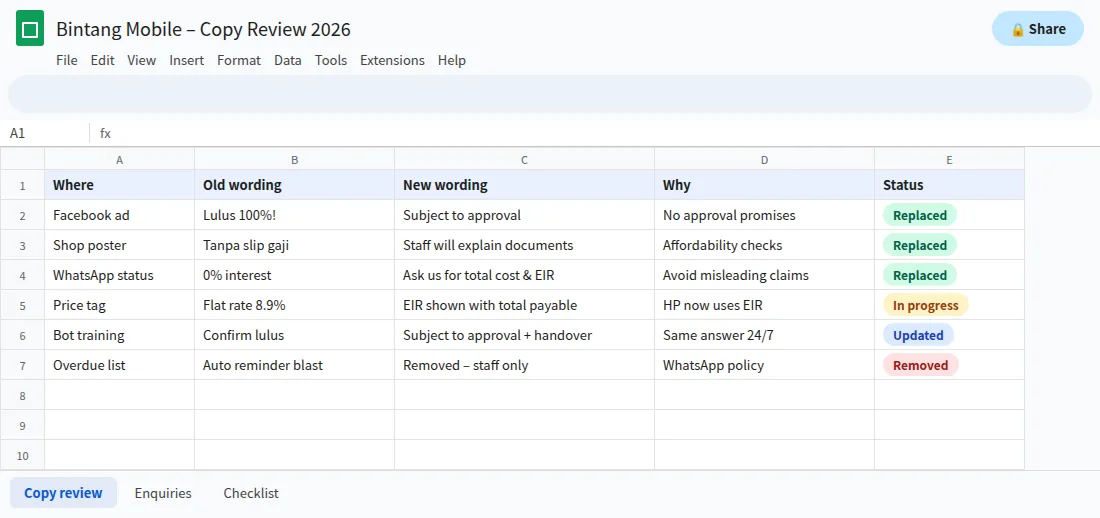
- “Lulus 100%” / “guaranteed approval” – approval must depend on an assessment. Say “subject to approval”.
- “Tanpa slip gaji” / “no documents needed” – credit providers are expected to check whether customers can afford to repay. Say “our staff will explain what is needed”.
- “0% interest” – unless it is genuinely free and your lawyer has confirmed the wording, avoid it. Show the EIR and total payable instead.
- “Flat rate only X%” – hire-purchase agreements now use EIR, so a flat-rate headline gives the wrong impression.
Train the ChatsHero AI to use your approved information and test its replies; AI can still make mistakes. If you remove these phrases from your training material, the bot should avoid them – and it will answer “can I get approval?” with “subject to approval” but staff should review and test its replies.
Can I use WhatsApp to chase customers who miss payments?
No automation for arrears – full stop. Meta's WhatsApp Business Policy lists debt collection among the financial services businesses may not message about, together with payday loans and peer-to-peer lending – regardless of local licences. Breaking this can get your number restricted.
Debt collection is also regulated in Malaysia: under the Consumer Credit Act 2025, debt collection agencies must register with SKP and follow conduct standards. So:
- Never set up automatic overdue reminders, “final notice” messages or blasts to customers in arrears.
- If a customer raises a payment problem in chat, the AI should hand over to a trained staff member immediately.
- Handle collections through proper, compliant channels – and get advice on what those are for your scheme.
Use WhatsApp to sell and to serve, not to collect. Product questions, store hours and appointments are fine. Arrears are not a chatbot job.
How should a phone shop handle IC, payslips and customer data?
Credit applications involve highly sensitive documents – IC, payslips, bank statements. Under Malaysia's Personal Data Protection Act 2010, as amended in 2024, you must collect only what you need, protect it and notify the Commissioner of data breaches.
- Do not ask for IC or payslip photos in a chatbot's first reply. Let trained staff handle the application.
- Keep documents in a secure, access-controlled system – not in personal phones or group chats.
- Tell customers why you need each document and who will see it.
- Delete documents you no longer need.
What is the phone instalment shop law 2026 checklist for owners?
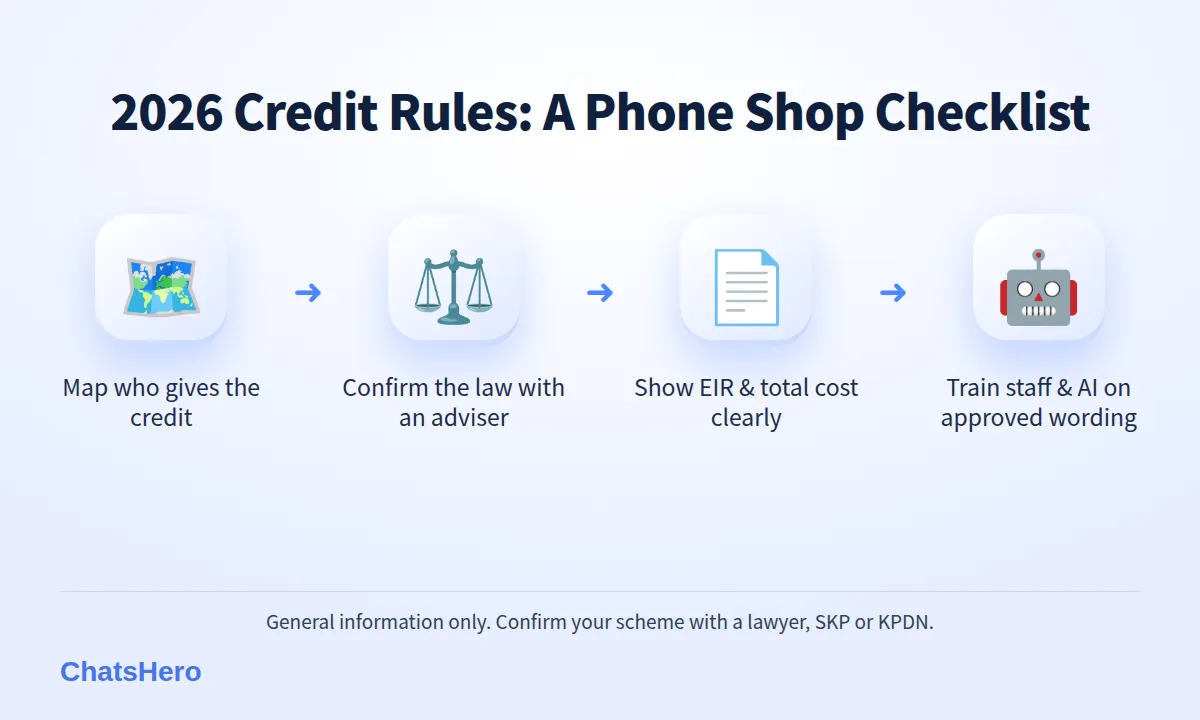
Map → Advise → Fix copy → Train staff and bot
- Map your scheme. Write down who gives the credit, who signs the agreement and who collects payments.
- Get advice. Ask a lawyer, SKP or KPDN which law applies and whether you or your partner needs a licence.
- Check your partners. If you refer customers to a BNPL or leasing provider, confirm they are licensed or within the transition.
- Fix your disclosure. Show price, down payment, monthly amount, tenure, total payable and EIR together.
- Rewrite your copy. Remove the risky phrases listed above from ads, posters, WhatsApp status and bot training.
- Set clear chatbot limits. The AI answers product and process questions and hands credit questions to staff; it never chases arrears.
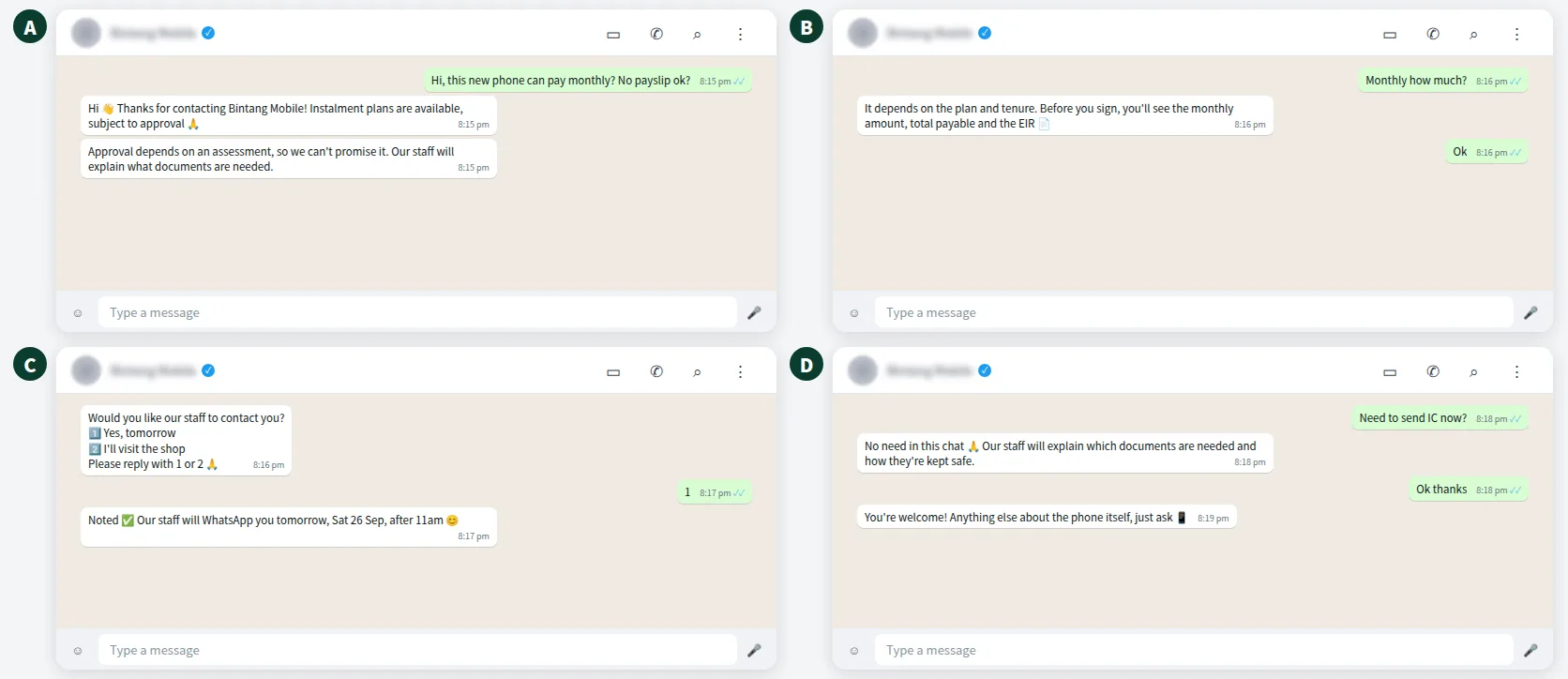
A WhatsApp AI can make this easier to follow day to day. Here is how a compliant enquiry can look:
How can WhatsApp AI help a phone shop stay compliant?
A risky reply is easy to type late at night, when a tired staff member wants to close a sale with an approval promise. An AI assistant trained on approved wording gives the same careful answer every time: instalment plans are available, subject to approval, and staff will explain the full cost and EIR before anything is signed.
With ChatsHero, each enquiry is recorded in Google Sheets (phone model, language, preferred callback time), and the chat is handed to a staff member with a “Human Agent Needed” alert in your team's WhatsApp group. The AI replies 24/7 in English, Bahasa Melayu and Chinese. Before you switch it on, show your approved script to your lawyer – then the bot repeats only what was checked. Plans and our team are a click away, and related compliance explainers are in the blog.
Want to see how this looks with your own business? WhatsApp us and chat with the ChatsHero AI.
Again: this guide is general information, not legal advice. Laws, regulations and transition dates can change – always confirm with SKP, KPDN or a qualified lawyer.
Frequently Asked Questions
What does the phone instalment shop law 2026 mean for my shop?
It depends on your scheme. If you sell phones on hire purchase, the Hire-Purchase (Amendment) Act 2026 (in force 1 June 2026, provider grace period to 31 March 2027) may apply and moves agreements to EIR and the reducing balance method. If you or your partner provide BNPL or leasing credit, the Consumer Credit Act 2025 licensing rules apply. Get legal advice for your structure.
When did the Consumer Credit Act 2025 come into force?
It came into force on 1 March 2026. Licensing of credit providers and registration of credit service providers under Part V started on 1 June 2026, with a transition period for existing businesses; confirm the exact end date with SKP.
Does the Hire-Purchase Act apply to phones?
It may apply to consumer goods such as phones sold on hire purchase, since the Act's First Schedule includes consumer goods bought for personal, family or household use. Confirm your specific agreement with KPDN or your lawyer.
Can I still advertise interest-free or guaranteed-approval offers?
We recommend not to. Approval promises and unclear interest claims can be misleading. Use “subject to approval” and show the total payable and EIR instead.
Can I send WhatsApp reminders to customers who are behind on payments?
Do not automate it. WhatsApp's Business Policy prohibits debt collection messaging, and debt collection is regulated under the Consumer Credit Act 2025. Handle arrears through trained staff and compliant channels.
Is this article legal advice?
No. ChatsHero is a WhatsApp software company, not a law firm. This is general information based on public sources; please confirm with a lawyer, SKP or KPDN.