An omnichannel chatbot in Malaysia is one AI assistant that answers customer messages on Facebook, Instagram, TikTok, Telegram and WhatsApp with the same knowledge, prices and tone. You train it once, connect the channels you use, and every enquiry gets a fast reply in English, BM or Chinese, while serious buyers are passed to your team and recorded in Google Sheets.
RM0.35 and RM0.06 in this article and its supplied illustrations are planning assumptions, not verified current Meta quotations. Gupshup's October announcement describes 1,000 free service replies per business phone number per month, then eligible service charges from 1 October 2026. Utility templates do not use that allowance. Inbound messages and qualifying 72-hour free entry point messages remain exempt. Confirm the recipient market, applicable rate card, free allowance and provider fees before budgeting. Figures below exclude tax and any unlisted costs.
Examples show a proposed workflow, not a guarantee that every account or plan supports it. Ask our team to confirm the channel, integration, permissions and delivery method for your setup. Staff-group notifications and group assistants require separate eligibility and integration checks; a standard one-to-one WhatsApp API account should not be assumed to access every existing staff group. Use approved individual notifications or a staff dashboard if group delivery is unavailable. Test the workflow and human handover before use.
- Customers message you on whichever app they found you on; an omnichannel chatbot answers all of them with one set of facts.
- Train the AI once (price list, FAQ, policies) instead of maintaining separate auto-replies for each app.
- Keep simple questions on the original channel; move bookings, payments and after-sales to WhatsApp where records are easier.
- Each platform has its own reply-time rules, such as Messenger's 24-hour standard messaging window, so fast replies matter everywhere.
- Record every lead in one Google Sheet with a Channel column, so you can see which platform brings real customers.
- Meta's per-message fees apply to the WhatsApp Business Platform; your ChatsHero plan is separate.
What is an omnichannel chatbot, and why do Malaysian SMEs need one?
Your customers don't choose a channel for you. They message wherever they found you.
A customer sees your TikTok video and comments "how much?". Another sends an Instagram DM after a Story. A regular WhatsApps you directly, and someone else clicks "Send message" on your Facebook Page. Four channels, one question: the price.
An omnichannel chatbot is a single AI assistant connected to all of those channels. It uses one set of knowledge (your products, prices, policies and tone) and replies wherever the question arrives. The alternative, which many small teams live with, is one person switching between four apps and copy-pasting the same answer into each.
The audiences are big on every platform. DataReportal's Digital 2026 Malaysia report lists ad reach in late 2025 of 23.0 million on Facebook, 16.1 million on Instagram, 9.6 million on Messenger and 30.7 million adults on TikTok, based on each platform's advertising tools. An omnichannel chatbot for Malaysia simply makes sure none of those audiences waits for an answer.
Which channels can one omnichannel chatbot in Malaysia cover?
ChatsHero runs on the official WhatsApp Business API and also connects Facebook, Instagram, TikTok and Telegram. Each channel tends to bring a different kind of conversation:
| Channel | Typical conversation | Worth knowing |
|---|---|---|
| Bookings, orders, payment details, after-sales | Meta charges per message on the Business Platform, billed to your WhatsApp account | |
| Facebook Messenger | Page enquiries, older customers, ad replies | Standard 24-hour window to respond |
| Instagram DM | Questions after Reels and Stories, product photos | Visual shoppers; often ask for price and stock |
| TikTok | Quick "how much?" and "still available?" questions | Short attention span; reply fast and keep it brief |
| Telegram | Community groups, repeat customers, some B2B | Handy for customers who prefer it over WhatsApp |
You don't have to connect everything on day one. Start with the two channels where most of your enquiries already arrive, then add the rest.
How does one chatbot work across Facebook, Instagram, TikTok and WhatsApp?
The setup is closer to briefing a new staff member than to programming:
- Train the AI once. In ChatsHero's Plan and Build modes you paste your price list, FAQ and policies, or share screenshots and voice notes, and the AI builds the assistant. No prompt writing.
- Connect your channels. Link your WhatsApp Business API number, Facebook Page, Instagram account, TikTok and Telegram as needed.
- Set the questions to ask. For example: product, date, delivery area and budget.
- Set handover rules. Complaints, custom orders and anything the AI shouldn't decide go to a person, with a "Human Agent Needed" alert in your team's WhatsApp group.
- Record and report. Leads are written to Google Sheets, and a daily or weekly report goes to your WhatsApp group.
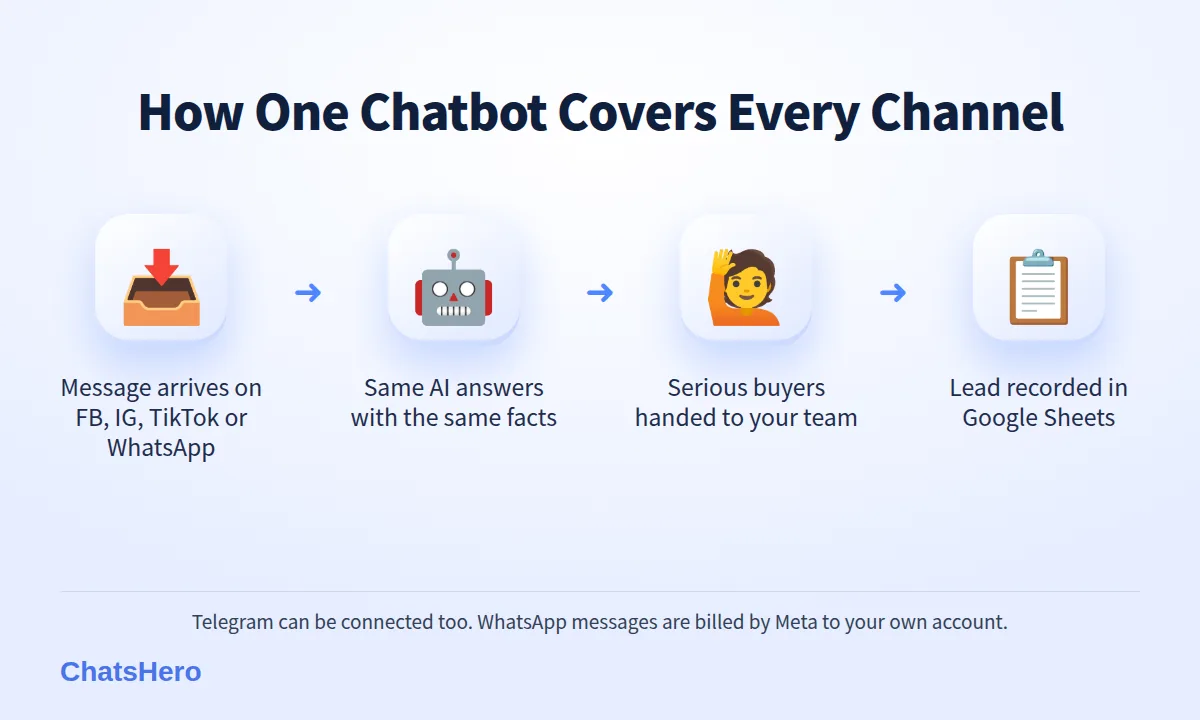
Because every channel uses the same knowledge, a price change is made once. There is no risk of Instagram quoting last month's price while WhatsApp quotes this month's.
Should every chat move to WhatsApp, or stay where it started?
Both, depending on the stage. Quick questions are best answered where they were asked; forcing someone to switch apps just to learn a price loses people. But once a customer is ready to book, order or pay, WhatsApp is usually the better home: it is where Malaysians share addresses, receipts and location pins, and where your reminders and after-sales follow-ups will reach them.
Answer on the original channel; confirm on WhatsApp. Price, stock and delivery area can be answered in a DM. Orders, deposits and delivery details move to WhatsApp, with the customer's agreement.
Timing rules also differ by platform. Meta's Messenger Platform policy gives businesses up to 24 hours to respond to a user under standard messaging, with a Human Agent tag allowing manual replies within 7 days. Instagram, TikTok and Telegram set their own rules, so check each platform's current policy. A chatbot that replies within seconds makes most of those windows irrelevant.
What does an omnichannel conversation look like in practice?
Here is an illustrative example for a fictional Kota Kinabalu florist, Bloom & Bough. The customer first asked about a bouquet on TikTok, got a quick answer there, then moved to WhatsApp to place the order.
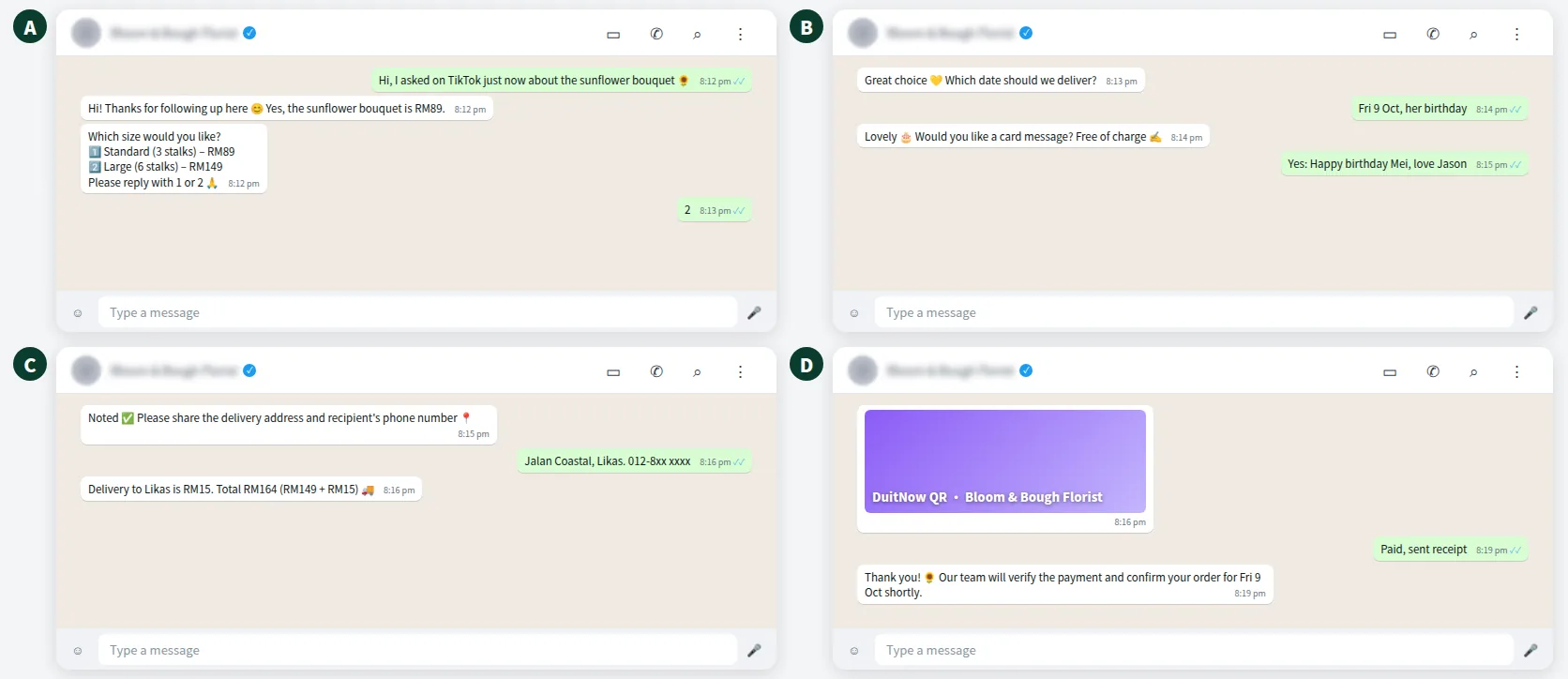
Because the customer mentions the TikTok chat and the bouquet, the AI picks up from the same item and price, using the same knowledge it used on TikTok. Payment is checked by the team, not by the bot, and the order lands in Google Sheets for the florist to prepare.
Same answers in three languages
Omnichannel also means multilingual in Malaysia. The same customer may write "Ada bunga matahari?" on Instagram and "sunflower one how much ah" on WhatsApp. ChatsHero replies in English, Bahasa Melayu and Chinese, and copes with mixed-language messages; our guide on how AI chatbots understand Bahasa Rojak explains how.
How do you keep answers consistent on every channel?
Consistency is the main reason to use one omnichannel chatbot rather than five separate auto-replies. Three habits keep it that way:
- One price listUpdate prices and promos in one place, not per app.
- One tone of voiceFriendly and short everywhere, adjusted for TikTok's quick questions.
- One escalation pathEvery channel hands over to the same team alert.
Review the conversations each week. If customers on one platform keep asking something the AI can't answer well, add it to the training once, and every channel improves at the same time.
Want to see how this looks with your own business? WhatsApp us and chat with the ChatsHero AI.
How do you track leads from every channel in one place?
Scattered chats mean scattered data. With ChatsHero, the details the AI collects are recorded in Google Sheets. Add a Channel column and you can see, in one list, where each lead came from and what happened next. Your team updates the status when an order is paid or delivered.
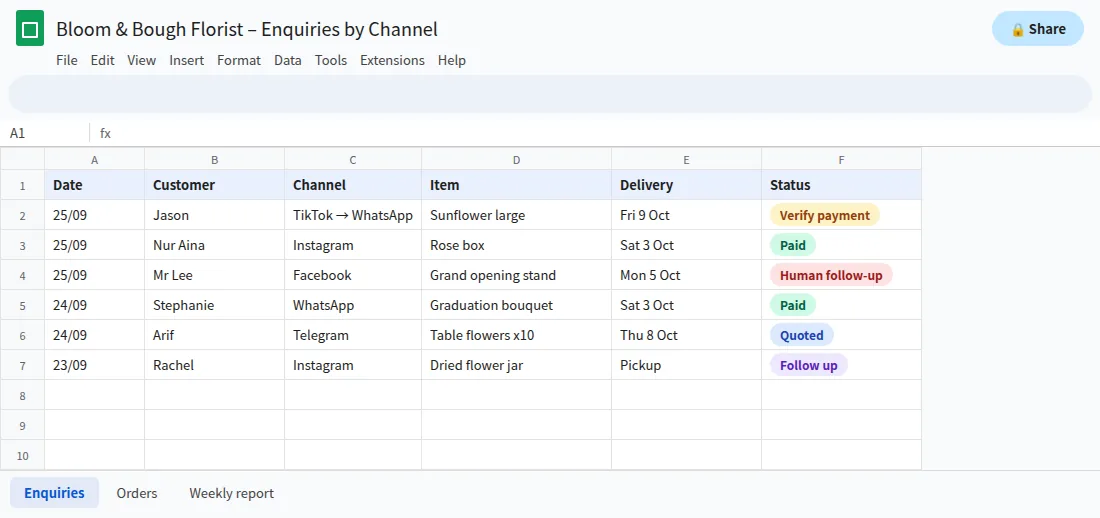
After a month, the sheet answers questions that are otherwise guesswork: does TikTok bring many enquiries but few orders? Do Instagram customers spend more? Is Facebook mostly existing customers? That tells you where to put your content and ad budget next.
Omnichannel chatbot vs manual replies: what changes?
| Manual replies in each app | Separate auto-replies per app | One omnichannel chatbot | |
|---|---|---|---|
| Reply speed at night | Next morning | Instant, but generic | Instant, specific answers |
| Price updates | Remember to tell everyone | Edit each app | Update once |
| Languages | Depends on who is on duty | Usually one | EN, BM and Chinese |
| Lead records | Scattered in phones | Scattered in apps | One Google Sheet |
| Handover to staff | Always manual | Rarely | Alert in your WhatsApp group |
A chatbot does not replace your team; it handles the repeated questions so staff can spend their time on custom orders, complaints and closing sales.
What does an omnichannel chatbot cost in Malaysia?
There are two parts. First, the ChatsHero plan: Starter is RM350 a month (billed annually) and Growth is RM650 a month (billed annually), with unlimited bots on Growth, which suits businesses running several channels or brands. The done-for-you WE-DO plan has our team build it with you. See the full comparison on the pricing page.
Second, Meta's WhatsApp fees, which apply to the WhatsApp Business Platform and are billed to your own WhatsApp account. From 1 October 2026, replies inside WhatsApp's 24-hour customer service window are charged per message using an illustrative utility-rate assumption (≈ RM0.06 in Malaysia), according to Meta's pricing documentation and this summary of the change. As an illustration, 300 WhatsApp replies a day for 30 days is 9,000 messages × RM0.06 = RM540 a month. Answering simple questions on the channel where they were asked, and moving only real orders to WhatsApp, keeps that number sensible.
Want to know more about the team behind the product? Read about ChatsHero.
Frequently Asked Questions
What is an omnichannel chatbot in Malaysia?
It is one AI assistant that answers customer messages across several channels, such as Facebook, Instagram, TikTok, Telegram and WhatsApp, using the same knowledge, prices and tone, and in English, Bahasa Melayu and Chinese.
Which channels does ChatsHero support?
ChatsHero runs on the official WhatsApp Business API and also supports Facebook, Instagram, TikTok and Telegram.
Do I need to train a separate bot for each channel?
No. You train the AI once with your price list, FAQ and policies, and the same knowledge is used on the channels you connect. Updating a price is done once.
Should I move all customers from Instagram and TikTok to WhatsApp?
Not for simple questions. Answer price and stock questions where they are asked, and move customers to WhatsApp when they are ready to order, book or pay, with their agreement.
Are Facebook and Instagram messages charged like WhatsApp?
Meta's per-message pricing described here applies to the WhatsApp Business Platform, billed to your own WhatsApp account. Messenger has its own rules, such as a 24-hour standard messaging window. Your ChatsHero plan is a separate fixed monthly fee.
Can the chatbot hand a conversation to my staff?
Yes. When a customer needs a person, for example a complaint or custom order, ChatsHero sends a Human Agent Needed alert to your team's WhatsApp group so someone can take over.