For most small businesses, the MyInvois e-invoice question in 2026 is simple: if your annual turnover is below RM3 million, you are exempt from mandatory e-Invoicing from 1 September 2026, subject to LHDN's conditions. SMEs above it are in Phase 4, with a relaxation period until 31 December 2027. WhatsApp can collect buyer details; your accounting software handles the submission.
Examples show a proposed workflow, not a guarantee that every account or plan supports it. Ask our team to confirm the channel, integration, permissions and delivery method for your setup. Staff-group notifications and group assistants require separate eligibility and integration checks; a standard one-to-one WhatsApp API account should not be assumed to access every existing staff group. Use approved individual notifications or a staff dashboard if group delivery is unavailable. Test the workflow and human handover before use.
WhatsApp's Business Messaging Policy says not to share or request full personal ID numbers, financial account numbers or other sensitive identifiers. Use WhatsApp for a checklist and appointment, not for full MyKad, bank-statement or payslip uploads. Collect required documents through your authorised secure portal or in person, with a privacy notice, limited access and a documented retention period. Healthcare chats should remain administrative; do not request clinical records or diagnose through the bot.
- From 1 September 2026, businesses with annual turnover below RM3 million are exempt from mandatory e-Invoicing (previously RM1 million).
- The exemption has conditions: links to a related company, holding company or corporate shareholder with RM3 million or more in revenue can remove it.
- Phase 4 SMEs have a relaxation period until 31 December 2027, including monthly consolidated e-Invoices.
- Exempt businesses may still join voluntarily, for example if big customers ask for e-Invoices.
- WhatsApp can collect buyer details (TIN, BRN, email) and create sales invoices, but ChatsHero does not submit to MyInvois.
- Your accounting software handles MyInvois submission if it supports it; check with your vendor and tax agent.
Which SMEs must use MyInvois e-Invoice in 2026?
LHDN (HASiL) rolled out e-Invoicing in phases by annual turnover or revenue, starting with the largest companies. For SMEs, the phase that matters is Phase 4.
| Phase | Annual turnover or revenue | Mandatory from |
|---|---|---|
| Phase 1 | Above RM100 million | 1 August 2024 |
| Phase 2 | RM25 million to RM100 million | 1 January 2025 |
| Phase 3 | RM5 million to RM25 million | 1 July 2025 |
| Phase 4 | Up to RM5 million, above the exemption threshold | 1 January 2026 |
| Exempt | Below RM3 million (from 1 September 2026) | Not required; voluntary |
The big change came on 30 August 2026. In the National Day address, the Prime Minister announced that the exemption threshold would rise from RM1 million to RM3 million, effective 1 September 2026. LHDN's media statement says more than 1.1 million businesses benefit. According to The Star, about 265,379 taxpayers had submitted more than 1.84 billion e-Invoices since August 2024.
In practice, Phase 4 now covers businesses with RM3 million to RM5 million in turnover.
Is your SME exempt under the RM3 million e-Invoice threshold?
Start with your annual turnover or revenue. If it is below RM3 million, LHDN's e-Invoice FAQ (updated 4 September 2026) says taxpayers who meet the exemption criteria are exempt from implementing e-Invoice, including the self-billed e-Invoice requirements.
But turnover is not the only test. As BDO's summary of the guidelines explains, the exemption does not apply if your business has a non-individual shareholder, holding company, related company or joint venture partner with annual turnover or revenue of RM3 million or more. A small subsidiary of a larger group may still have to comply.
Two fictional examples:
- A family sundry shop in Seremban with about RM1.8 million a year and no corporate links: exempt from 1 September 2026. It can still join voluntarily.
- Rimba Hardware in Kuching, a trading company with about RM4.2 million a year: in Phase 4, and within the relaxation period until 31 December 2027.
Check with your tax agent. If you started e-Invoicing under the old RM1 million threshold, confirm your position before you stop, and keep issuing to customers who still need e-Invoices for their records.
What does the Phase 4 relaxation period until 31 December 2027 mean?
Phase 4 became mandatory on 1 January 2026, but LHDN gave these businesses an interim relaxation period. In April 2026 it was extended by a year to 31 December 2027, with the e-Invoice Specific Guideline version 4.7, as VATupdate reported. The legal start date did not move; the extension gives SMEs more time before full enforcement.
During the relaxation period, Phase 4 businesses can keep using monthly consolidated e-Invoices and are not penalised for non-compliance as long as basic requirements are met. The FAQ also sets the timing rule for consolidated e-Invoices: they must be issued within 7 calendar days after month end.
- Buyers who ask for an e-Invoice (typically businesses claiming the expense) should get an individual one.
- Everyone else can go into the monthly consolidated e-Invoice, except for activities LHDN excludes in the Specific Guideline.
- Use the time well: clean your customer records, choose your software route and test before 2028.
Where does WhatsApp fit into your MyInvois e-invoice process?
WhatsApp doesn't replace MyInvois. It gets the right data to your accounts team faster.
To be clear about roles: ChatsHero does not submit e-Invoices to LHDN. It passes invoice data to your accounting software (AutoCount, SQL Account or Bukku), and your accounting software handles MyInvois submission if it supports it. Where WhatsApp helps is everything before that:
- Collect buyer detailsWhen a customer asks for an e-Invoice, the AI asks for TIN, BRN or MyKad, address and email, and records them in Google Sheets.
- Invoice from one lineSalespeople turn one WhatsApp message into a sales invoice in your accounting software, the same day.
- Answer the FAQ"Can I get an e-Invoice?" and "How long does it take?" are answered 24/7 in English, BM and Chinese.
Setup depends on your accounting software, so ask us what applies to your version before you plan around it. Plans are listed on our pricing page.
How does a WhatsApp e-Invoice request work, step by step?
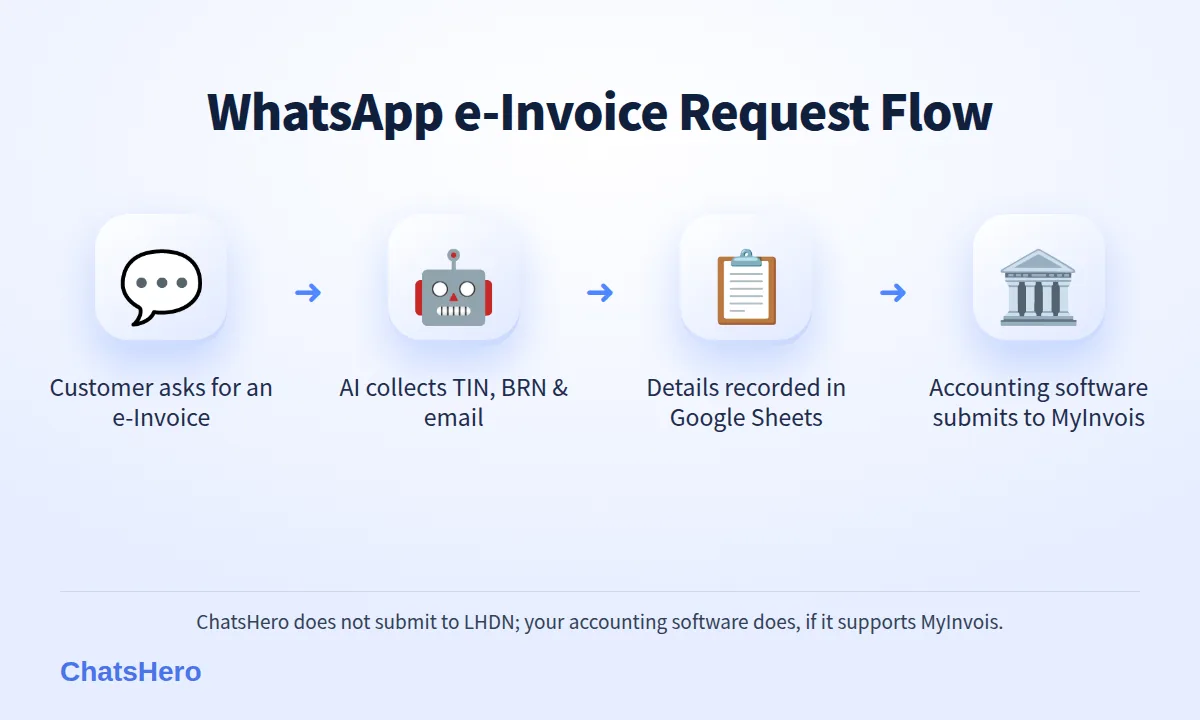
Here is how a Phase 4 business can handle e-Invoice requests from walk-in or WhatsApp customers without a phone call:
- Customer asks on WhatsApp. "Can I get an e-Invoice for my purchase?"
- AI asks company or individual. The details needed are different, so it offers two options.
- AI collects the details. Name, TIN, BRN or MyKad number, SST number if any, billing address, email and receipt number.
- AI confirms before saving. The customer checks the summary and replies 1 if it is correct.
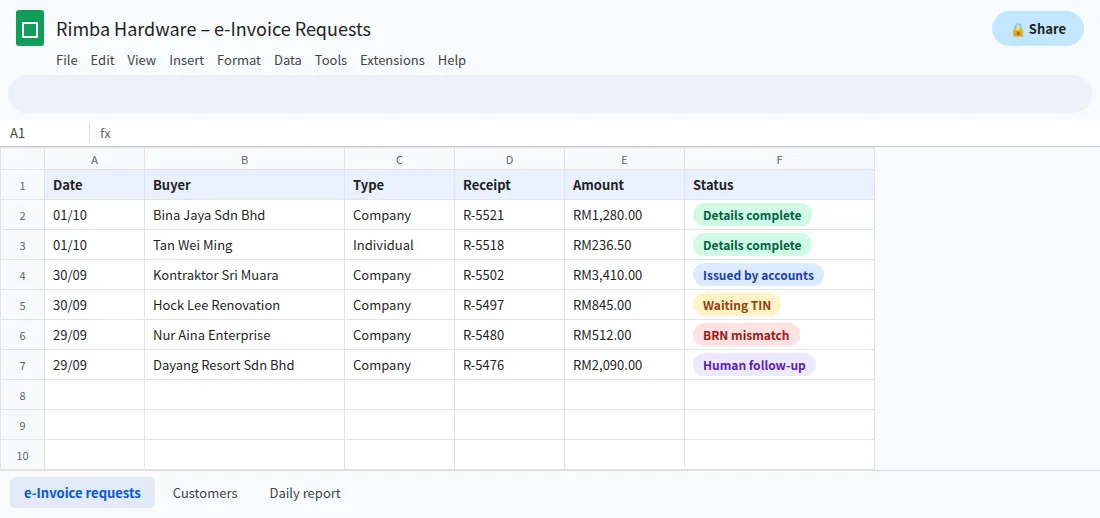
- Details are recorded in Google Sheets. Your accounts team issues the e-Invoice through your accounting software, which submits it to MyInvois if supported.
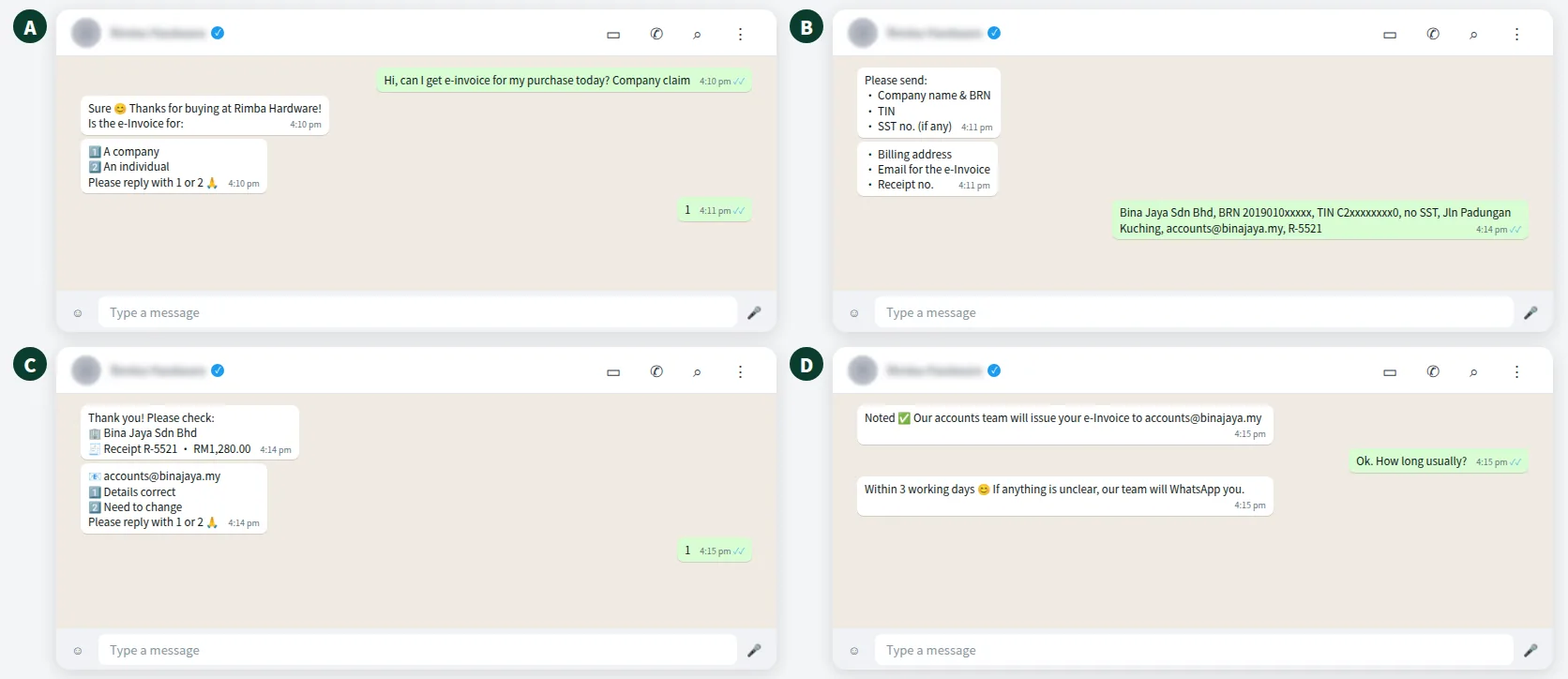
Below is an illustrative conversation for the fictional Rimba Hardware. The shop's own policy says e-Invoices are issued within 3 working days; set yours to match what your accounts team can actually do.
What buyer details does an e-Invoice need, and how do you keep them safe?
An e-Invoice carries more buyer information than a normal receipt. For a business buyer, you typically need the registered name, Tax Identification Number (TIN), business registration number, SST registration number if any, address, email and contact number. Individual buyers who request one give their name and identification details instead.
Use an authorised secure portal or an in-person check for required identity, bank or health documents. WhatsApp should provide the checklist and instructions, not request full identifiers or confidential records. Give a privacy notice, restrict access and delete data according to your lawful retention schedule.
- Ask only for what the e-Invoice needs, and only when the customer requests one.
- Limit who can open the Google Sheet; the accounts team, not the whole company.
- Don't post buyer details into staff WhatsApp groups.
- Once the e-Invoice is issued, your accounting software is the record; decide how long the sheet keeps the request details.
MyInvois Portal or accounting software: which route suits a small business?
LHDN offers the MyInvois Portal for businesses that issue e-Invoices directly, and accounting software can connect to MyInvois through its API. Which route fits depends on your volume:
| MyInvois Portal | Accounting software | |
|---|---|---|
| Best for | Low volume, occasional e-Invoices | Daily invoicing, many customers |
| How invoices are entered | Keyed in on LHDN's portal | Created in your system, then submitted if supported |
| Double entry risk | Higher: invoice in your system and again on the portal | Lower: one record |
| Where WhatsApp helps | Collecting buyer details | Collecting details and creating invoices from one message |
If you are exempt and only a few customers ask, the portal or a voluntary setup may be enough. If you are in Phase 4 and invoice daily, the software route saves the most time. Confirm MyInvois support with your software vendor.
What should an SME do about MyInvois e-invoice before 2028?
- Confirm your turnover band for the relevant year, and check group or shareholder links with your tax agent.
- If exempt: decide whether to join voluntarily, for example if large customers keep asking for e-Invoices.
- If in Phase 4: use the relaxation period until 31 December 2027 to choose your route (portal or software) and test it.
- Clean customer records: collect TINs and registration numbers for regular business customers now.
- Set up how requests come in: a WhatsApp flow that collects buyer details stops the back-and-forth.
- Keep watching LHDN updates: the rules changed several times in 2025 and 2026 and may change again.
Want to see how this looks with your own business? WhatsApp us and chat with the ChatsHero AI.
Want to know who we are? Read about ChatsHero, or browse more company-wide guides on the ChatsHero blog. This article is general information, not tax advice.
Frequently Asked Questions
Does my SME need a MyInvois e-Invoice in 2026?
If your annual turnover or revenue is below RM3 million, you are exempt from mandatory e-Invoicing from 1 September 2026, provided you meet LHDN's conditions, such as having no related company, holding company or corporate shareholder with RM3 million or more in revenue. Businesses above that are in Phase 4.
What is the e-Invoice exemption threshold now?
RM3 million in annual turnover or revenue, effective 1 September 2026. It was previously RM1 million. The change was announced on 30 August 2026.
When does the Phase 4 relaxation period end?
31 December 2027. During the relaxation period, Phase 4 businesses can use monthly consolidated e-Invoices and are not penalised as long as basic requirements are met. Consolidated e-Invoices must be issued within 7 calendar days after month end.
Can an exempt business still issue e-Invoices?
Yes. The Government encourages voluntary participation. Some exempt SMEs join because large business customers prefer e-Invoices.
Does ChatsHero submit e-Invoices to MyInvois?
No. ChatsHero collects buyer details and can pass invoice data to your accounting software, such as AutoCount, SQL Account or Bukku. Your accounting software handles MyInvois submission if it supports it.
Is it safe to collect TIN and IC numbers over WhatsApp?
It can be, if you collect only what the e-Invoice needs, record it in a Google Sheet with limited access, and never share it in staff groups, in line with Malaysia's Personal Data Protection Act.
Sources
- LHDN (HASiL) media statement: e-Invoice exemption threshold raised to RM3 million (30 Aug 2026, Malay)
- LHDN: Implementation of e-Invoice in Malaysia – FAQs (updated 4 Sep 2026)
- The Star: Over 1.1 million businesses to benefit from higher e-invoicing threshold (30 Aug 2026)
- BDO Malaysia: Guide to e-Invoicing in Malaysia