A lash refill reminder works best when it arrives just before the customer notices gaps: lash refills are typically every 2–3 weeks, and a gel manicure usually lasts around two weeks. Send one friendly WhatsApp message near day 14, ask which day suits her, and log the answer. Booking the next visit before she leaves is even better — the reminder then is illustrated here at RM0.06 instead of a marketing rate.
RM0.35 and RM0.06 in this article and its supplied illustrations are planning assumptions, not verified current Meta quotations. Gupshup's October announcement describes 1,000 free service replies per business phone number per month, then eligible service charges from 1 October 2026. Utility templates do not use that allowance. Inbound messages and qualifying 72-hour free entry point messages remain exempt. Confirm the recipient market, applicable rate card, free allowance and provider fees before budgeting. Figures below exclude tax and any unlisted costs.
Examples show a proposed workflow, not a guarantee that every account or plan supports it. Ask our team to confirm the channel, integration, permissions and delivery method for your setup. Staff-group notifications and group assistants require separate eligibility and integration checks; a standard one-to-one WhatsApp API account should not be assumed to access every existing staff group. Use approved individual notifications or a staff dashboard if group delivery is unavailable. Test the workflow and human handover before use.
- Lash refills are typically every 2–3 weeks, and a gel manicure usually lasts around two weeks — time reminders to your own service, not a random blast day.
- The best refill reminder is a booked appointment: rebook at the counter, then remind the day before.
- For customers who did not rebook, send one nudge around day 12–14 and at most one follow-up.
- A reminder for an appointment already booked is usually a utility message (an assumed RM0.06 in Malaysia); an unbooked 'time to refill?' nudge is often charged as marketing (an assumed RM0.35).
- Get opt-in, let customers pause or stop, and record every answer in Google Sheets.
- Treat the numbers here as examples — track your own rebooking rate for a month before judging.
Why does a lash refill reminder bring customers back?
A regular does not have to be unhappy to drift away. Sometimes life just gets busy and the next refill slips.
Lash extensions and gel nails are repeat services by nature. Extensions fall out as natural lashes shed, and gel starts lifting or growing out. When the customer finally notices, your favourite slots may be gone — or a new studio's ad appears first.
A lash refill reminder solves a timing problem, not a loyalty problem. It reaches the customer at the moment she would book anyway, with a one-tap way to do it. For a small studio whose customers already chat with it on WhatsApp, that message is one of the cheapest retention tools available.
The same routine works for gel nail refills, so this guide treats them together. Kiko Nail & Lash, a fictional two-person studio in Johor Bahru, is our running example.
How often do lash and gel customers typically need a refill?
Timing matters more than wording. Here are typical ranges you can use as a starting point, then adjust to your own customers:
| Service | Typical interval | Source / note | Suggested first reminder |
|---|---|---|---|
| Lash extension refill | Every 2–3 weeks | EyeWiki (American Academy of Ophthalmology, US) | Around day 12–14 |
| Gel manicure | Lasts around two weeks | TIME (US magazine, quoting dermatologists) | Around day 12–14 |
| Other services (gel pedicure, lash lift) | Set from your own records | Check your past rebooking dates | Your choice |
These are typical ranges, not rules. Some customers prefer a longer gap or a break between sets, so every reminder should include a “not now” option. The US-based American Academy of Ophthalmology also notes extensions typically last three to four weeks before falling off with the natural lash (AAO), which is why refills are booked before that point.
When should you send a lash refill reminder on WhatsApp?
Use one simple timeline for every lash and gel customer. It keeps the number of messages low and the timing right.
- Day 0 – at the counter. Offer to book the next refill now, while she is still in the chair. Ask if they are happy to receive reminders on WhatsApp.
- Day 0 – after the visit. Send a short thank-you with your general aftercare notes and the booked date, if any.
- Day before a booked refill. A reminder with “1 Confirm / 2 Reschedule”.
- Day 12–14 – no booking yet. One friendly lash refill reminder asking which day suits her; your team confirms the exact time.
- Day 18–20 – still no reply. One last, softer nudge. Then stop and move her to your win-back list.
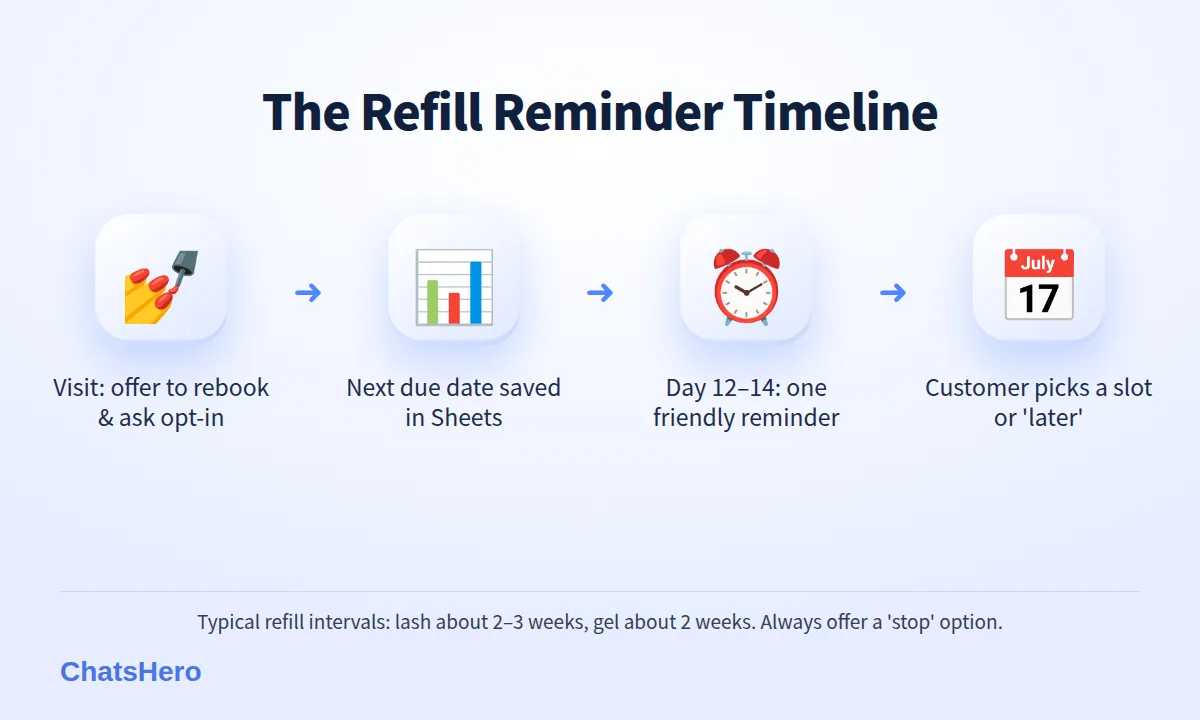
Two messages is the ceiling for an unbooked customer. More than that feels like chasing, and customers who block or report you lower your number's quality rating.
Rebook at the counter or remind later: which works better?
If you can only do one thing, rebook at the counter. A booked slot is a firm plan, and the day-before reminder is a service message, not a promotion.
| Rebook at the counter + reminder | Nudge later (no booking yet) | |
|---|---|---|
| Customer commitment | High — date already chosen | Medium — still deciding |
| Typical Meta category | Utility (an assumed RM0.06) | Often marketing (an assumed RM0.35) |
| Messages needed | 1 reminder | 1–2 nudges |
| Best for | Regulars with a routine | Customers who were unsure of their schedule |
Meta classifies messages by content, so a “time for your refill?” message with no appointment behind it is usually treated as marketing, and any reminder that includes a discount certainly is. Check Meta's pricing page for current rates. From 1 October 2026, eligible service replies above the monthly 1,000-message allowance per phone number inside the customer-service window are also charged per message, using an illustrative utility-rate assumption (summary of the change). These fees go to your own WhatsApp Business account, separate from your ChatsHero plan.
What does a refill reminder conversation look like?
Here is an illustrative lash refill reminder from Kiko Nail & Lash. The customer, Sharon, had a hybrid refill on Saturday 19 September and did not rebook at the counter.
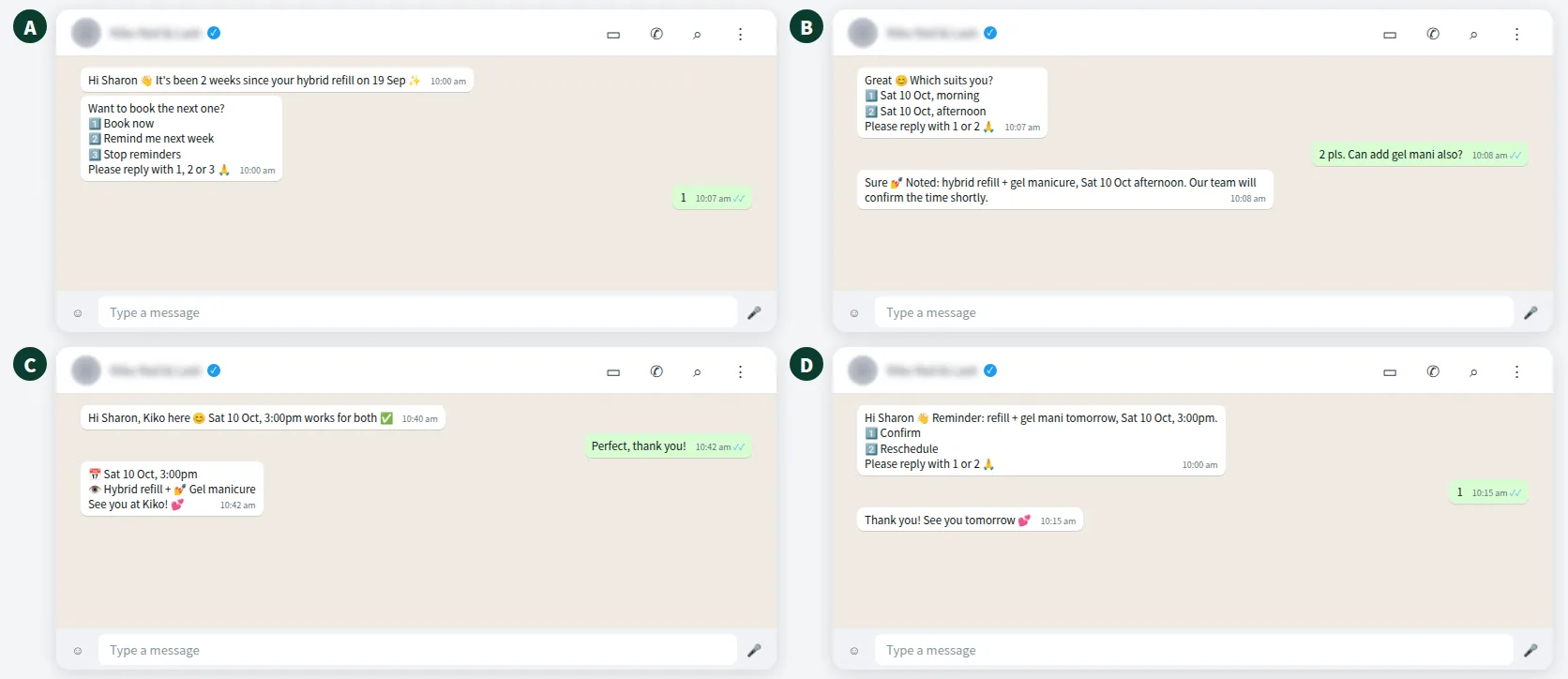
The AI does three useful things here: it names the exact service and date, offers numbered choices instead of “when free?”, and leaves the exact time to your team, who keep the calendar. Had Sharon picked “remind me next week”, she would get one follow-up, not a push. And if she had answered in Malay or Chinese, the reply would come back in the same language (the Bahasa Rojak explainer covers mixed messages).
How do you track who is due for a gel nail refill reminder?
A reminder routine only works if you know who is due. With ChatsHero, every booking and every reminder reply is recorded in Google Sheets: last visit, service, next due date, whether the customer agreed to reminders, and her latest answer.
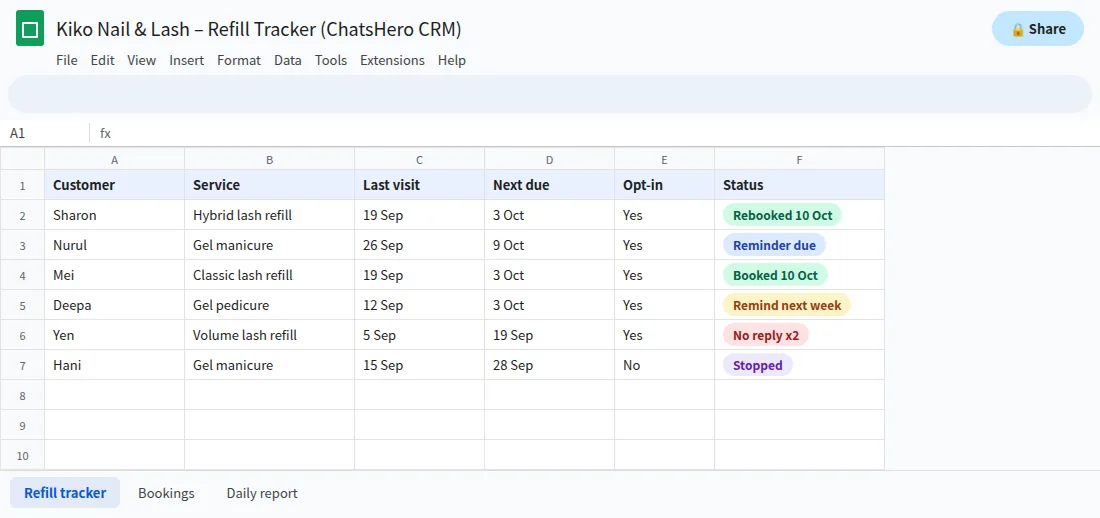
- Next dueOne date column per customer shows who is due this week.
- Replies logged“Book”, “later” and “stop” answers are recorded; your team marks stops and removes them from the list.
- Daily listRebookings are summarised in your team's WhatsApp group.
You set the rules in plain language — for example, “lash refill: remind on day 14, once more on day 19; gel: remind on day 13” — and the AI builds the flow. No prompt writing is needed. Learn more about ChatsHero.
What should a lash refill reminder say?
Short, personal, and easy to answer. Edit these templates to match your studio:
Lash refill (day 14, not booked): “Hi Sharon 👋 It's been 2 weeks since your hybrid refill on 19 Sep ✨ Want to book your next one? 1️⃣ Book now 2️⃣ Remind me next week 3️⃣ Stop refill reminders. Please reply with 1, 2 or 3 🙏”
Gel nail refill (day 13, not booked): “Hi Nurul 💅 Your gel from 26 Sep is about 2 weeks old. Which day suits you? 1️⃣ Thu 8 Oct 2️⃣ Sat 10 Oct. Please reply with 1 or 2 🙏 (Reply STOP anytime to stop reminders.)”
Booked refill (day before): “Hi Mei 👋 Reminder: lash refill tomorrow, Sat 10 Oct, 3:00pm at Kiko. 1️⃣ Confirm 2️⃣ Reschedule. Please reply with 1 or 2 🙏”
Don't mix promotions into reminders. Adding “10% off this week” turns a service message into marketing, and it can train customers to wait for discounts.
Want to see how this looks with your own business? WhatsApp us and chat with the ChatsHero AI.
How do you stay within PDPA and WhatsApp rules?
Refill reminders use the customer's name, number and service history, so treat them as personal data. Under Malaysia's Personal Data Protection Act, tell customers what you collect and why, keep it secure, and stop marketing messages when asked.
- Ask at the counter or in the first chat: “Can we WhatsApp you when your refill is due?”
- Record the answer in your sheet, with the date.
- Honour “stop” immediately: her reply is recorded in the sheet, and your team marks her as stopped and removes her from the reminder list.
- Use the official WhatsApp Business API. It keeps the risk of restrictions lower than unofficial tools, although no provider can guarantee zero risk; your quality rating still depends on how customers react.
What if a customer replies “later” or goes quiet?
“Later” is a normal answer, not a rejection. Let the AI note the preference in the sheet so one follow-up goes out on the date she chose, then stop. If a customer goes quiet after two messages, move her to a slower list — for example, a single friendly check-in a month or two later, sent only if she agreed to hear from you. If she asks a question the AI should not answer, such as a complaint about how her last set lasted, the chat is handed to your team with a “Human Agent Needed” alert in your WhatsApp group, so a real person replies with care.
Is a lash refill reminder system worth the cost?
Do the maths with your own numbers. As an example only: suppose 60 regular lash and gel customers, an average refill of RM80, and reminders help 8 extra customers a month rebook on time instead of drifting away. That is 8 × RM80 = RM640 a month in bookings, against the ChatsHero Starter plan at RM350 a month (annual) plus Meta fees. Even if all 60 customers received one unbooked nudge a month at the marketing rate, that is 60 × RM0.35 = RM21.
Your result could be higher or lower. Track rebookings for one month before and after, using the “Status” column in your sheet, and judge by your own data. Plan details are on our pricing page; the ChatsHero blog has more ideas for small studios.
Frequently Asked Questions
When should I send a lash refill reminder?
Around day 12–14 after the last visit for customers who have not rebooked, because lash refills are typically every 2–3 weeks. If the customer already booked, send a reminder the day before the appointment instead.
How often do gel nails need a refill?
A gel manicure usually lasts around two weeks, so a reminder around day 12–14 is a sensible starting point. Treat this as a typical range and adjust to your own customers.
Is a refill reminder a marketing or utility message on WhatsApp?
A reminder for an appointment that is already booked is usually utility (an assumed RM0.06 in Malaysia). A 'time to refill?' nudge with no booking, or any message with a promotion, is usually charged as marketing (an assumed RM0.35). Meta decides the category by content, and rates can change.
How many refill reminders is too many?
For a customer who has not rebooked, one reminder plus at most one follow-up. After that, stop and move her to a slower win-back list. Always include a way to pause or stop reminders.
Do I need permission to send refill reminders?
Yes. Ask customers if they agree to WhatsApp reminders, record the answer, and stop when they ask. This keeps you aligned with Malaysia's PDPA and Meta's opt-in rules.
Can ChatsHero send refill reminders automatically?
Yes. ChatsHero's Remind feature sends follow-ups on the schedule you set, answers the customer's reply, records her preferred day in Google Sheets and hands the booking to your team to confirm, in English, Bahasa Melayu or Chinese.