WhatsApp broadcasting is not automatically lawful or policy-compliant. Use data for a lawful, disclosed purpose, obtain appropriate consent, identify your business and honour opt-outs. Bought or scraped numbers and unauthorised bulk tools carry privacy and account-enforcement risks. This is general guidance, not a legal opinion; check current Malaysian rules and your sector with an adviser.
RM0.35 and RM0.06 in this article and its supplied illustrations are planning assumptions, not verified current Meta quotations. Gupshup's October announcement describes 1,000 free service replies per business phone number per month, then eligible service charges from 1 October 2026. Utility templates do not use that allowance. Inbound messages and qualifying 72-hour free entry point messages remain exempt. Confirm the recipient market, applicable rate card, free allowance and provider fees before budgeting. Figures below exclude tax and any unlisted costs.
Examples show a proposed workflow, not a guarantee that every account or plan supports it. Ask our team to confirm the channel, integration, permissions and delivery method for your setup. Staff-group notifications and group assistants require separate eligibility and integration checks; a standard one-to-one WhatsApp API account should not be assumed to access every existing staff group. Use approved individual notifications or a staff dashboard if group delivery is unavailable. Test the workflow and human handover before use.
- No Malaysian law bans WhatsApp broadcasts as such — the risk comes from who you message and how.
- The PDPA 2010 (amended 2024) requires notice and consent for personal data, and gives people the right to stop direct marketing.
- Confirm current legal requirements with the regulator or your legal adviser; this guide does not certify campaign legality.
- Meta’s policy only allows messages to people who gave you their number and opted in; unofficial bulk-sending tools break WhatsApp’s terms.
- The safe setup: an opted-in list, the official WhatsApp Business API, clear sender name and an easy STOP.
- This is general information, not legal advice — speak to a lawyer for your specific situation.
Is WhatsApp blasting legal in Malaysia, in short?
The message is not the problem. Sending it to people who never agreed is.
“Blasting” usually means sending the same promotional message to many people at once. There is no Malaysian law that says “WhatsApp broadcasts are illegal”. So, is WhatsApp blasting legal Malaysia-wide? It can be — when it respects three sets of rules:
- The Personal Data Protection Act 2010 (PDPA), as amended in 2024 — how you collect and use people’s numbers.
- The Communications and Multimedia Act 1998 (CMA), as amended in 2025 — including a new provision on unsolicited commercial electronic messages that was not yet in force when the rest of the amendments took effect.
- Meta’s WhatsApp rules — not a law, but they decide whether your number survives.
We are a software company, not a law firm. This article is general information to help you ask better questions; it is not legal advice.
What does the PDPA say about WhatsApp blasting in Malaysia?
A customer’s name and phone number are personal data. When a business uses them for marketing, the PDPA applies. In simple terms:
- Notice and choice. You should tell people why you collect their data and how you will use it — for example, “to send you promotions on WhatsApp”.
- Consent. Personal data generally needs the person’s consent before you process it.
- Right to stop direct marketing. Section 43 lets a person require you to stop, or not begin, processing their data for direct marketing.
- Security and retention. Protect the list and do not keep data longer than needed.
Check current requirements and commencement dates directly with MCMC and the Personal Data Protection Department before a campaign. Do not assume a proposed rule is in force. Consent, sender identification and prompt opt-out handling remain essential practical safeguards.
A number in your phone is not consent. Buying a list, scraping a Facebook group or copying another company’s customers gives you no permission to market to those people.
What does the Communications and Multimedia Act add?
Check current requirements and commencement dates directly with MCMC and the Personal Data Protection Department before a campaign. Do not assume a proposed rule is in force. Consent, sender identification and prompt opt-out handling remain essential practical safeguards.
- Confirm current legal requirements with the regulator or your legal adviser; this guide does not certify campaign legality.
- Confirm current legal requirements with the regulator or your legal adviser; this guide does not certify campaign legality.
- came into force on 11 February 2025, except for a few provisions — including the one on unsolicited commercial messages.
In 2025, MCMC ran a public consultation on how the anti-spam rules would work. The proposals discussed getting permission before sending promotional messages, identifying the sender, offering a free and simple way to unsubscribe, keeping consent records, and restricting harvested or bought contact lists. Law firms reported the proposals would cover channels such as WhatsApp, SMS, Telegram and email.
Check current requirements and commencement dates directly with MCMC and the Personal Data Protection Department before a campaign. Do not assume a proposed rule is in force. Consent, sender identification and prompt opt-out handling remain essential practical safeguards.
What do Meta’s rules say about WhatsApp blasting?
Even where the law is still developing, Meta’s rules are already strict. The WhatsApp Business Messaging Policy says you may only contact people who have given you their phone number and opted in to hear from your business, and you must honour requests to stop.
WhatsApp’s help centre also warns against the unauthorised use of automated or bulk messaging. Cheap “blasting” tools that run on ordinary WhatsApp accounts through unofficial methods are exactly what this covers.
| How you send | Who receives it | Rule risk | Number risk |
|---|---|---|---|
| Unofficial blasting tool on a normal number | Any number you load | High — breaks WhatsApp’s terms | High — restriction risk is high |
| WhatsApp Business app broadcast list | Only contacts who saved your number | Low if they opted in | Medium — reports still count |
| Official WhatsApp Business API with approved templates | Your opted-in list | Low | Lower — depends on quality rating |
No setup can promise your number will never be restricted. The official API with an opted-in list simply keeps the risk low, because Meta rates your number on how people react to your messages.
How do you send WhatsApp broadcasts in Malaysia the safe way?
Take a fictional example: Borneo Home Furniture in Kuching wants to promote its year-end sale. Instead of blasting 3,000 phone contacts, it follows this checklist:
- Use a list of people who said yes. Customers who ticked a WhatsApp box on the delivery form, or replied “1 – Yes” when asked in chat.
- Say who you are. Put the business name in the message and keep your WhatsApp business profile complete.
- Keep it relevant. Members who bought sofas get the sofa promo, not every product.
- Offer an easy exit. End with “Reply STOP to unsubscribe” and honour it the same day.
- Send through the official API using an approved marketing template.
- Keep records. When and how each person opted in, and when anyone opted out.
- Check sector rules. Credit, instalment, health and beauty promotions have extra advertising rules — for example, moneylender ads must show KPKT licence details.
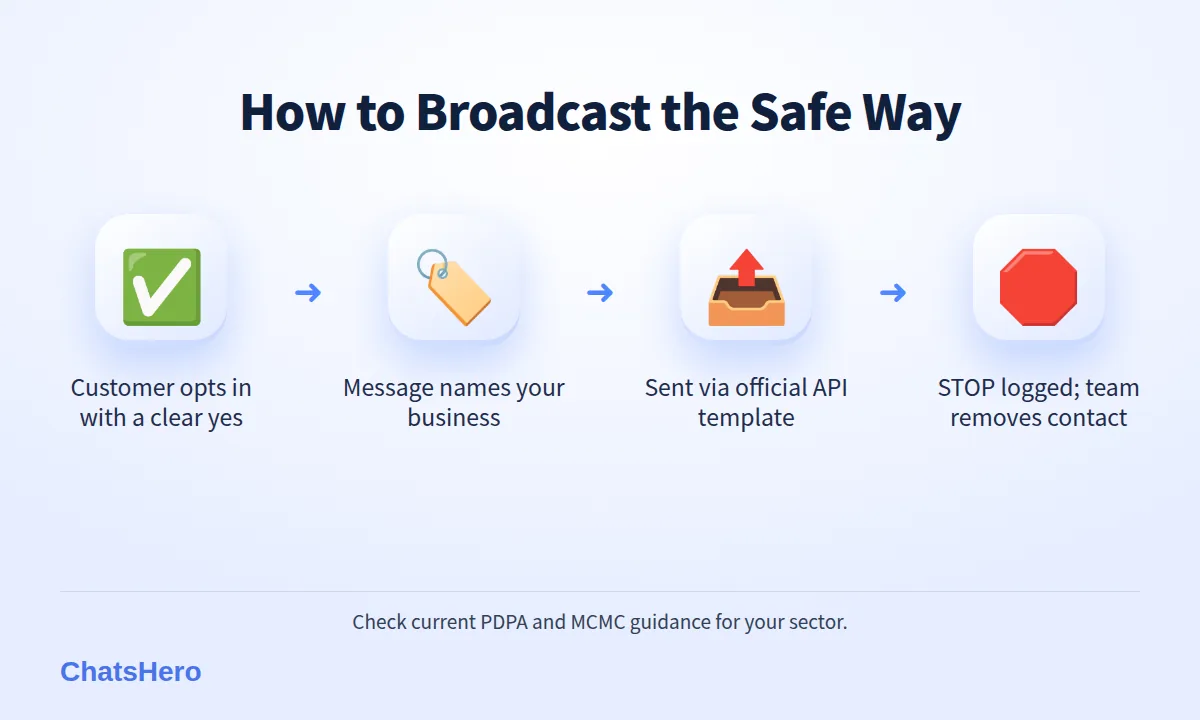
Each marketing message on the official API is illustrated here at RM0.35 in Malaysia, billed by Meta to your own WhatsApp account (see Meta’s pricing page). That cost is another reason to send to fewer, better-chosen people.
What does a compliant broadcast look like on WhatsApp?
Here is an example of the same furniture shop’s broadcast and what happens when customers reply. Notice the sender name, the clear offer and the STOP option — and that the AI handles both a buyer and an unsubscribe politely.
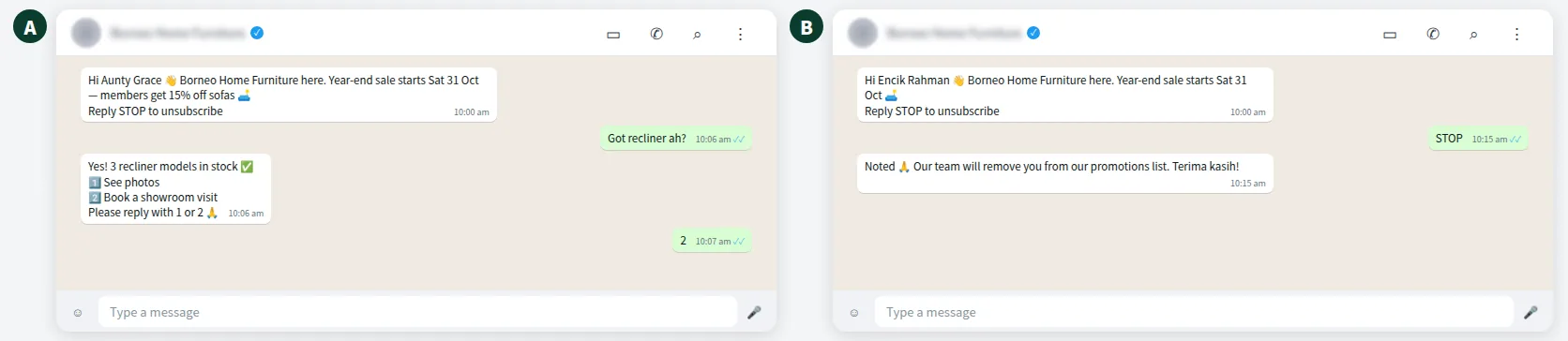
Replies can arrive in English, Bahasa Melayu or Chinese, and the AI answers in the customer’s language. A “berhenti” or “不要了” is treated like a STOP and passed to your team.
Want to see how this looks with your own business? WhatsApp us and chat with the ChatsHero AI.
How can you prove consent if a customer complains?
If someone says “I never agreed to this”, you want the answer in one search. With ChatsHero, replies from WhatsApp — including opt-in answers and STOP messages — are recorded in Google Sheets with the date. Your team marks each contact’s status and source, so you can see who agreed, when, and through which channel.
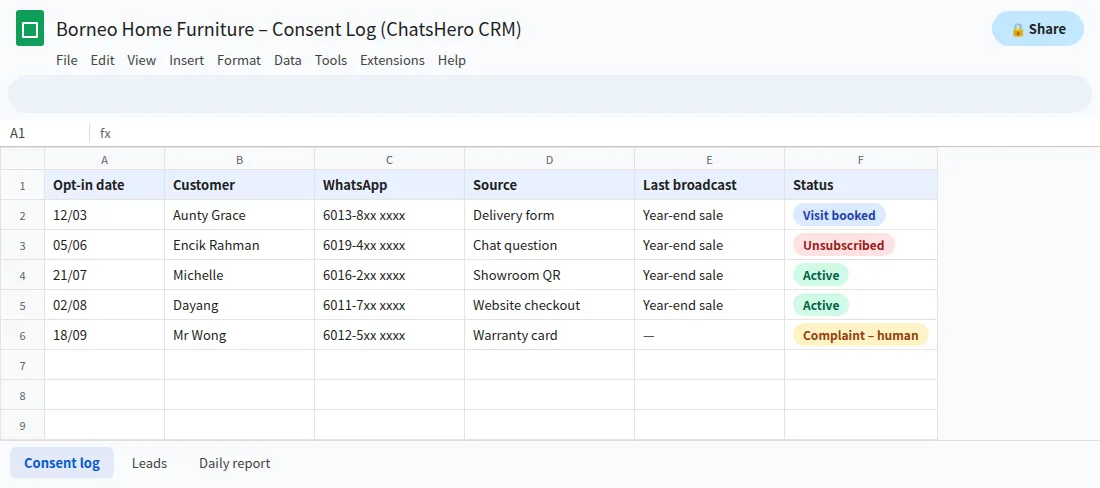
- RecordEach reply is saved with its date; your team adds the source.
- RespectOpt-outs are logged in Google Sheets so your team can remove them before the next broadcast.
- Hand overComplaints flagged to a human in your team’s WhatsApp group.
Keep the sheet even after a customer unsubscribes: the opt-out date is part of your answer if a complaint comes later. What each plan includes is on our pricing page.
When should you speak to a lawyer?
For most SMEs sending occasional promos to their own opted-in customers, the checklist above answers the everyday version of “is WhatsApp blasting legal Malaysia-wide?” Get professional advice when:
- you plan to message people who are not yet your customers;
- you handle large volumes of personal data, or sensitive data such as health information;
- you work in a regulated sector like lending, instalment sales, insurance or healthcare;
- you have received a complaint, or a notice from a regulator.
Check current requirements and commencement dates directly with MCMC and the Personal Data Protection Department before a campaign. Do not assume a proposed rule is in force. Consent, sender identification and prompt opt-out handling remain essential practical safeguards.
Frequently Asked Questions
Is WhatsApp blasting legal Malaysia-wide for small businesses?
Sending broadcasts is not banned by itself. It is generally safe when recipients opted in, your business is clearly identified, you offer an easy way to unsubscribe, and you handle their data under the PDPA. This is general information, not legal advice.
Can I blast promotions to all the contacts in my phone?
Having a number is not consent. Messaging people who never agreed risks PDPA issues and reports that can get your number restricted by WhatsApp, and the CMA anti-spam provision could apply once it takes effect.
Where should I check current Malaysian anti-spam requirements?
It is a provision added by the Communications and Multimedia (Amendment) Act 2025 dealing with unsolicited commercial electronic messages. When the amendments took effect in February 2025, this provision was not yet in force, and MCMC consulted on the detailed rules in 2025. Check its current status.
Are unofficial WhatsApp blasting tools illegal?
Using them is against WhatsApp’s terms, which prohibit unauthorised automated or bulk messaging, and numbers using them carry a high ban risk. Whether a particular campaign also breaks Malaysian law depends on consent and content.
Does the official WhatsApp Business API make blasting legal?
The API keeps you within Meta’s rules and lowers the risk to your number, but it does not replace consent. You still need an opted-in list and must honour opt-outs under the PDPA.
What are the penalties under the PDPA?
Check current requirements and commencement dates directly with MCMC and the Personal Data Protection Department before a campaign. Do not assume a proposed rule is in force. Consent, sender identification and prompt opt-out handling remain essential practical safeguards.