The Hire Purchase Amendment Act 2026 took effect on 1 June 2026, with a grace period for providers until 31 March 2027. New hire-purchase agreements calculate interest on the reducing balance and are quoted as an effective interest rate (EIR), capped at 17% a year for fixed-rate loans up to five years. For motor shops, that means ads and WhatsApp replies should show EIR from the financier, not flat rates.
RM0.35 and RM0.06 in this article and its supplied illustrations are planning assumptions, not verified current Meta quotations. Gupshup's October announcement describes 1,000 free service replies per business phone number per month, then eligible service charges from 1 October 2026. Utility templates do not use that allowance. Inbound messages and qualifying 72-hour free entry point messages remain exempt. Confirm the recipient market, applicable rate card, free allowance and provider fees before budgeting. Figures below exclude tax and any unlisted costs.
Examples show a proposed workflow, not a guarantee that every account or plan supports it. Ask our team to confirm the channel, integration, permissions and delivery method for your setup. Staff-group notifications and group assistants require separate eligibility and integration checks; a standard one-to-one WhatsApp API account should not be assumed to access every existing staff group. Use approved individual notifications or a staff dashboard if group delivery is unavailable. Test the workflow and human handover before use.
- In force since 1 June 2026 for new hire-purchase agreements; the flat rate and the Rule of 78 method are abolished.
- Interest is calculated on the outstanding principal (reducing balance) and quoted as an effective interest rate (EIR).
- Bank Negara's consumer guide lists caps of 17% p.a. (fixed, up to 5 years), 16% p.a. (fixed, above 5 years) and 17% p.a. (variable).
- Providers have a grace period until 31 March 2027 to switch systems, so shops should always quote the financier's written EIR.
- Remove flat-rate, interest-free and approval-guarantee claims from ads and WhatsApp replies.
- This is general information, not legal advice. Check specific cases with your financier or a lawyer.
What is the Hire Purchase Amendment Act 2026?
We are not lawyers, and this is not legal advice. ChatsHero builds WhatsApp AI for businesses. This article summarises public information from Bank Negara Malaysia, KPDN and major news outlets as of 26 September 2026. For your own agreements and ads, check with your financier or a lawyer.
The Hire-Purchase (Amendment) Act 2026 updates the Hire-Purchase Act 1967, the law behind most car and motorcycle instalment purchases in Malaysia. According to KPDN's announcement reported by paultan.org, it was gazetted on 30 January 2026 and came into force on 1 June 2026.
The headline change: the old flat interest rate and the Rule of 78 method are abolished for new agreements. Both front-loaded interest, so borrowers who settled early paid more than they expected. In their place, the Act uses the reducing balance method and the effective interest rate (EIR).
In one line: interest is now charged on what the customer still owes, and quoted as EIR.
What changed on 1 June 2026 compared with the old rules?
The table below summarises the main differences, based on Bank Negara Malaysia's consumer guide to the Hire-Purchase (Amendment) Act 2026.
| Topic | Before 1 June 2026 | New agreements from 1 June 2026 |
|---|---|---|
| How interest is calculated | Flat rate on the original loan amount | Reducing balance on the outstanding principal |
| Rate quoted to customers | Flat rate (e.g. "2.5% p.a.") | Effective interest rate (EIR) |
| Early settlement | Rule of 78 rebate; interest front-loaded | No statutory rebate needed; interest runs only on what is still owed |
| Rate options | Mostly fixed | Fixed or variable (linked to the Overnight Policy Rate) |
| Rate caps | — | Fixed: 17% p.a. up to 5 years, 16% p.a. above 5 years. Variable: 17% p.a. |
| Signing | Paper | Electronic signatures and digital delivery allowed |
Two points shops often miss. First, the Act applies to new agreements; existing contracts keep their terms unless both parties agree to switch. Second, a flat rate always looks smaller than the EIR for the same loan. The Vibes reported that a flat rate advertised at around 2–3% could equal roughly 5.5% in effective annual cost. A customer comparing an old flat-rate poster with a new EIR quote may think prices went up, so explain the difference calmly.
What must motor shops disclose under the hire purchase amendment act 2026?
The hire-purchase agreement itself is issued by the financier (a bank or hire-purchase company), and the legal duties sit mainly with that provider. But the customer usually hears about financing first from the shop: on a banner, in a Facebook ad, or in a WhatsApp chat. That is where mistakes happen.
Based on public summaries of the Act, these are the points to get right:
- EIR, not flat rateReports on the Act say the EIR must be clearly shown in agreements and marketing materials.
- Full costLaw firm summaries note agreements should show the total cost of credit and an instalment schedule.
- No guaranteesApproval is the financier's decision; the shop should never promise it.
In practice, a motor shop should only share figures that come in writing from the financier: the EIR, the tenure, whether the rate is fixed or variable, and the monthly instalment. If a salesperson or a chatbot works out a "rough monthly" figure on its own, it can easily differ from the real agreement.
Not every provider switched on day one. Providers have until 31 March 2027 to update their systems. Bernama reported on 19 September 2026 that 14 of 20 banks offering hire-purchase financing had started using the reducing balance method, with full compliance required from 1 April 2027. Always quote what your financier confirms in writing.
Which ad and WhatsApp phrases should motor shops stop using?
Ads written before June 2026 were often built around flat rates. Here is a quick way to review them. The "avoid" column shows the kind of wording to remove, not wording to copy.
| Avoid | Why it is a problem | Safer wording |
|---|---|---|
| "Flat rate 2.5%!" | Flat rate is abolished for new agreements | "Financing available. EIR and full schedule provided by the financier before you sign." |
| "0% interest" / "no interest" | Misleading unless the financier's written terms truly show this | "Ask us for the financier's EIR quote." |
| "Confirm approve" / "lulus 100%" | Approval is decided by the financier, not the shop | "Our advisor will explain the financing options available." |
| "Monthly only RM199!" | A monthly figure without EIR, tenure and deposit hides the real cost | Show the monthly amount only with the EIR, tenure and deposit from the financier's quote |
Consumer protection rules against misleading statements also apply to ads in general; the Ministry of Domestic Trade and Cost of Living (KPDN) oversees both the Hire-Purchase Act and consumer protection.
How should a WhatsApp chatbot answer instalment questions after the hire purchase amendment act 2026?
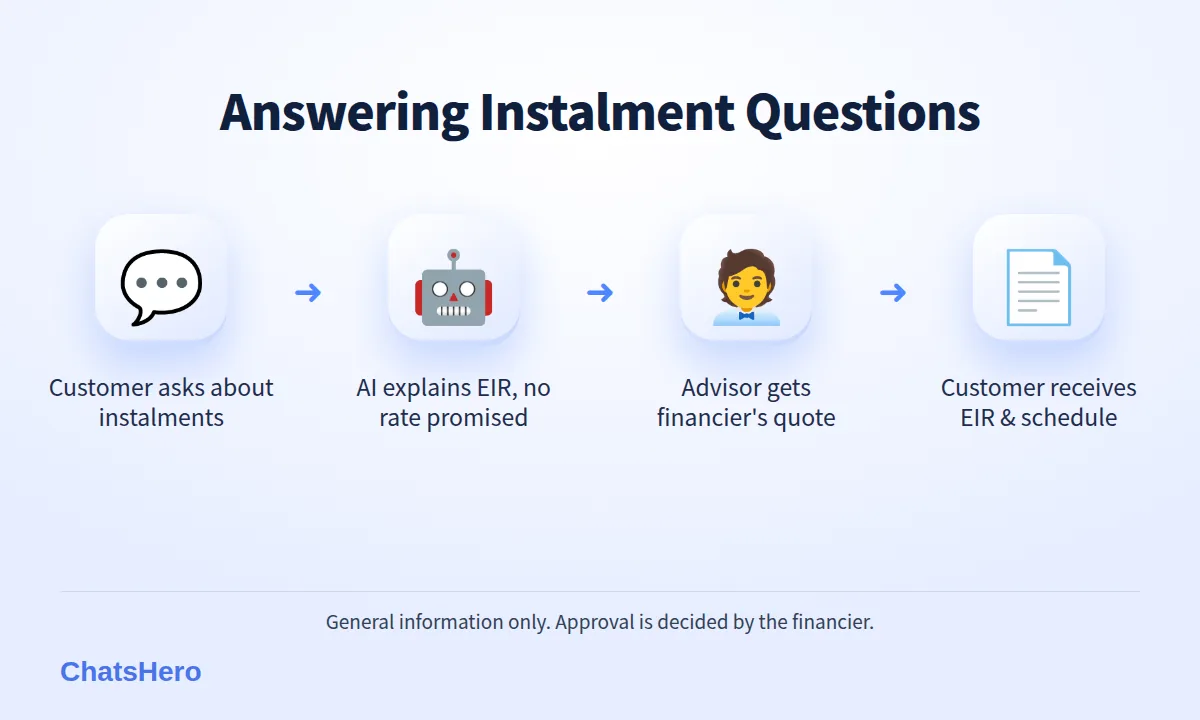
Instalment questions arrive in every form: "Bike this one monthly how much?", "Can loan?", "Flat rate berapa?". An AI chatbot can answer these safely if you set clear boundaries. With ChatsHero, you train the AI in plain language, the same way you would brief a new staff member.
- Explain the basics. The AI can say that new hire-purchase agreements since 1 June 2026 use EIR on a reducing balance.
- Never invent numbers. It does not calculate monthly instalments or quote rates unless you give it a financier's current, written package.
- Never promise approval. Its instructions say approval is the financier's decision, so it never suggests a customer will pass.
- Collect the basics. Model of interest, preferred tenure, and a good time to call. It does not ask for IC numbers or payslips in the chat.
- Hand over. The chat goes to a sales advisor, with a "Human Agent Needed" alert in your team's WhatsApp group.
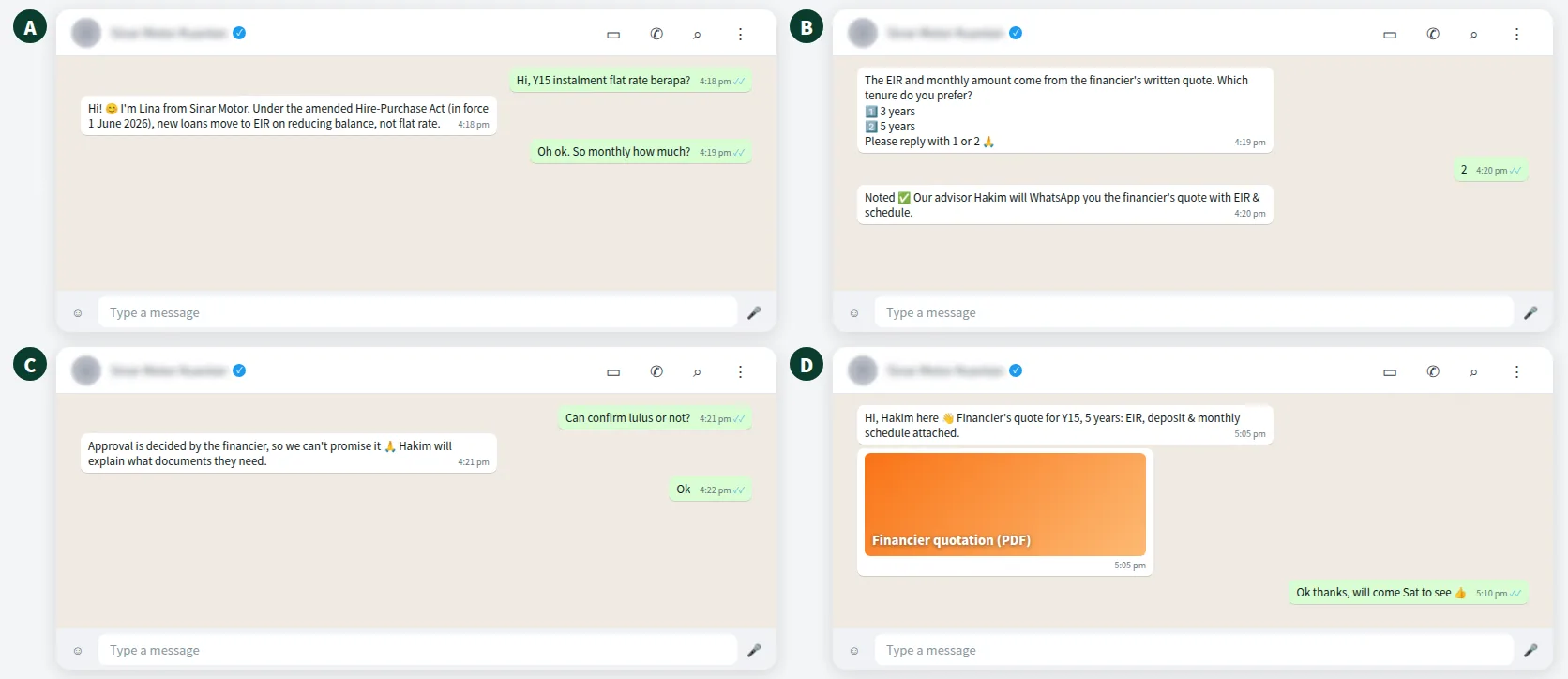
Here is what that looks like for a fictional motorcycle shop in Kuantan. The customer asks for a flat rate; the AI explains the change politely and passes the chat to an advisor who sends the financier's quote.
How do I update my motor shop for the new rules step by step?
A simple checklist most shops can finish in a week:
- Collect your current materials. Banners, flyers, Facebook and TikTok ads, website pages, WhatsApp quick replies and broadcast templates.
- Remove flat-rate wording. Replace any flat-rate or interest-free claim with a line that points to the financier's EIR quote.
- Ask each financier for their new package sheet. Note the EIR, fixed or variable, tenure options and any fees. Keep the date you received it.
- Brief your sales team. Explain EIR vs flat rate in two sentences so they can answer customers calmly.
- Retrain your chatbot. Update its instructions: explain the change, never quote its own rates, never promise approval, always hand over.
- Keep a record. Log which quote each customer received and when, in case questions come up later.
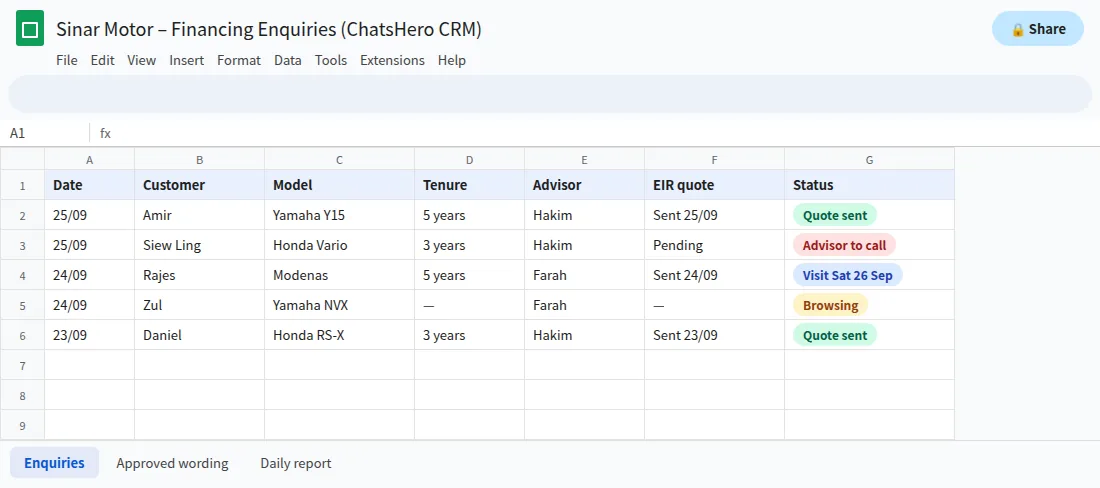
Step 6 is easier when WhatsApp enquiries are recorded automatically. ChatsHero saves each financing enquiry to Google Sheets, and your advisor marks the date the financier's EIR quote was sent.
Want to see how this looks with your own business? WhatsApp us and chat with the ChatsHero AI.
Does the Consumer Credit Act 2025 also affect motor shops?
Possibly, depending on how you offer credit. The Consumer Credit Act 2025 came into force on 1 March 2026 and set up the Consumer Credit Commission (Suruhanjaya Kredit Pengguna, SKP). Licensing and registration under Part V started on 1 June 2026: according to the Ministry of Finance, credit providers such as buy now pay later, leasing and factoring companies need a licence, and credit service providers such as debt collection agencies need registration. There is a transition period for existing businesses; confirm the exact end date with the SKP.
If your shop only refers customers to a bank or hire-purchase company, your main job is accurate advertising. If you run your own instalment or "pay later" scheme, get legal advice on whether you need a licence. Either way, keep debt collection out of your chatbot. That is not what automation should be used for.
What does this mean for your WhatsApp setup and costs?
Clear, consistent answers are easier to deliver with a chatbot than with ten salespeople typing their own versions. Once the AI is trained with your approved wording, every customer gets the same accurate explanation, 24/7, in English, Bahasa Melayu or Chinese.
- Official API. ChatsHero runs on the official WhatsApp Business API, which lowers the risk of restrictions. Only message customers who contacted you or opted in; numbers that many people block or report get a lower quality rating.
- Meta fees. Meta's per-message fees are billed to your own WhatsApp account, separate from your plan: an assumed RM0.06 for a utility message and RM0.35 for marketing in Malaysia (Meta's rates, which may change). From 1 October 2026 free-form eligible service replies above the monthly 1,000-message allowance per phone number inside the customer-service window are also charged using an illustrative utility-rate assumption (see Meta's pricing page).
- Personal data. Financing enquiries contain personal data. Follow the PDPA: collect only what you need, and never ask for IC or payslips in an automated chat.
The law will keep evolving as providers finish switching before 31 March 2027, so review your approved wording every few months. Plan details are on the pricing page; if you want help writing a compliant instalment script for your bot, talk to our team. Other motor-trade explainers sit in the blog archive.
Frequently Asked Questions
When did the Hire Purchase Amendment Act 2026 come into force?
It came into force on 1 June 2026 and applies to new hire-purchase agreements. Providers have a grace period until 31 March 2027 to update their systems. This is general information, not legal advice.
Is the flat rate still allowed for car and motorcycle loans?
Not for new hire-purchase agreements under the amended Act. Interest is calculated on the reducing balance and quoted as an effective interest rate (EIR). Existing agreements keep their original terms unless both parties agree to switch.
What is the maximum interest rate under the new rules?
Bank Negara Malaysia's consumer guide lists caps of 17% p.a. for fixed-rate financing up to 5 years, 16% p.a. for fixed-rate financing above 5 years, and 17% p.a. for variable-rate financing.
Can my shop still advertise a monthly instalment?
Only with care. A monthly figure on its own hides the real cost. Show it together with the EIR, tenure and deposit from the financier's written quote, and check your ads with the financier or a lawyer.
Can a WhatsApp chatbot answer loan questions?
It can explain the general change to EIR and reducing balance and collect the customer's model and preferred tenure. It should not calculate instalments, quote its own rates or promise approval; those questions go to a sales advisor with the financier's quote.
Is this article legal advice?
No. ChatsHero is not a law firm. This is a summary of public information as of 26 September 2026. For advice on your agreements or ads, speak to your financier or a lawyer.
Sources
- Bank Negara Malaysia: Five key highlights of the Hire-Purchase (Amendment) Act 2026 (consumer guide)
- Bernama: 14 banks begin offering reducing balance method for hire-purchase financing (19 Sep 2026)
- paultan.org: Hire Purchase (Amendment) Act 2026 comes into force on June 1 (16 Mar 2026)
- Ministry of Finance: Credit providers and credit service providers require licensing, registration effective June 1