The Consumer Credit Act 2025 Malaysia came into force on 1 March 2026 and created the Consumer Credit Commission (Suruhanjaya Kredit Pengguna, SKP). From 1 June 2026, BNPL, leasing and factoring providers need a licence, and debt collection, debt counselling and impaired-loan buyers must register, with a transition period (confirm the end date with SKP). Conventional moneylenders and pawnbrokers stay with KPKT for now.
Examples show a proposed workflow, not a guarantee that every account or plan supports it. Ask our team to confirm the channel, integration, permissions and delivery method for your setup. Staff-group notifications and group assistants require separate eligibility and integration checks; a standard one-to-one WhatsApp API account should not be assumed to access every existing staff group. Use approved individual notifications or a staff dashboard if group delivery is unavailable. Test the workflow and human handover before use.
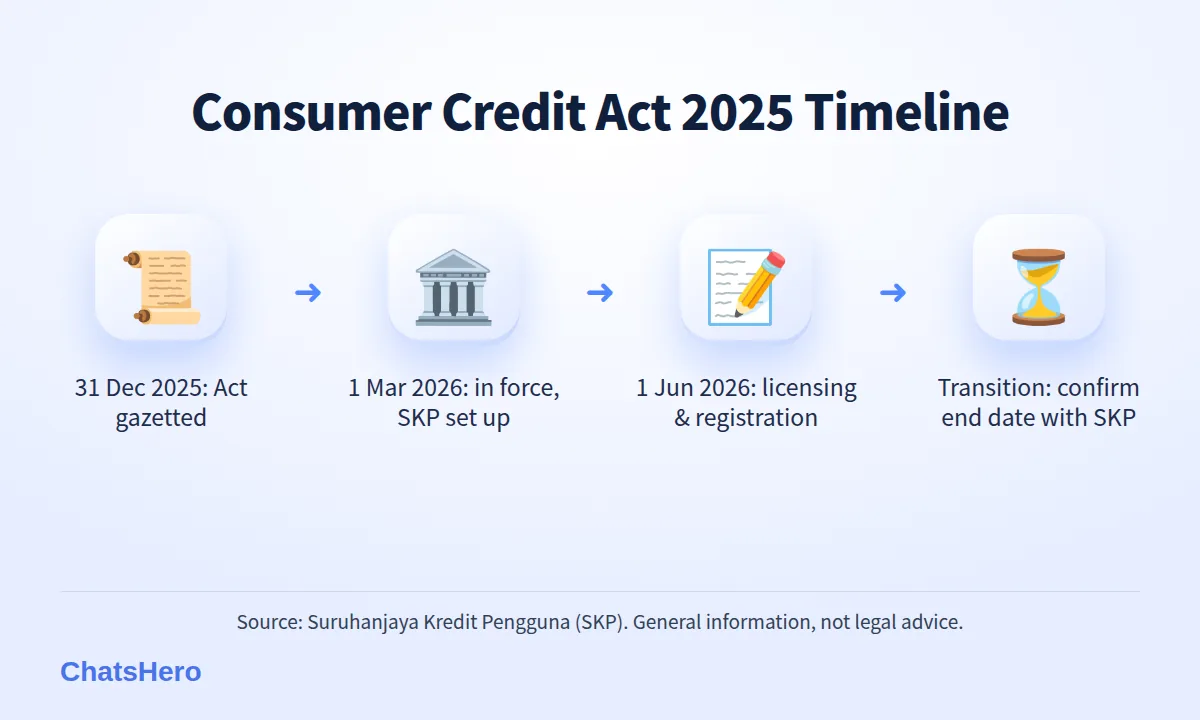
- The Act was gazetted on 31 December 2025 and took effect on 1 March 2026; Part V on licensing and registration took effect on 1 June 2026.
- Credit businesses (BNPL, leasing, factoring, including Islamic) need a licence; credit service businesses (debt collection, debt counselling, impaired loan buyers) need registration.
- There is a transition period from 1 June 2026 (The Edge reported six months) — confirm your exact end date with SKP.
- KPKT remains the regulator for conventional moneylenders and pawnbrokers for now; more sectors are expected to move to SKP in later phases.
- Conduct Standards cover plain-language disclosure, fair advertising, affordability checks, complaints handling and fair debt collection.
- Your WhatsApp scripts, ads and complaint handling become compliance evidence — keep them consistent and recorded.
What is the Consumer Credit Act 2025 in Malaysia?
One law, one regulator, and a licence for credit businesses that used to have none.
The Consumer Credit Act 2025 (CCA) is Malaysia's framework for regulating non-bank consumer credit. Before it, BNPL schemes, leasing and factoring firms, and debt collection agencies were largely outside a dedicated licensing regime, while moneylenders, pawnbrokers and hire purchase each sat under their own laws and ministries. Hire purchase still does: it is governed by the Hire-Purchase Act 1967 under KPDN, as amended by the Hire-Purchase (Amendment) Act 2026, which came into force on 1 June 2026 with a grace period for providers until 31 March 2027, according to Bank Negara Malaysia.
According to the Consumer Credit Commission's media release, the Act was gazetted on 31 December 2025 and came into force on 1 March 2026, when the Commission (Suruhanjaya Kredit Pengguna, SKP) was established. SKP licenses and registers industry players, sets standards, supervises providers, handles complaints and enforces the Act.
This is general information, not legal advice. We are a WhatsApp software company, not lawyers. Use this overview to prepare the right questions, then confirm details with SKP and your legal adviser.
Who needs a licence or registration under the Consumer Credit Act 2025 Malaysia?
The Act splits regulated businesses into two groups. SKP's FAQ lists them as follows:
| Group | Examples | Requirement |
|---|---|---|
| Credit businesses (credit providers) | Buy now pay later (BNPL), leasing, factoring — conventional and Islamic | Licence from SKP |
| Credit service businesses | Debt collection agencies, impaired loan/financing acquisition, debt counselling and management | Registration with SKP |
| Conventional moneylenders and pawnbrokers | KPKT-licensed moneylenders, pawnshops | Remain under KPKT for now |
| Banks and BNM-regulated institutions | Licensed banks | Continue under Bank Negara Malaysia |
The SKP FAQ states that "the Ministry of Housing and Local Government (KPKT) remains the Registrar responsible for regulating conventional moneylenders and pawnbrokers." During the debate on the Bill, the government described a phased approach, with functions from KPKT and the domestic trade ministry expected to move to the Commission around 2028, and full consolidation targeted for 2031, as reported by Bernama. Those later dates are plans, not law yet, so keep an eye on official announcements.
What are the key 2026 dates and the transition period?
Three dates matter for the Consumer Credit Act 2025 Malaysia this year:
- 1 March 2026 — the Act (except Part V) comes into force and SKP is established.
- 1 June 2026 — Part V, covering licensing and registration, takes effect.
- The transition period from 1 June 2026 — The Edge reported a six-month window for the industry to comply, which would end around December 2026. Confirm the exact end date that applies to you directly with SKP.
SKP's Authorisation Standards took effect in early June 2026. Law firm summaries report that applications go through SKP's online regulatory system (CORE), with minimum shareholders' funds of RM2 million for credit businesses and RM500,000 for credit service businesses (or a lower amount combined with professional indemnity insurance). Treat these figures as a starting point and read the official standards on the SKP website before you plan capital.
If your business is in scope and you have not started, the time to prepare your application is now.
What conduct rules affect how you talk to customers?
Licensing gets the headlines, but the Conduct Standards will shape everyday work. Based on SKP's published summary, they cover:
- DisclosurePlain-language key information before the customer commits, with access to key credit terms.
- AdvertisingNo misleading, deceptive, exploitative or harassing conduct in marketing.
- AffordabilityPrudent credit assessment, with limits on lending to over-leveraged consumers.
They also cover complaints handling with defined turnaround times, fair debt collection and help for customers in financial hardship. Under the Act, credit providers must act in a fair, responsible and professional manner. Carrying on a regulated business without the required licence is a criminal offence under the Act; check the exact penalties with your adviser.
For most firms, the practical question is simple: do your sales staff, your ads and your WhatsApp replies all say the same thing? If ten staff each explain fees in their own words, you cannot prove consistent disclosure.
How does the Consumer Credit Act 2025 change WhatsApp communication?
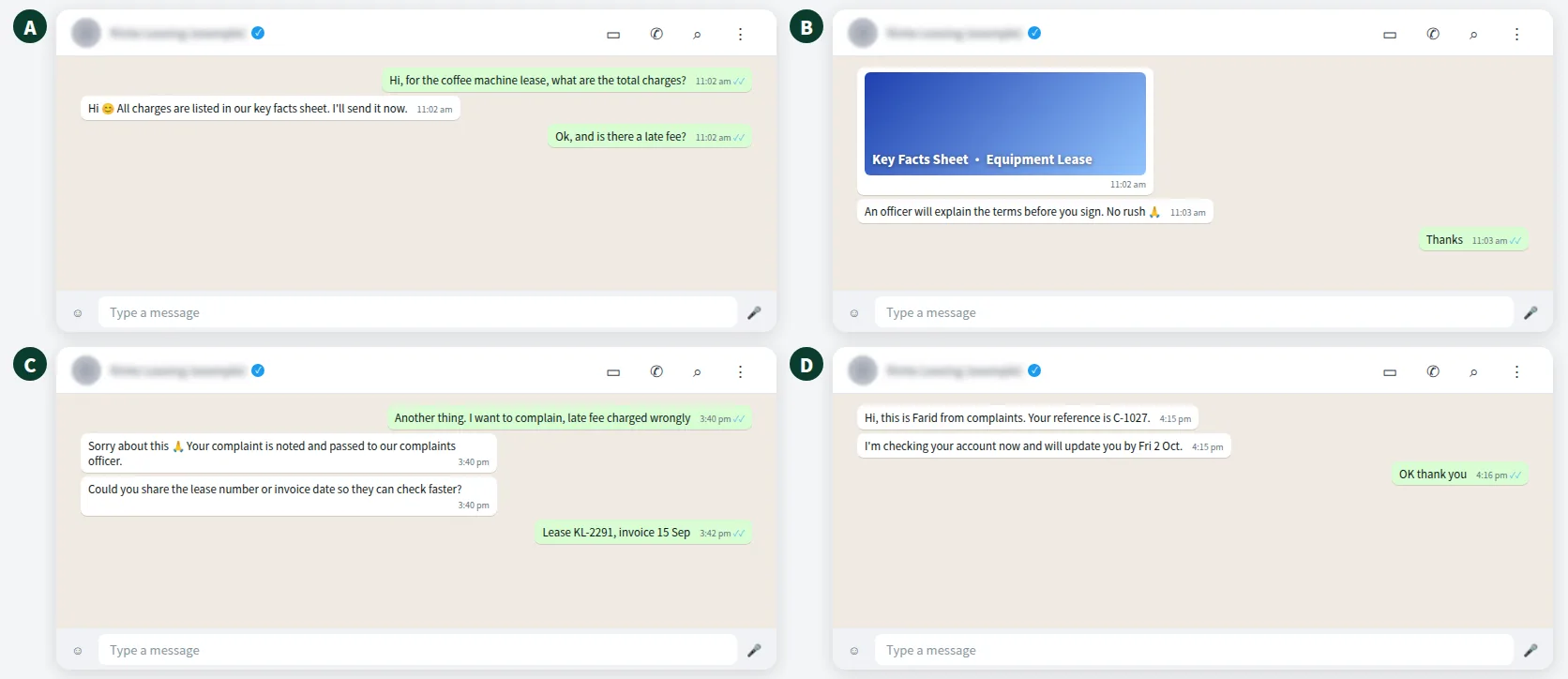
If customers ask you about BNPL plans, leases or repayments on WhatsApp, your WhatsApp replies become part of your conduct record. A consistent, well-trained AI assistant can help:
- Same answer every time. Train the AI on your approved fee explanations and key facts sheet, so every customer receives the same wording, in English, BM or Chinese.
- No pressure selling. Remove approval promises and pressure lines such as "limited time, sign today" from all scripts.
- Human for decisions. Credit assessments, personalised offers and hardship requests go to trained staff through a "Human Agent Needed" alert in your team's WhatsApp group.
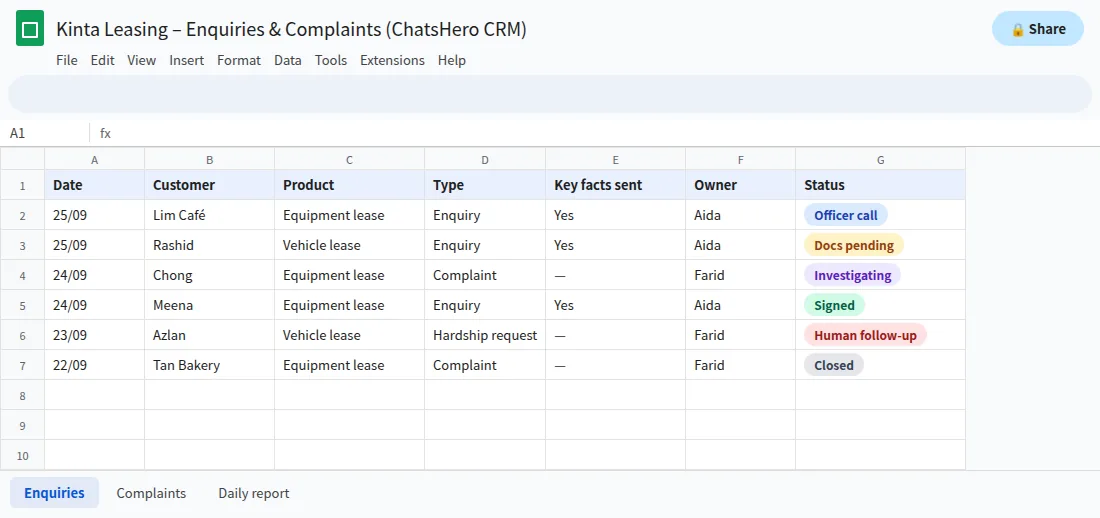
- Complaints are recorded. When a customer complains, the AI acknowledges it, records the details in Google Sheets and hands it to your complaints officer, who issues the reference number and updates the status.
One important limit: Meta's WhatsApp Business Policy prohibits payday loans, paycheck advances, peer-to-peer lending and debt collection on WhatsApp for Business. Registered debt collection agencies and collection teams should not use WhatsApp automation for collection at all, whatever their SKP status, and every credit business should confirm its product is eligible before automating.
Want to see how this looks with your own business? WhatsApp us and chat with the ChatsHero AI.
How should you handle complaints and records?
SKP expects customers to raise complaints with the provider first, and to escalate unresolved cases to the Commission. That means your own complaint process is the first line of defence. Keep it simple and visible:
- Publish one complaint channel and a reference-number format.
- Acknowledge every complaint quickly and tell the customer when to expect a reply.
- Assign each case to a named officer.
- Record the outcome and the date closed.
- Review repeat issues monthly and fix the script or process behind them.
With ChatsHero, every WhatsApp enquiry and complaint is recorded in Google Sheets with the product and assigned owner; your team updates the status as each case moves. A daily report to your management WhatsApp group shows open cases, so nothing sits unanswered over a weekend.
Remember the Personal Data Protection Act as well: keep only the data you need, restrict access to credit documents and have a breach response plan.
What should credit businesses do before the end of 2026?
Here is a practical checklist to discuss with your legal adviser and team:
| Area | Question to answer | Owner (example) |
|---|---|---|
| Scope | Is our product a credit business, a credit service business, or still under KPKT? | Director + legal |
| Licence | Have we applied through SKP's system within the transition window? | Compliance |
| Capital | Do we meet the minimum shareholders' funds in the Authorisation Standards? | Finance |
| Disclosure | Is there one approved key facts sheet per product? | Product |
| Ads & chat scripts | Are ads, social posts and WhatsApp replies free of misleading claims? | Marketing |
| Complaints | Can we show every complaint, owner and outcome? | Customer service |
Consumer credit rules will keep evolving through standards and guidelines, so set a quarterly reminder to check SKP's latest publications.
Can a WhatsApp chatbot help with Consumer Credit Act compliance?
A chatbot cannot make you compliant — your licence, capital, policies and people do that. What it can do is make your customer communication consistent and traceable, which is hard to achieve when every staff member types their own version.
ChatsHero runs on the official WhatsApp Business API and replies 24/7 in English, Bahasa Melayu and Chinese. You train it like you would brief a new staff member: paste your approved scripts and key facts, add screenshots, and the AI builds the flow in Plan and Build modes, with no prompt writing. Your compliance officer approves the scripts before launch. Meta's per-message fees are billed to your own WhatsApp account, separate from your plan — see our pricing page.
Put the SKP deadline in your calendar first, the chatbot second. When your approved scripts are ready, the ChatsHero team can help load them; our blog also has sector guides on phone instalment shops and licensed lenders.
Frequently Asked Questions
When did the Consumer Credit Act 2025 Malaysia come into force?
It was gazetted on 31 December 2025 and came into force on 1 March 2026. Part V, which covers licensing and registration, took effect on 1 June 2026.
Who needs a licence under the Consumer Credit Act 2025?
Credit businesses such as BNPL, leasing and factoring providers, including Islamic ones, need a licence from the Consumer Credit Commission. Debt collection, debt counselling and impaired loan acquisition businesses need registration.
Do licensed moneylenders need an SKP licence?
Not for now. SKP's FAQ says KPKT remains the regulator for conventional moneylenders and pawnbrokers. The government has described later phases in which more sectors may move to the Commission, so watch for official updates.
How long is the transition period?
Licensing and registration started on 1 June 2026 with a transition period for existing businesses; The Edge reported it as six months. Confirm the exact end date for your business directly with SKP.
Where can customers complain about a credit provider?
Customers should first complain to the provider. If the issue is not resolved, they can escalate it to the Consumer Credit Commission through its complaint channel.
Can I use WhatsApp for debt collection if I am registered with SKP?
No. Meta's WhatsApp Business Policy prohibits debt collection on WhatsApp for Business, regardless of your registration. Use WhatsApp only for permitted enquiries and customer service.