A clinic appointment reminder on WhatsApp should say only what the patient needs: clinic name, date, time and a simple confirm-or-reschedule option — never the condition, test or treatment. Send it only to patients who gave explicit consent, keep the chatbot away from diagnosis or medical advice, and point emergencies to 999. Each reminder is illustrated here at RM0.06 in Meta fees.
RM0.35 and RM0.06 in this article and its supplied illustrations are planning assumptions, not verified current Meta quotations. Gupshup's October announcement describes 1,000 free service replies per business phone number per month, then eligible service charges from 1 October 2026. Utility templates do not use that allowance. Inbound messages and qualifying 72-hour free entry point messages remain exempt. Confirm the recipient market, applicable rate card, free allowance and provider fees before budgeting. Figures below exclude tax and any unlisted costs.
Examples show a proposed workflow, not a guarantee that every account or plan supports it. Ask our team to confirm the channel, integration, permissions and delivery method for your setup. Staff-group notifications and group assistants require separate eligibility and integration checks; a standard one-to-one WhatsApp API account should not be assumed to access every existing staff group. Use approved individual notifications or a staff dashboard if group delivery is unavailable. Test the workflow and human handover before use.
WhatsApp's Business Messaging Policy says not to share or request full personal ID numbers, financial account numbers or other sensitive identifiers. Use WhatsApp for a checklist and appointment, not for full MyKad, bank-statement or payslip uploads. Collect required documents through your authorised secure portal or in person, with a privacy notice, limited access and a documented retention period. Healthcare chats should remain administrative; do not request clinical records or diagnose through the bot.
- Keep reminders minimal: first name, clinic, date, time and 1-to-confirm, 2-to-reschedule. No condition, test or treatment names.
- Health information is sensitive personal data under the PDPA, which requires explicit consent to process it.
- The chatbot must never diagnose, suggest medicine or judge urgency; symptom questions go to staff, emergencies to 999.
- Reminders are not adverts: keep promotions out, and remember that healthcare advertising in Malaysia needs approval and bans treatment testimonials.
- Store the minimum in Google Sheets — appointment details and consent status, not clinical notes.
- Reminders sent via the official WhatsApp Business API are usually utility messages, an assumed RM0.06 each in Malaysia.
Why use a clinic appointment reminder on WhatsApp?
A missed appointment is a lost slot for the clinic and a delayed visit for the patient.
Patients forget. A follow-up booked three weeks ago is easy to miss when it sits in a paper card or a calendar nobody checks. Phoning every patient the day before takes a front-desk staff member hours, and many calls go unanswered during working hours.
Text reminders are one of the better-studied fixes. A Cochrane review of mobile phone messaging reminders found that they improved attendance at healthcare appointments compared with no reminder. The evidence is general rather than Malaysia-specific, but the logic carries over: a short, timely message with an easy way to reschedule.
In Malaysia, WhatsApp is where patients already are. The challenge is not whether to send reminders, but how to send them without exposing health information, overstepping into medical advice or turning a reminder into an advert. The rest of this guide covers exactly that.
What should a clinic appointment reminder on WhatsApp say — and not say?
Write every reminder as if someone else might read it on the patient's lock screen, because sometimes they will. Include only what the patient needs to turn up at the right time.
| Include | Avoid |
|---|---|
| First name or title (“Encik Lim”) | Full IC number or date of birth |
| Clinic name and address pin | Condition, diagnosis or reason for visit |
| Date, day and time (“Tue 6 Oct, 9:30am”) | Test names or results (“your blood test results are ready”) |
| Confirm / reschedule option | Treatment or procedure names |
| Practical notes (“please bring your IC”) | Offers, discounts or promotions |
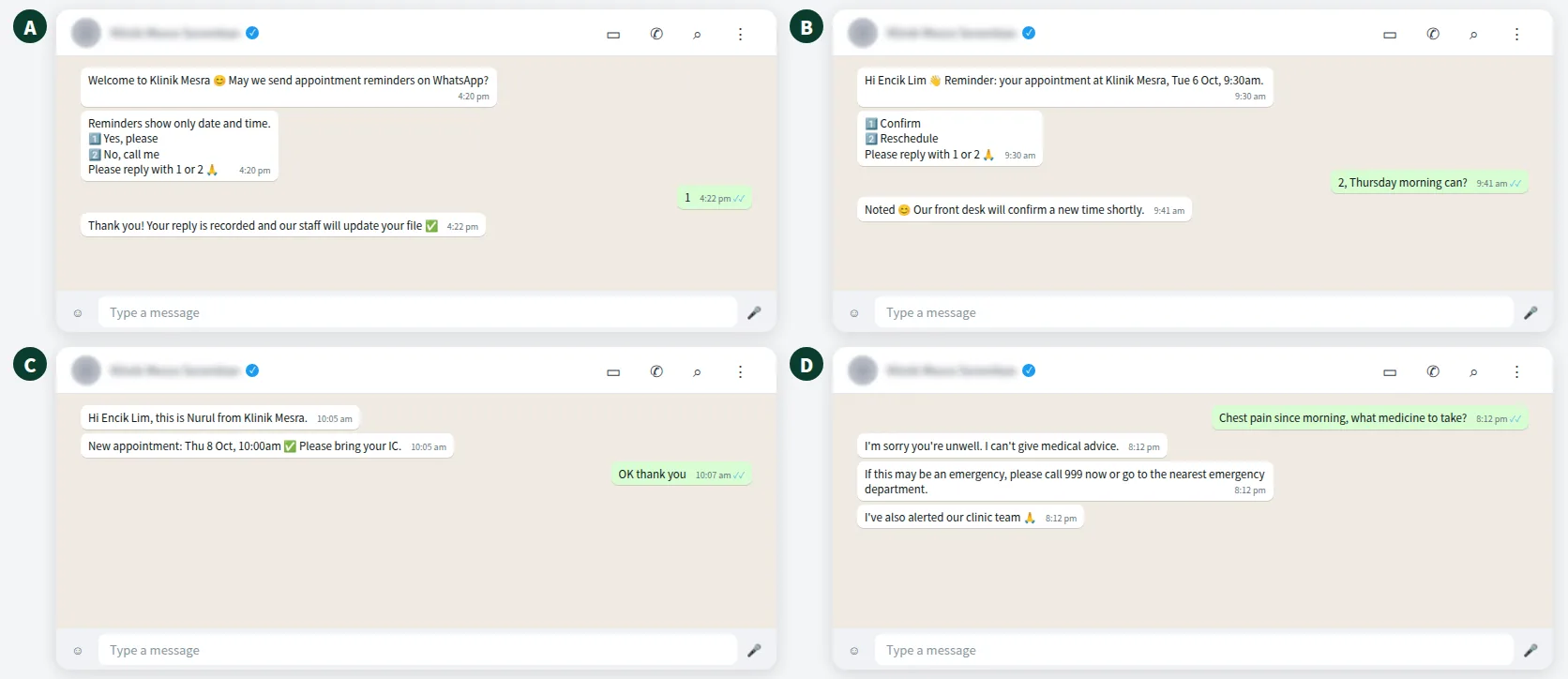
Example: “Hi Encik Lim 👋 Reminder: your appointment at Klinik Mesra, Tue 6 Oct, 9:30am. 1️⃣ Confirm 2️⃣ Reschedule. Please reply with 1 or 2 🙏”
If your clinic's own name reveals a sensitive speciality, consider a neutral sender profile and message wording. And if a patient needs to fast before a test, ask your doctor to decide how that instruction is given — for example on the printed appointment slip rather than in the WhatsApp reminder.
How does a clinic appointment reminder WhatsApp flow work?
Here is the flow we recommend for GP clinics, dental clinics and aesthetic centres. It keeps the AI to scheduling tasks and leaves every clinical question to people.
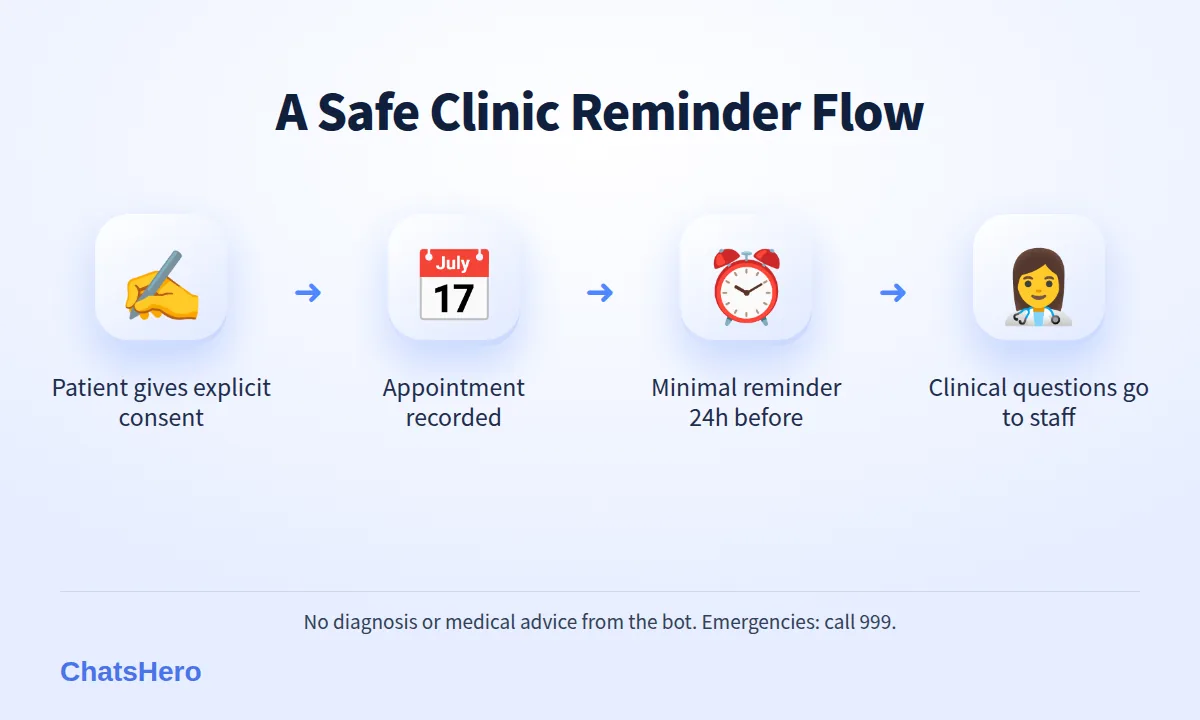
- Consent at registration. The patient agrees in writing, or on your registration form, to receive appointment reminders on WhatsApp. Your staff record the answer in the patient's file and the Google Sheet.
- Appointment booked. Staff or the AI record the date and time; the booking is added to Google Calendar. Your team keeps the calendar up to date.
- Reminder 24 hours before. A short template message with the date, time and a confirm-or-reschedule option.
- Patient replies. “1” confirms. “2” passes the request to your front desk, who offer a new slot.
- Anything clinical goes to staff. Questions about symptoms, results or medicine trigger a “Human Agent Needed” alert in your team's WhatsApp group.
The AI can answer the practical questions patients ask at night: opening hours, location, parking, which documents to bring and how to reschedule — in English, Bahasa Melayu or Chinese.
What must a clinic chatbot never do?
A clinic assistant is a receptionist, not a clinician. Draw the line clearly when you train it:
- No diagnosis. It never suggests what a symptom might mean.
- No medical advice. No medicines, doses, home remedies or “you can wait until Monday”.
- No urgency judgement. It does not decide whether something is serious.
- No results. It never shares or interprets test results.
When a patient describes symptoms, the AI replies with a fixed message: it cannot give medical advice, staff will contact them, and in an emergency they should call 999, Malaysia's MERS 999 emergency line, or go to the nearest emergency department. The alert then goes to your team.
If a question needs a doctor or nurse to answer, the bot's only job is to hand it over quickly. Write the emergency reply once, have a doctor approve it, and do not let the AI rephrase it.
What this looks like in practice
This illustrative conversation shows consent, a reminder, a reschedule confirmed by staff, and a symptom message handled safely.
How does the PDPA apply to patient reminders on WhatsApp?
Under the Personal Data Protection Act 2010, information about a person's physical or mental health is sensitive personal data. The PDP Department's FAQ explains that processing it requires the explicit consent of the data subject, unless a specific exemption applies. That is why consent comes first in the flow above.
Practical steps for clinics:
- Get explicit consent for WhatsApp reminders, separately from general registration, and record it.
- Minimise. The reminder sheet needs name, WhatsApp number, appointment and consent status — not diagnoses or clinical notes, which belong in your clinic system.
- Limit access. Share the Google Sheet only with staff who need it, and remove access when staff leave.
- Respect withdrawal. If a patient asks to stop WhatsApp reminders, your team updates their record and switches to phone or SMS.
- Check the 2024 amendments. Some organisations must now appoint a Data Protection Officer — for example those processing sensitive personal data of more than 10,000 people, according to the PDP FAQ — and data breach notification rules apply.
This is general information, not legal advice. For your own clinic, check with the PDP Department or a lawyer.
Can clinics send promotions or testimonials on WhatsApp?
Be very careful. Healthcare advertising in Malaysia is tightly regulated. The Medicine Advertisements Board's Advertising Guidelines for Healthcare Facilities and Services state that most advertisements need approval before publication, and that patient testimonials related to treatment or healthcare services are not allowed. The guidelines also prohibit offers of free healthcare services and gifts as inducements.
For doctors personally, the Malaysian Medical Council's guideline on dissemination of information, which includes WhatsApp in its definition of social media, says patient confidentiality is paramount and advertising to obtain patients is not appropriate.
What this means for your WhatsApp setup:
- Keep reminders purely about the appointment.
- Do not train the bot to share “before and after” stories or patient reviews about treatment.
- Do not broadcast discounts on treatments; check any promotional material with the relevant rules first.
- Aesthetic clinics are not exempt — the same healthcare advertising rules apply.
Want to see how this looks with your own business? WhatsApp us and chat with the ChatsHero AI.
How do you track appointments and no-shows in Google Sheets?
A simple sheet is enough for reminders: appointment date and time, first name, WhatsApp number, consent status, reminder sent and reply. No clinical information. ChatsHero records the patient's replies in the sheet; your team marks attendance and updates consent when it changes.
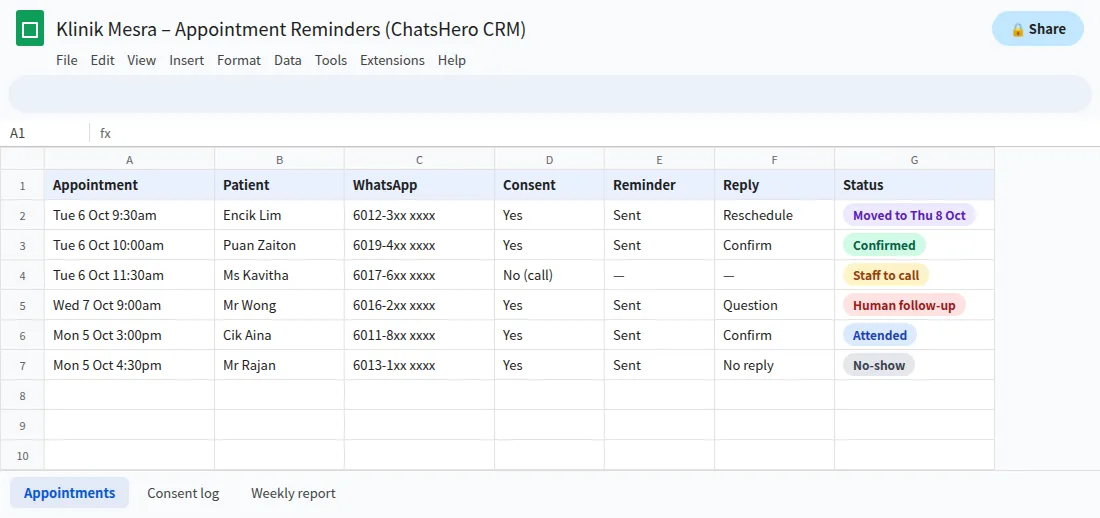
Over a few weeks the sheet shows which sessions have the most reschedules and no-shows, so you can adjust your booking pattern. A weekly summary can be sent to the clinic manager's WhatsApp group — using counts, not patient names.
What does a clinic appointment reminder system on WhatsApp cost?
There are two separate costs. Meta charges per message on the official WhatsApp Business API, billed to the clinic's own WhatsApp account. A reminder is usually a utility message, an assumed RM0.06 in Malaysia; for example, 900 reminders a month × RM0.06 = RM54. From 1 October 2026, replies sent inside the 24-hour customer service window are also charged using an illustrative utility-rate assumption. See Meta's pricing page; rates are set by Meta and can change.
The second cost is the ChatsHero plan, which covers the AI assistant, Google Sheets and Calendar integration and handover alerts. Plans and what each includes are listed on our pricing page. To learn who we are and how we work with regulated businesses, see About ChatsHero, and find more guides on the ChatsHero blog.
Frequently Asked Questions
Is it legal to send a clinic appointment reminder on WhatsApp in Malaysia?
Yes, when the patient has given explicit consent and the message is kept minimal. Health information is sensitive personal data under the PDPA 2010, so get consent, avoid condition or test names in reminders and protect the data you store.
What should a clinic reminder message include?
The patient's first name or title, clinic name, date, day, time, a location pin if useful, practical notes such as bringing an IC, and a confirm-or-reschedule option. Nothing about the condition, test or treatment.
Can a clinic chatbot answer medical questions?
No. It should never diagnose, suggest medicine or judge urgency. It hands symptom questions to staff and tells patients to call 999 or go to the nearest emergency department in an emergency.
Can clinics share patient testimonials on WhatsApp?
The Medicine Advertisements Board's guidelines for healthcare facilities do not allow patient testimonials related to treatment or healthcare services, and most healthcare advertisements need approval before publication.
What patient data should be stored in the reminder sheet?
Only what reminders need: appointment date and time, name, WhatsApp number, consent status and replies. Keep diagnoses and clinical notes in your clinic system, not in the reminder sheet.
How much does a WhatsApp appointment reminder cost?
On the official WhatsApp Business API, a reminder is usually a utility message at an assumed RM0.06 in Malaysia, billed by Meta to the clinic's own WhatsApp account and separate from the ChatsHero plan.
Sources
- PDP Department: Frequently Asked Questions (sensitive personal data, DPO)
- Medicine Advertisements Board: Advertising Guidelines for Healthcare Facilities and Services
- Malaysian Medical Council: The Dissemination of Information by Medical Professionals Including on Social Media
- MyGOV: MERS 999 Emergency Line