Beauty advertising rules in Malaysia cover WhatsApp promos just like posters or Facebook ads. In short: never claim slimming, fat loss, permanent whitening or treating acne and other conditions; do not promote injections or other invasive procedures from a beauty centre; and use only genuine, fair before-and-after photos. Send promos only to clients who opted in.
- The Ministry of Health treats any promotional message to the public, including online, as an advertisement.
- Cosmetic product ads do not need Medicine Advertisements Board (MAB) approval, but must follow NPRA's cosmetic claims guideline.
- Claims about treating diseases, slimming, fat loss or hair regrowth are the fastest way into trouble.
- Beauty centres are not authorised to offer injections, fillers or other invasive aesthetic procedures.
- Train your WhatsApp chatbot with a 'never say' list and hand medical questions to a person.
- This is general guidance, not legal advice: check with MAB, NPRA or a lawyer for your specific promo.
Does a WhatsApp promo count as an advertisement in Malaysia?
If a message is meant to attract customers to a product or service, treat it as an advertisement.
It is easy to assume the rules only cover billboards, magazines and TV. That is not how the Ministry of Health (MOH) sees it. Its Pharmaceutical Services Programme states that all types of dissemination of information about products and healthcare services to attract public attention, including on the internet, are classified as an advertisement.
So a WhatsApp broadcast to 500 clients, a status update, a promo poster sent in chat and even the replies your chatbot gives about a treatment can all fall under beauty advertising rules in Malaysia. The channel changes; the rules do not.
We are not lawyers. This guide summarises public guidance from MOH, NPRA and the Content Forum as we understand it. For a specific campaign or product, check with the Medicine Advertisements Board, NPRA or a qualified lawyer.
Which laws and bodies set beauty advertising rules in Malaysia?
Several rules overlap. Which ones apply depends on whether you are promoting a cosmetic product, a beauty service or something that touches on health.
| Rule / body | What it covers | What it means for a salon promo |
|---|---|---|
| Medicines (Advertisement and Sale) Act 1956 + Medicine Advertisements Board (MAB) | Ads for medicines and for skills or services relating to diseases and health conditions | No claims to treat or prevent diseases; health-related ads may need MAB approval (shown as a KKLIU number) |
| NPRA cosmetic guidelines | Cosmetic products and their claims | No MAB approval needed, but claims must be cosmetic, not medical |
| Content Code 2022 (Communications and Multimedia Content Forum) | Advertising content on communications platforms | Testimonials must be genuine and current; before-and-after images must be fair |
| Private Healthcare Facilities and Services Act 1998 | Who may run healthcare facilities and procedures | Beauty centres must not offer or promote invasive aesthetic procedures |
| Personal Data Protection Act 2010 | Using clients' personal data | Broadcast only to clients who agreed; honour opt-outs |
The full text of the Medicines (Advertisement and Sale) Act 1956 is published by MOH. Its Schedule lists conditions you must never advertise treatments for, including diabetes, hypertension, cancer, infertility and sexual dysfunction.
Do cosmetic ads need Medicine Advertisements Board approval?
Generally no. MOH states that cosmetic advertisement is self-regulatory and does not require MAB approval, but the product must be notified to NPRA and the ad must follow NPRA's cosmetic advertising guidance.
The catch is the word cosmetic. Under NPRA's definition, a cosmetic cleans, perfumes, changes appearance or keeps the skin, hair or nails in good condition. Its effect is not permanent, and it is not presented as treating or preventing disease. Once your promo claims a medical effect, it is no longer a cosmetic claim, and you are in MAB territory or simply making an illegal claim.
- Cosmetic product (e.g. a moisturiser you retail): no MAB approval, NPRA notification and claims rules apply.
- Registered medicinal or health product: MOH says ads for supplements, over-the-counter and traditional products registered with the Drug Control Authority require MAB approval, and approved ads carry a KKLIU number.
- Beauty service (facial, massage, lash lift): keep claims to relaxation, grooming and appearance. Do not link the service to curing any condition.
Which claims must your WhatsApp promos avoid?
NPRA's guideline for cosmetic claims lists wording that is not acceptable for cosmetics. These are the ones most relevant to salons and spas:
- Slimming and fat loss: "slimming", "fat burn", "fat loss", "inch loss", "lose 5kg in 2 weeks".
- Medical skin claims: "treats", "heals" or "stops" acne; references to eczema, psoriasis or infections.
- Pharmacological whitening: claims such as "inhibits melanin", "stimulates collagen production" or "repairs DNA".
- Hair loss: "reverses" or "arrests" hair loss, or anything about hereditary or hormonal baldness.
- Body shape: breast enlargement or reduction.
- Safety absolutes: "no side effects", "100% safe".
- Unproven numbers: percentages or results you cannot back with evidence.
Also avoid words that imply a permanent result, such as "permanently fair" or "acne gone forever". Cosmetic effects need ongoing use by definition.
How can you rewrite risky beauty promo wording?
You can still write attractive promos. Focus on the experience, the look and the care, not on medical outcomes.
| Risky promo line | Why it is risky | Safer alternative (example) |
|---|---|---|
| "Slimming body wrap, lose 3 inches in one session!" | Slimming and inch-loss claims | "60-minute body wrap and massage to relax and pamper you" |
| "Whitening facial, fair skin permanently" | Permanent effect, whitening framed as a biological change | "Hydrating facial for a fresh, glowing look" |
| "Our facial cures acne" | Treatment claim for a skin condition | "Deep-cleansing facial to keep pores clean" |
| "Hair regrowth scalp therapy" | Hair-loss treatment claim | "Scalp care treatment for clean, healthy-looking hair" |
| "Glutathione whitening drip, RM199" | Injection or IV procedure promoted by a beauty centre | Do not offer or promote it at all |
The safer lines are examples to spark ideas, not pre-approved copy. If your product label or NPRA notification supports a specific claim, keep your WhatsApp wording within that claim.
Can a beauty salon promote injections, fillers or whitening drips?
No. In January 2025, MOH said that no beauty centre in Malaysia has been authorised to provide surgical or invasive aesthetic procedures, which may only be done by certified doctors. The ministry was prosecuting such cases under Section 5 of the Private Healthcare Facilities and Services Act 1998, with fines of up to RM300,000 for individuals and RM500,000 for companies reported.
For a WhatsApp promo, the practical rule is simple: if it involves a needle, a drip, a thread or a scalpel, it does not belong in a beauty salon's broadcast. That includes "collaboration" offers where an outside party performs the procedure on your premises.
What about before-and-after photos?
Section 4.9 of the Content Code 2022 requires testimonials to reflect a genuine experience and still be current, and before-and-after claims to allow a fair comparison. In practice:
- Use the same lighting, angle and makeup in both photos, with no filters or AI edits.
- Get the client's written consent before sharing her photo, and let her withdraw it.
- Never pair a photo with a medical or slimming claim.
How do you keep a chatbot within beauty advertising rules in Malaysia?
Your AI assistant talks to hundreds of clients, so it must follow the same beauty advertising rules as your posters. Here is how we set it up for salons and spas:
- Write an approved claims list. For each service and retail product, note what you can say ("hydrating", "relaxing", "for a fresh look").
- Add a "never say" list. Slimming, fat loss, cure, treat, heal, permanent, no side effects, and the names of any conditions. Train the bot to avoid them, even when a client uses them first.
- Hand medical questions to a person. If a client asks whether a facial can treat eczema or acne, the bot says it cannot advise on skin conditions, suggests seeing a doctor, and flags the chat for your therapist.
- Review every broadcast before it goes out. The owner or a senior therapist checks the wording against both lists.
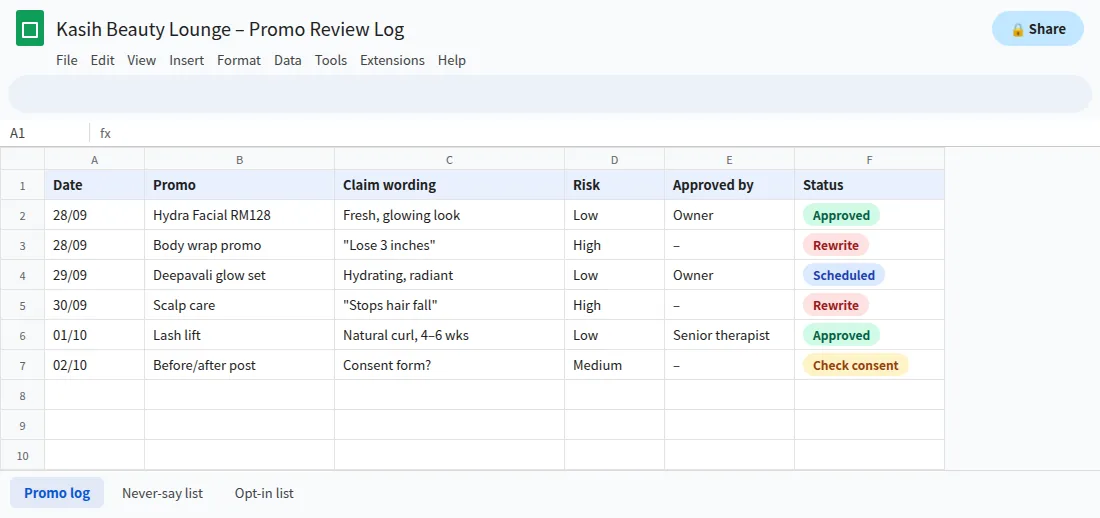
- Keep a record. Log each promo, its wording and who approved it in Google Sheets.
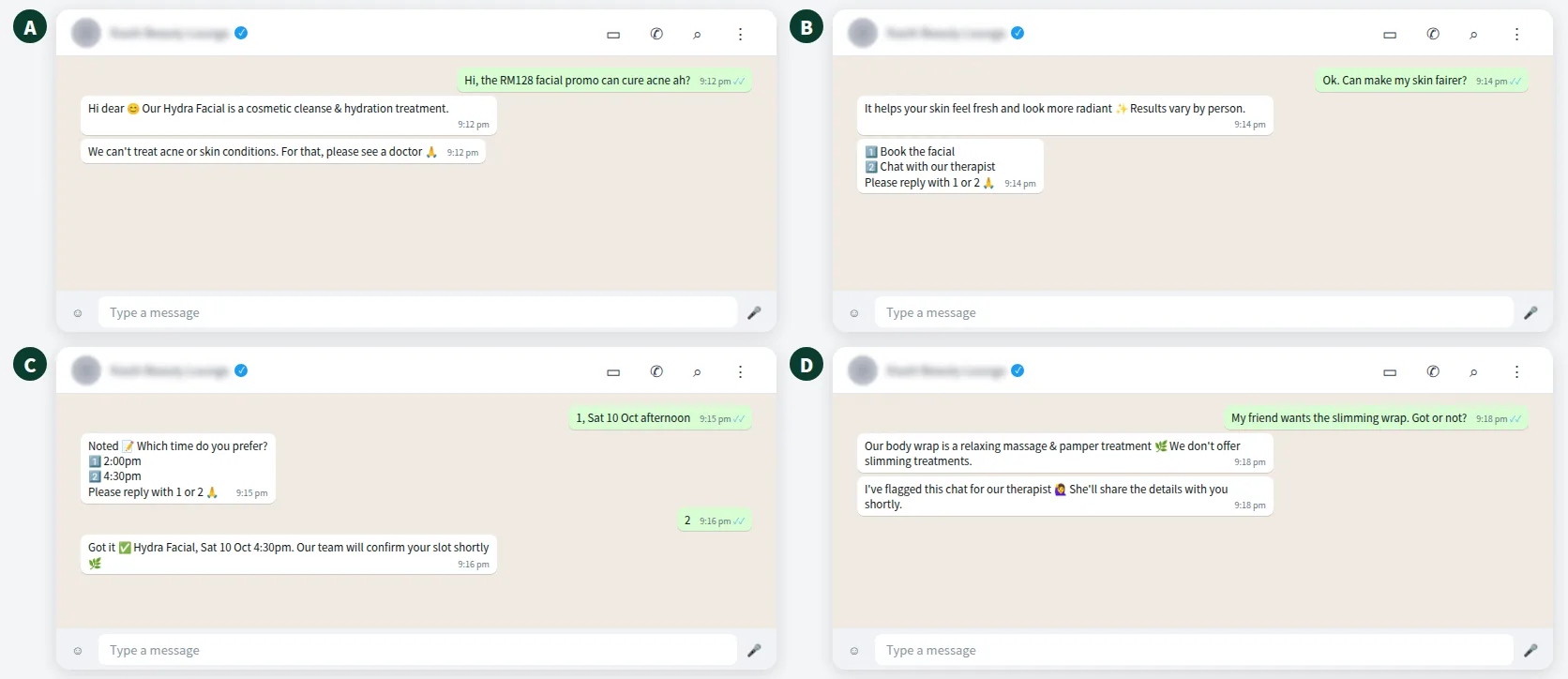
With ChatsHero, you train the bot the way you would brief a new staff member: paste your price list, your approved claims and your "never say" list, and the AI builds the replies in English, Bahasa Melayu and Chinese. Learn more about ChatsHero.
Want to see how this looks with your own business? WhatsApp us and chat with the ChatsHero AI.
What else must a beauty promo broadcast on WhatsApp follow?
Even perfectly worded promos need permission. On the official WhatsApp Business API, promotional broadcasts are marketing messages. Meta bills them to your own WhatsApp Business account at the marketing rate (see Meta's pricing page), and Meta decides a template's category from its content, so a "skin tips" message with a discount inside is still marketing.
- Send promos only to clients who opted in, and record when and how they agreed.
- Offer a simple "Reply STOP to opt out", and have your team remove that number from the list, in line with the PDPA.
- Clients who block or report your promos lower your quality rating. The official API lowers the risk to your number, but it is never zero.
You can track each promo's wording, approval and opt-in list in one sheet:
- CheckWording compared against your approved and "never say" lists.
- ApproveOwner signs off before anything is sent.
- RecordPromo, list and date saved in Google Sheets.
Plans and features are on our pricing page.
What is a quick checklist before you hit send?
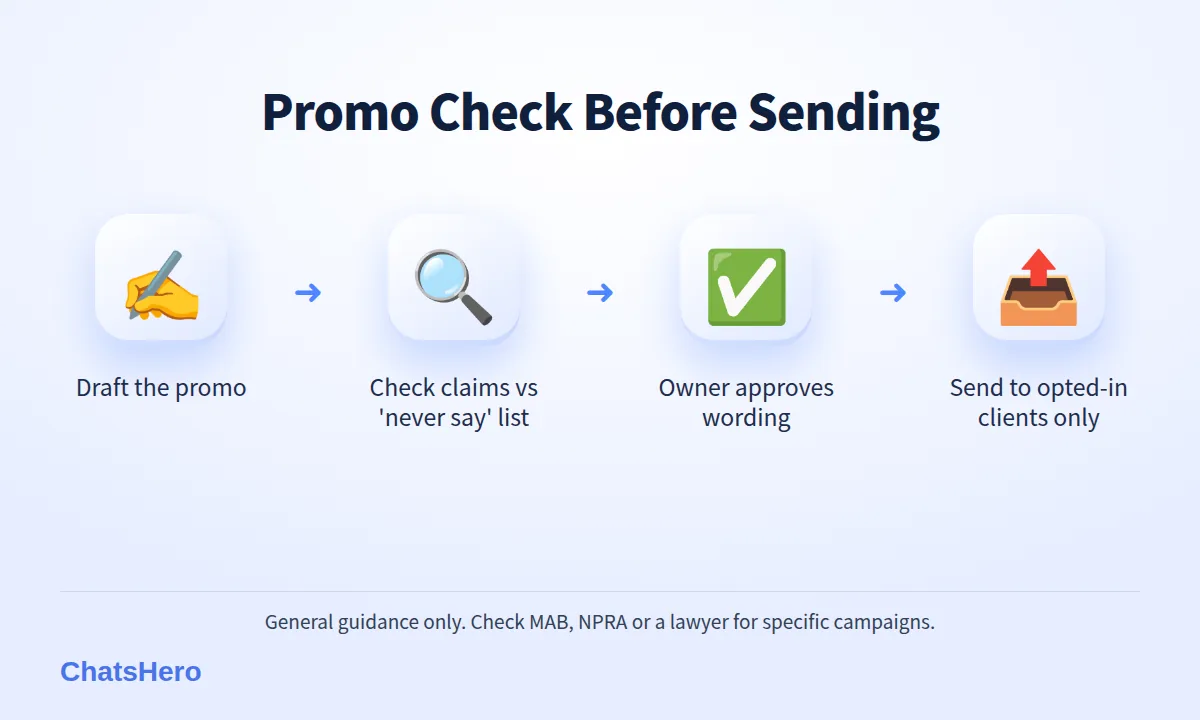
Before any beauty promo goes out on WhatsApp, run through these questions:
- Does it claim to treat, cure or prevent any condition? Remove it.
- Does it mention slimming, fat loss, inch loss or permanent whitening? Rewrite it.
- Does it promote an injection, drip, filler or other invasive procedure? Do not send.
- Are the before-and-after photos genuine, consented and fairly compared?
- Is every number (price, duration, result) true and provable?
- Is the list opted in, with an easy way to stop?
When in doubt, contact the Medicine Advertisements Board or NPRA, or ask a lawyer. A promo that waits one more day for a check costs far less than one that has to be withdrawn. Other compliance and WhatsApp guides live on the ChatsHero blog.
Frequently Asked Questions
What are the main beauty advertising rules in Malaysia for salons?
Keep claims cosmetic: no treating or curing conditions, no slimming or fat-loss claims, no permanent whitening, no promotion of injections or other invasive procedures, and only genuine, fair before-and-after photos. Promos should also go only to people who opted in.
Does my WhatsApp broadcast need MAB approval?
Not for ordinary cosmetic products or grooming services, which are self-regulated under NPRA's cosmetic guidance. Ads for registered medicinal or health products, or services linked to health conditions, may need Medicine Advertisements Board approval. Check with MAB if you are unsure.
Can I say 'whitening' in a beauty promo?
Be careful. NPRA does not accept whitening claims framed as biological changes, such as inhibiting melanin, and permanent results are not cosmetic. Appearance-based wording such as 'for a brighter, fresher look' is safer, as long as your product supports it.
Can a beauty centre advertise slimming treatments?
Slimming, fat-loss and inch-loss claims are not acceptable for cosmetics. Ads for slimming products, especially registered supplements or traditional products, may require approval from the Medicine Advertisements Board, so check with MAB before promoting one. A beauty centre should describe body treatments in terms of relaxation and care instead.
Are before-and-after photos allowed?
They can be, if they are genuine, current and fairly compared, with the client's consent. Do not use filters or edits, and do not pair them with medical or slimming claims.
Is this article legal advice?
No. It is a general summary of public guidance. For a specific product or campaign, contact the Medicine Advertisements Board, NPRA or a qualified lawyer.