The difference between an AI chatbot vs keyword chatbot is understanding. A keyword chatbot only replies when the customer types a word you set up in advance; an AI chatbot understands the meaning, even in Bahasa Rojak. There are now three generations: keyword bots, knowledge-base AI you train with prompts, and plan-and-build AI such as ChatsHero 3.0, which builds the bot for you — plans from RM350 a month.
Examples show a proposed workflow, not a guarantee that every account or plan supports it. Ask our team to confirm the channel, integration, permissions and delivery method for your setup. Staff-group notifications and group assistants require separate eligibility and integration checks; a standard one-to-one WhatsApp API account should not be assumed to access every existing staff group. Use approved individual notifications or a staff dashboard if group delivery is unavailable. Test the workflow and human handover before use.
- Generation 1, keyword bots: no AI, strict keyword rules, lots of setup, and customers must hit the exact keyword.
- Generation 2, knowledge-base AI: understands natural language, but you write prompts and must keep fine-tuning.
- Generation 3, plan-and-build AI: plans with you, then the AI builds the bot — no prompt writing.
- Plan-and-build AI accepts copy-paste, screenshots and voice notes as training input.
- Keyword menus still suit very simple, fixed flows; for varied Malaysian chat, AI understands far more phrasings.
- Whatever the generation, use the official WhatsApp Business API, a human handover and PDPA-safe data handling.
What is the difference between an AI chatbot vs keyword chatbot?
A keyword bot matches words. An AI chatbot understands meaning.
When comparing an AI chatbot vs keyword chatbot, the simplest test is to ask the same question three ways: "How much is a screen replacement?", "brp tukar skrin?" and "换屏幕多少钱?". A keyword bot answers only the version it was set up for. An AI chatbot understands all three.
IBM describes the split clearly: traditional chatbots follow predefined rules, decision trees and scripted flows, while AI chatbots use natural language processing and large language models to understand intent and handle a wider range of conversations.
But "AI chatbot" now covers two quite different experiences for the business owner. That is why it helps to think in three generations, not two.
How does a keyword-based chatbot work, and where does it break?
Generation 1: keyword and menu bots
A keyword-based chatbot has no AI. You write rules: IF the message contains "price" THEN send the price list. Menu bots work the same way: "Reply 1 for prices, 2 for location".
This works for very predictable questions, but Malaysian customers rarely type predictably:
- Customers must hit the keyword. You set "harga" but the customer types "brp", "hrg", "how much ah" or "多少钱". Each variation needs its own rule.
- Lots of setup. Every product, question and spelling becomes a rule or a menu branch. A small shop can end up with hundreds.
- Inflexible. Two questions in one message ("price and today siap tak?") usually get one answer — or none.
- Frustrating dead ends. Anything outside the rules gets "Sorry, I don't understand. Type MENU."
Keyword bots are not useless. For a fixed menu — check order status, choose a branch — they are predictable and cheap to run. The problem appears when customers chat naturally, which on WhatsApp is most of the time.
What is a knowledge-base AI chatbot?
Generation 2: knowledge-base AI
The second generation added a large language model. You upload documents — price lists, FAQs, policies — and the AI answers from them. The technique behind many of these tools is retrieval-augmented generation, which AWS describes as making the model reference an authoritative knowledge base outside its training data before answering.
This is a big step up. The bot understands "brp tukar skrin" without a keyword rule, handles two questions in one message and replies in the customer's language.
The catch sits on the business owner's side:
- You write prompts. Instructions like "You are a friendly assistant for… Always ask for the phone model before quoting…" decide how the bot behaves.
- You must learn to train it. Getting tone, handover rules and edge cases right is a skill, and it takes trial and error.
- You keep fine-tuning. When the bot gives a wrong or awkward answer, someone has to work out which document or prompt to change.
The AI is smart, but training it is a job. Businesses with a tech-minded staff member do well; busy owners often find the prompts drifting out of date.
What is plan-and-build AI, the third generation?
Generation 3: plan-and-build AI (ChatsHero 3.0)
The third generation keeps the language understanding of generation 2 but removes the prompt writing. Training feels like using ChatGPT or Claude: you talk, and the AI does the building.
- Plan mode. You describe your business and goals. The AI plans with you and asks follow-up questions: "Do you give a warranty on screen replacements? What happens if the part is out of stock?"
- Give material in any form. Copy-paste your FAQ, upload a screenshot of your price list or send a voice note explaining your rules.
- Build mode. The AI builds the bot from the plan — the replies, the handover rules and what to record.
- Test and correct in plain language. "No, Samsung screens take two days" — and the AI updates the bot.
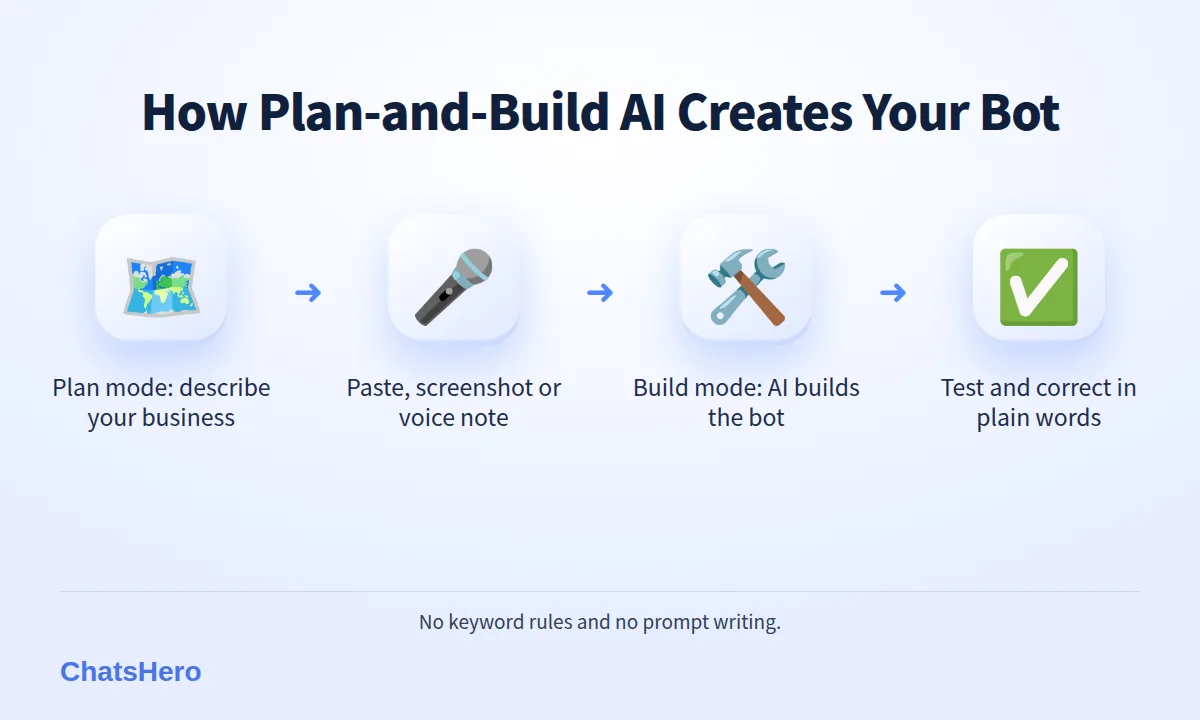
The shift is who does the technical work. In generation 1 you build rules; in generation 2 you write prompts; in generation 3 you explain your business and the AI builds it for you.
Keyword bot vs knowledge-base AI vs plan-and-build AI: how do they compare?
| 1. Keyword bot | 2. Knowledge-base AI | 3. Plan-and-build AI | |
|---|---|---|---|
| AI understanding | None — exact keywords or menu numbers | Yes | Yes |
| Who builds it | You, rule by rule | You, by uploading documents and writing prompts | The AI, after planning with you |
| Training input | Keywords and flow diagrams | Documents + prompts | Copy-paste, screenshot or voice note |
| Customer experience | Must hit the keyword or choose from a menu | Natural chat | Natural chat |
| Mixed languages, slang | Only if every variation has a rule | Handled | Handled |
| Ongoing maintenance | High: new question = new rule | Medium: prompt tweaks and fine-tuning | Lower: corrections in plain language |
| Skill needed | Patience with flow builders | Prompt writing | Explaining your business, like briefing staff |
| Best for | Very simple, fixed menus | Teams with a tech-minded owner or staff | Busy SMEs without a tech person |
Maintenance levels above are general characteristics of each approach, not measured figures; your experience depends on the tool and on how many products and rules you have.
What happens when a customer types in Bahasa Rojak?
Here is one illustrative message sent to a phone repair shop in Johor Bahru, first to a keyword bot and then to an AI bot. The keyword bot was set up with "price" and "harga"; the customer typed neither.
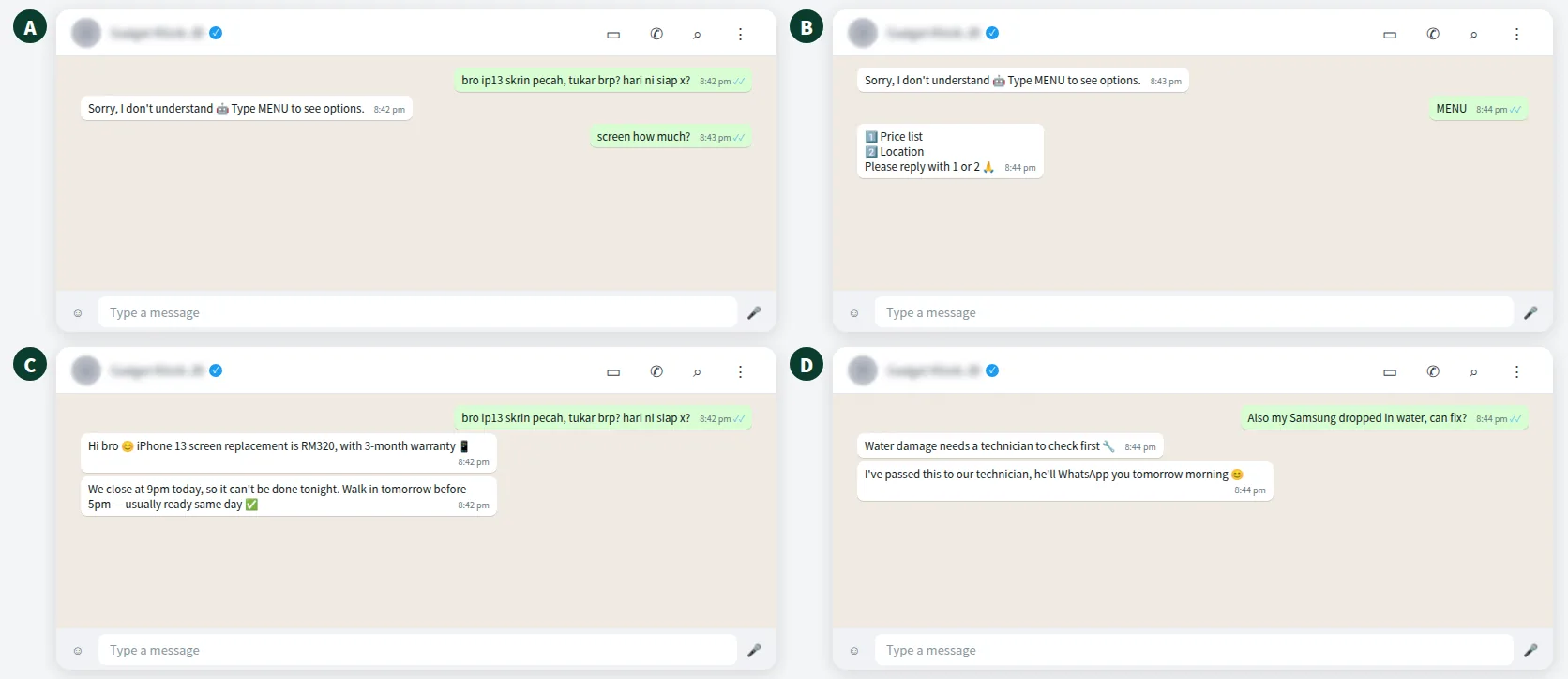
The keyword bot is not broken — it is doing exactly what it was told. The customer simply did not use the right word. The AI bot understands "brp", "skrin pecah" and "siap x" and answers both questions in one reply. For more on how this works, see how AI chatbots understand Bahasa Rojak.
Notice the last panel: a good AI bot also knows when not to answer. Water damage needs a technician, so it hands over.
Which chatbot generation fits your business?
- Keyword botYou have three or four fixed options and customers happily pick from a menu.
- Knowledge-base AIYou have someone who enjoys writing and testing prompts and time to keep tuning.
- Plan-and-build AICustomers chat naturally in mixed languages and nobody on the team wants to learn prompting.
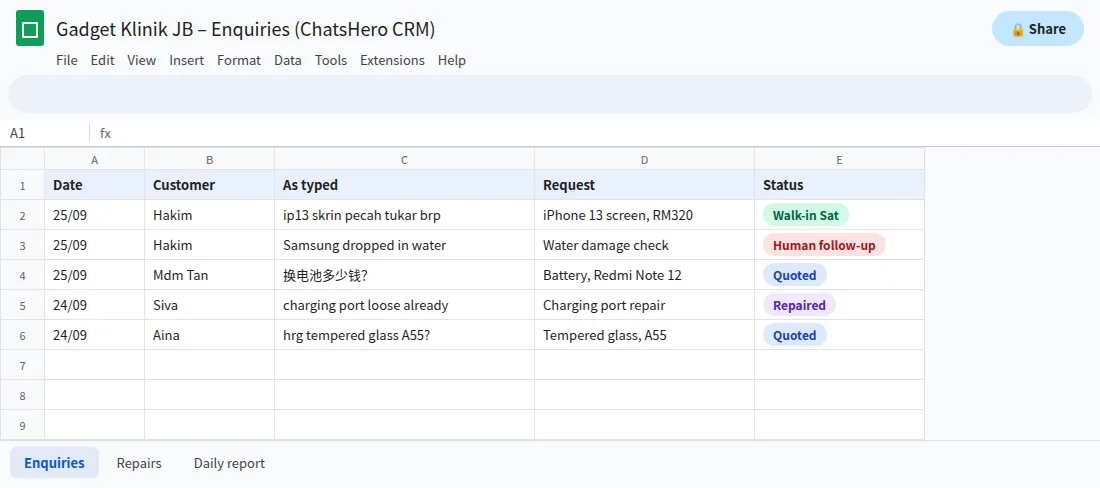
Whichever you pick, it should capture what matters from each chat. With ChatsHero, details such as the customer's request and status are recorded in Google Sheets, and your team updates the outcome.
If you are comparing specific vendors rather than generations, ask each one to show — live — how a price change is made. That single demo tells you which generation you are really buying.
What stays the same whichever chatbot you choose?
Smarter AI does not change the basics of running a WhatsApp bot responsibly:
- Official WhatsApp Business API. Keeps the risk of bans lower than unofficial tools; you still need opted-in customers and a healthy quality rating.
- Business-specific bots only. Since 15 January 2026 Meta has barred general-purpose AI assistants from the WhatsApp Business Platform, while bots for a business's own customer service and sales remain allowed (TechCrunch).
- Human handover. Complaints, refunds and anything risky go to a person. ChatsHero sends a "Human Agent Needed" alert to your team's WhatsApp group.
- Personal data care. Collect only what you need and protect it under Malaysia's PDPA.
How do you move from a keyword chatbot to plan-and-build AI?
Your old keyword rules are not wasted — they are a list of the questions customers ask.
- Export or screenshot your keyword rules and menus. They show your most common questions and approved answers.
- Paste them into Plan mode and explain what should change: "Answer these naturally, and stop sending the menu to everyone."
- Record voice notes for the exceptions the rules never handled well — warranties, out-of-stock parts, same-day cut-off times.
- Let Build mode create the bot, then test it with 10 real customer messages, including slang and Chinese.
- Go live on the same WhatsApp number and review the handed-over chats weekly.
ChatsHero plans start at RM350 a month billed annually, with Meta's per-message fees billed separately to your own WhatsApp account — see the pricing page, or read about ChatsHero. More guides are on the blog.
Want to see how this looks with your own business? WhatsApp us and chat with the ChatsHero AI.
Frequently Asked Questions
What is the main difference in an AI chatbot vs keyword chatbot?
A keyword chatbot replies only when the customer types a word or menu number you set up in advance. An AI chatbot understands the meaning of a message, including slang, typos and mixed languages, so customers can chat naturally.
Are keyword-based chatbots still worth using?
For very simple, fixed flows — such as picking a branch or checking a status from a short menu — they can be predictable and adequate. For open questions in mixed Malaysian languages, they need many rules and still miss variations.
What is a knowledge-base AI chatbot?
It is an AI chatbot that answers from documents you upload, such as price lists and FAQs, guided by prompts you write. It understands natural language, but someone has to learn how to train it and keep fine-tuning prompts.
What does plan-and-build AI mean?
It is the third generation, used in ChatsHero 3.0. In Plan mode the AI plans the bot with you; in Build mode it builds it. You give information by copy-paste, screenshot or voice note, and you never write prompts.
Can I switch from a keyword bot without losing my setup?
Yes. Your keyword rules and menus are a useful list of common questions and answers. Paste or screenshot them into Plan mode, add voice notes for exceptions, then test before going live.
Do AI chatbots on WhatsApp follow Meta's 2026 rules?
Business-specific AI bots for customer service and sales are allowed. Since 15 January 2026 Meta bars general-purpose AI assistants from the WhatsApp Business Platform.