Abandoned cart WhatsApp recovery works when you message shoppers who opted in, within an hour of leaving, and answer the reason they stopped — often postage, payment or a sizing doubt. Send at most two messages, keep discounts for the last one, then stop. With Baymard Institute’s average of international studies putting cart abandonment at about 70%, even a small recovery rate adds real sales; each message is illustrated here at RM0.35.
RM0.35 and RM0.06 in this article and its supplied illustrations are planning assumptions, not verified current Meta quotations. Gupshup's October announcement describes 1,000 free service replies per business phone number per month, then eligible service charges from 1 October 2026. Utility templates do not use that allowance. Inbound messages and qualifying 72-hour free entry point messages remain exempt. Confirm the recipient market, applicable rate card, free allowance and provider fees before budgeting. Figures below exclude tax and any unlisted costs.
- Around 7 in 10 online carts are abandoned, according to Baymard Institute’s average of 50 studies.
- Many reasons are fixable: surprise postage, missing payment options, trust and sizing doubts.
- Cart reminders are marketing messages under Meta’s rules, so collect WhatsApp opt-in at checkout.
- Send the first reminder within an hour, a second about a day later, then stop.
- Answer the objection before offering a discount — many shoppers just need one question answered.
- Don’t forget chat carts: customers who asked for a total on WhatsApp and then went quiet.
What is abandoned-cart recovery on WhatsApp?
Roughly 7 in 10 online carts are abandoned before payment.
Cart abandonment is when a shopper adds items to their cart, maybe even starts checkout, and then leaves without paying. Baymard Institute, which averages 50 international studies published between 2006 and 2025, puts the documented online cart abandonment rate at about 70% (70.22%). In other words, for every 10 carts, roughly seven are left behind.
Abandoned-cart recovery is simply reaching out to those shoppers to help them finish. Email has been the classic channel. An abandoned cart WhatsApp message lands in a chat app the shopper already uses to talk to your store, and — just as important — they can reply with a question instead of just clicking a link.
That two-way part is the real advantage. A shopper who stopped because of a postage doubt can ask “how much to Sibu?” and get an answer in seconds, 24/7, from an AI chatbot trained on your store.
Why do shoppers abandon carts in Malaysia?
Some shoppers were only browsing, and no message will change that. But many leave for fixable reasons. In Baymard’s survey of US online shoppers, the top reasons (excluding “just browsing”) included extra costs such as shipping and fees (40%), delivery that was too slow (20%), not trusting the site with card details (19%), being forced to create an account (18%) and a checkout that was too long or complicated (17%).
Malaysian stores see their own versions of these:
- Postage surprises, especially for Sabah, Sarawak and Labuan, shown only at the last step.
- Payment doubts: no FPX or DuitNow option, or uncertainty about COD.
- Trust: a new store with few reviews, or no clear return policy.
- Product questions: size, roast level, ingredients, or “will it arrive before Deepavali?”.
- Distraction: a phone call, a child, a lunch break — the easiest one to fix.
A reminder alone fixes distraction; an answer fixes doubt. That is why a two-way WhatsApp chat can recover carts that a one-way email cannot.
Is a WhatsApp cart reminder allowed without opt-in?
No. Under Meta’s template categorization rules, messages that encourage people who visited your website or engaged with you to come back and buy are marketing — even if the shopper requested them. Marketing templates require opt-in, and Meta’s opt-in policy says the person must clearly agree to receive messages from your named business.
- Add a WhatsApp opt-in at checkout. For example: “☐ Send me order updates and cart reminders on WhatsApp from Borneo Bean Roasters.” Do not pre-tick it.
- Only message the number the shopper entered and agreed to — never an imported or purchased list.
- Make stopping easy. “Reply STOP to stop reminders” — and honour it, in line with Malaysia’s Personal Data Protection Act.
There is one useful exception. If the shopper has messaged you on WhatsApp in the last 24 hours, you are inside the customer-service window and can simply reply in the chat. From 1 October 2026, Meta charges these replies per message as well, using an illustrative utility-rate assumption of RM0.06 (see this summary of the change).
What are the two kinds of abandoned carts on WhatsApp?
It is easy to forget that not every “cart” is on a website. A lot of orders happen entirely in chat — and those get abandoned too.
| Type | What happens | Message type | Best follow-up |
|---|---|---|---|
| Website checkout cart | Shopper enters phone number, then leaves checkout | Marketing template (needs opt-in) | Reminder within 1 hour, answer the likely objection |
| Chat cart | Customer asks price and total on WhatsApp, then goes quiet | Reply inside 24 hours (monthly 1,000-message service allowance first; additional eligible replies at an illustrative RM0.06); template after that | Friendly nudge the same day with the order summary |
| Unpaid order | Order confirmed but no payment received | Order update (utility if purely transactional) | Payment reminder with order details, no promo |
Chat carts are often the easiest win because the conversation is already open. With ChatsHero, the Remind step can follow up at the time you set when a customer asked for a total but did not order. Website carts are different: the cart details and opted-in number have to come from your store platform, and this is not a standard plug-in — check with our team what your setup would need.
How do you set up abandoned cart recovery on WhatsApp step by step?
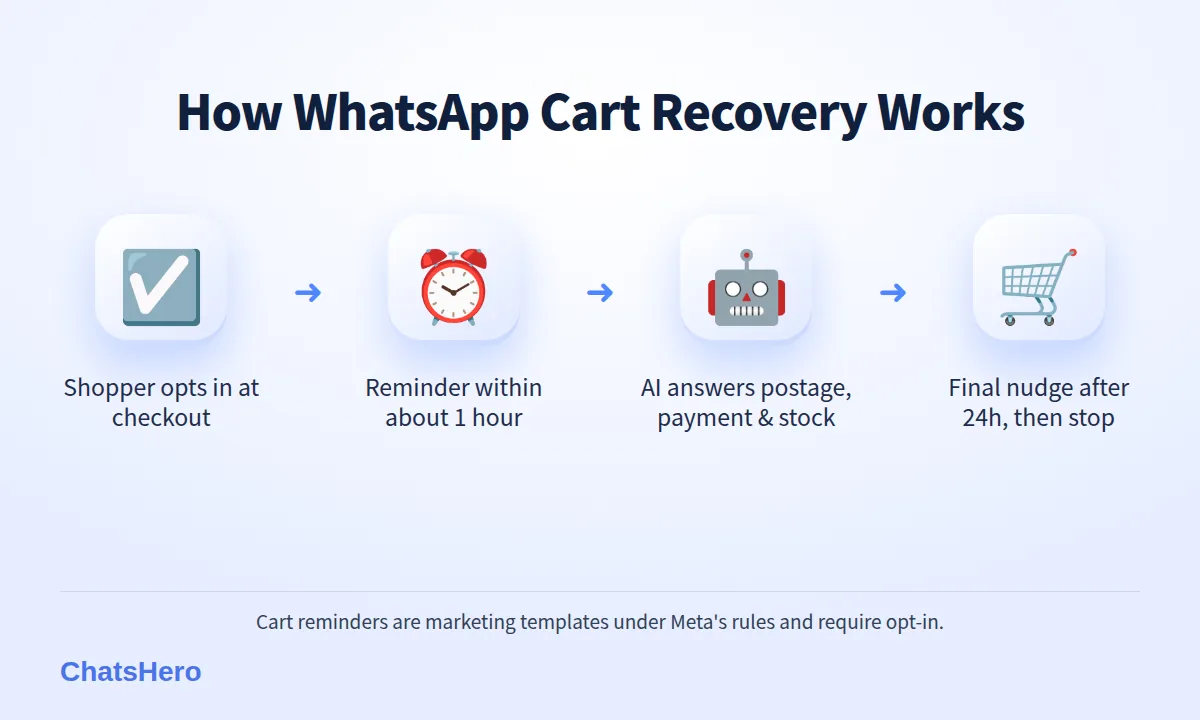
Opt-in → Remind in 1 hour → Answer → Final nudge → Stop
This is the sequence we recommend. The example is a fictional coffee-bean roaster in Kota Kinabalu that ships nationwide.
- Collect opt-in at checkout. An unticked WhatsApp checkbox, with your business name, next to the phone field.
- First reminder within about an hour. Mention the item by name and invite a question: “Any questions before checkout?”
- Answer the objection instantly. The AI replies 24/7 about postage, payment methods, stock and delivery times, in English, Malay or Chinese.
- Second reminder about 24 hours later. Add useful information — postage rates, delivery timing, or a small incentive if you choose to use one.
- Stop and record. After two messages, stop. Record the result in Google Sheets: recovered, replied, opted out or no response.
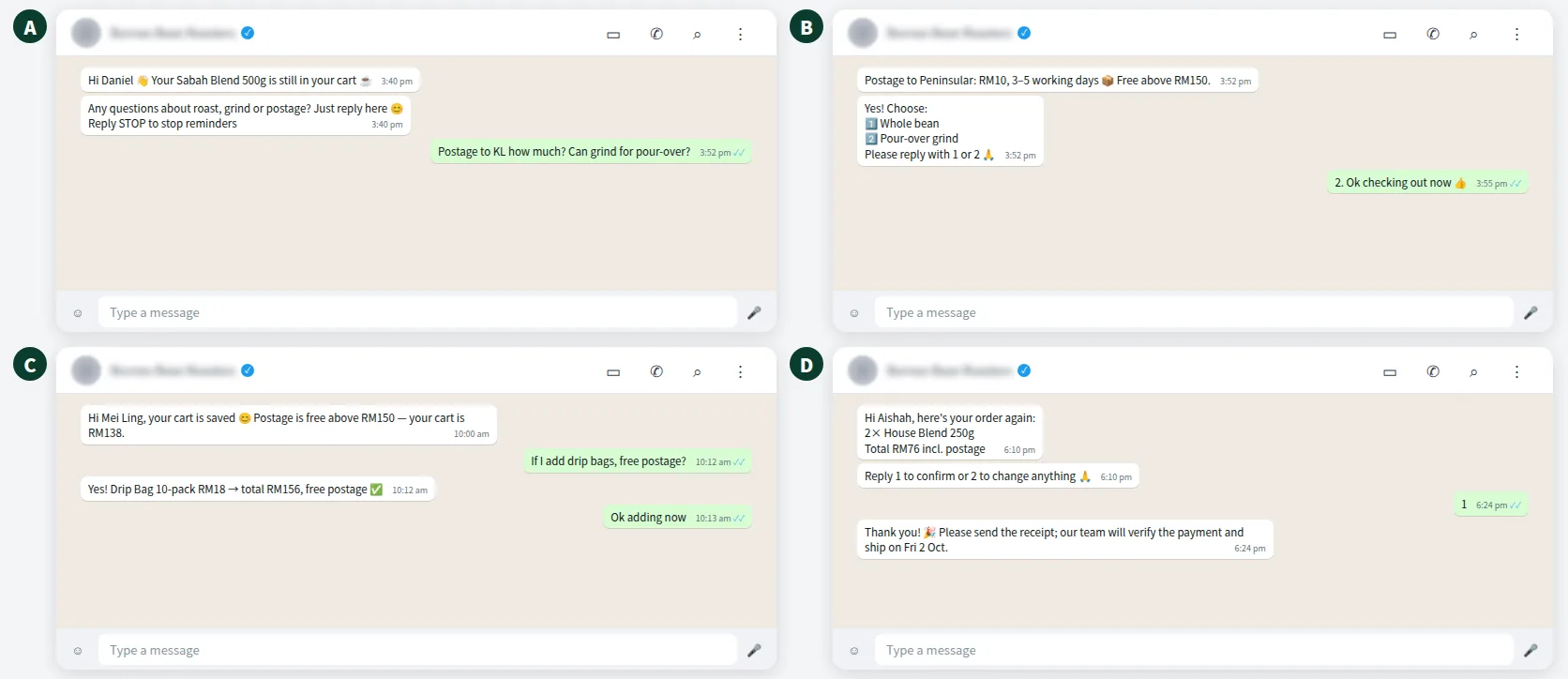
What the conversation looks like
An illustrative chat: a website cart reminder, a postage question, a completed order — and a chat cart recovered on the same day.
What should an abandoned cart WhatsApp message say?
Be helpful, not pushy. Name the item, invite a question and make the next step clear. Three templates you can adapt:
Reminder 1 (within an hour): “Hi Daniel 👋 Your Sabah Blend 500g is still in your cart at Borneo Bean Roasters ☕ Any questions about roast, grind or postage? Just reply here. Reply STOP to stop reminders.”
Reminder 2 (about 24 hours later): “Hi Daniel, your cart is saved 😊 Postage to Peninsular Malaysia is RM10, free above RM150, and we ship within 1 working day. Tap here to complete your order.”
Chat cart nudge (same day): “Hi Aishah, here’s your order summary again: 2× House Blend 250g, total RM76 with postage. Reply 1 to confirm or 2 if you’d like to change anything 🙏”
Keep discounts for the second message, and only if you actually need them. Offering a discount in every first reminder teaches regular customers to abandon on purpose.
Want to see how this looks with your own business? WhatsApp us and chat with the ChatsHero AI.
How much does abandoned cart recovery on WhatsApp cost?
On the official API, a marketing template is illustrated here at RM0.35 per message in Malaysia; see Meta’s pricing page. Meta bills this to your own WhatsApp Business account, separately from your ChatsHero plan, and the rates can change.
Here is an example calculation. The recovery rate is purely illustrative — measure your own:
| Item | Example figure |
|---|---|
| Abandoned carts with WhatsApp opt-in per month | 200 |
| Reminders sent (200 first + 150 second reminders) | 350 × RM0.35 = RM122.50 |
| Carts recovered (example: 5%) | 10 |
| Average order value | RM85 |
| Recovered sales | 10 × RM85 = RM850 |
Fewer, better-timed messages usually beat more messages. Every extra reminder adds cost and raises the chance of being blocked, which affects your number’s quality rating. See our plans and pricing for what each ChatsHero plan includes.
How do you track abandoned cart recovery results?
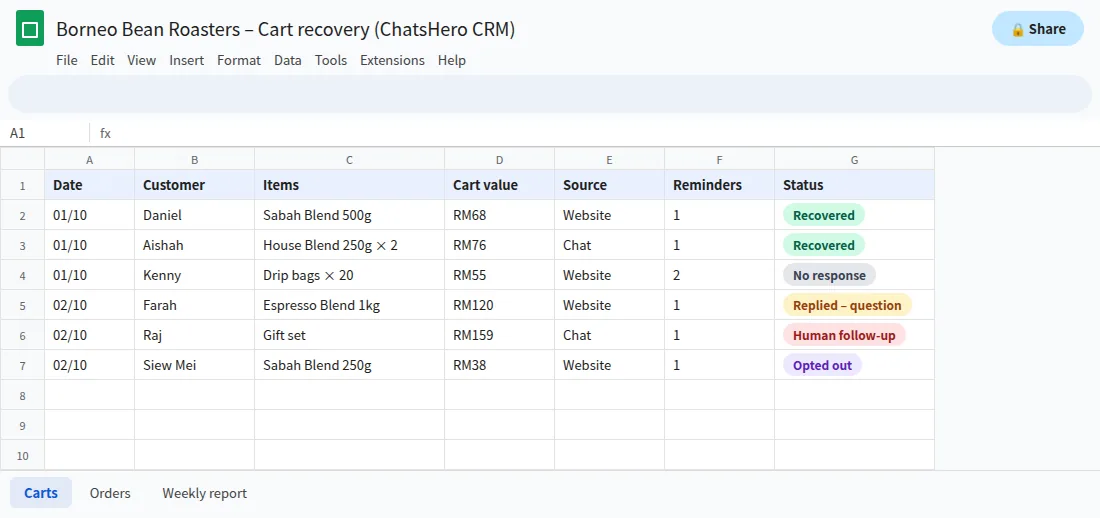
Track every cart and its outcome so you can see which message and timing actually work. ChatsHero records each follow-up and reply in Google Sheets: customer, items, cart value, reminders sent and status.
- Timing testCompare carts reminded at 1 hour with those reminded later.
- Objection logNote what shoppers asked — postage, grind, payment — and fix it on the site.
- Discount checkSee how many recoveries needed an incentive, and how many only needed an answer.
If a shopper replies with a complaint or a question the AI should not answer — a wholesale price, a damaged earlier order — a “Human Agent Needed” alert goes to your team, so a person takes over.
What mistakes should you avoid with cart abandonment in Malaysia?
- Messaging without opt-in. It breaks Meta’s rules, annoys shoppers and hurts your quality rating.
- Waiting too long. A reminder three days later arrives after the shopper has bought elsewhere.
- Too many reminders. Two is plenty. A third one adds cost and block risk for very little gain.
- Hiding postage until the end. Show East Malaysia rates early on your site; it removes one of the biggest reasons Baymard lists — unexpected extra costs.
- Promising what you can’t check. A chatbot should not guarantee stock or confirm payment; say that your team will verify the payment.
Start with chat carts this week — they need no website changes at all — and add website cart reminders once your checkout opt-in is live. For a store like Borneo Bean Roasters, a clear postage answer for Sabah and Sarawak may be all a quiet chat needs. More e-commerce walkthroughs are on our blog.
Frequently Asked Questions
How does abandoned cart WhatsApp recovery work?
When a shopper who opted in leaves checkout, you send a WhatsApp reminder within about an hour, answer any question they reply with, send one final reminder about a day later, then stop and record the outcome.
Do I need permission to send WhatsApp cart reminders?
Yes. Meta treats cart reminders as marketing messages, which need opt-in naming your business. Add an unticked WhatsApp opt-in at checkout and let shoppers stop reminders at any time, in line with PDPA.
What is the average cart abandonment rate?
Baymard Institute’s average across 50 studies is about 70%, meaning roughly seven in ten online carts are abandoned. Rates differ by industry and device.
How many cart reminders should I send?
Two at most: one within about an hour and one about 24 hours later. More reminders add cost and raise the chance of being blocked.
How much does a WhatsApp cart reminder cost in Malaysia?
About RM0.35 per marketing message on the official API. Meta sets and bills this on your own WhatsApp Business account, separate from your ChatsHero plan, and prices can change.
Should I offer a discount to recover abandoned carts?
Not in the first message. Answer the shopper’s question first; if you use an incentive, keep it for the final reminder so regular customers do not learn to abandon carts on purpose.